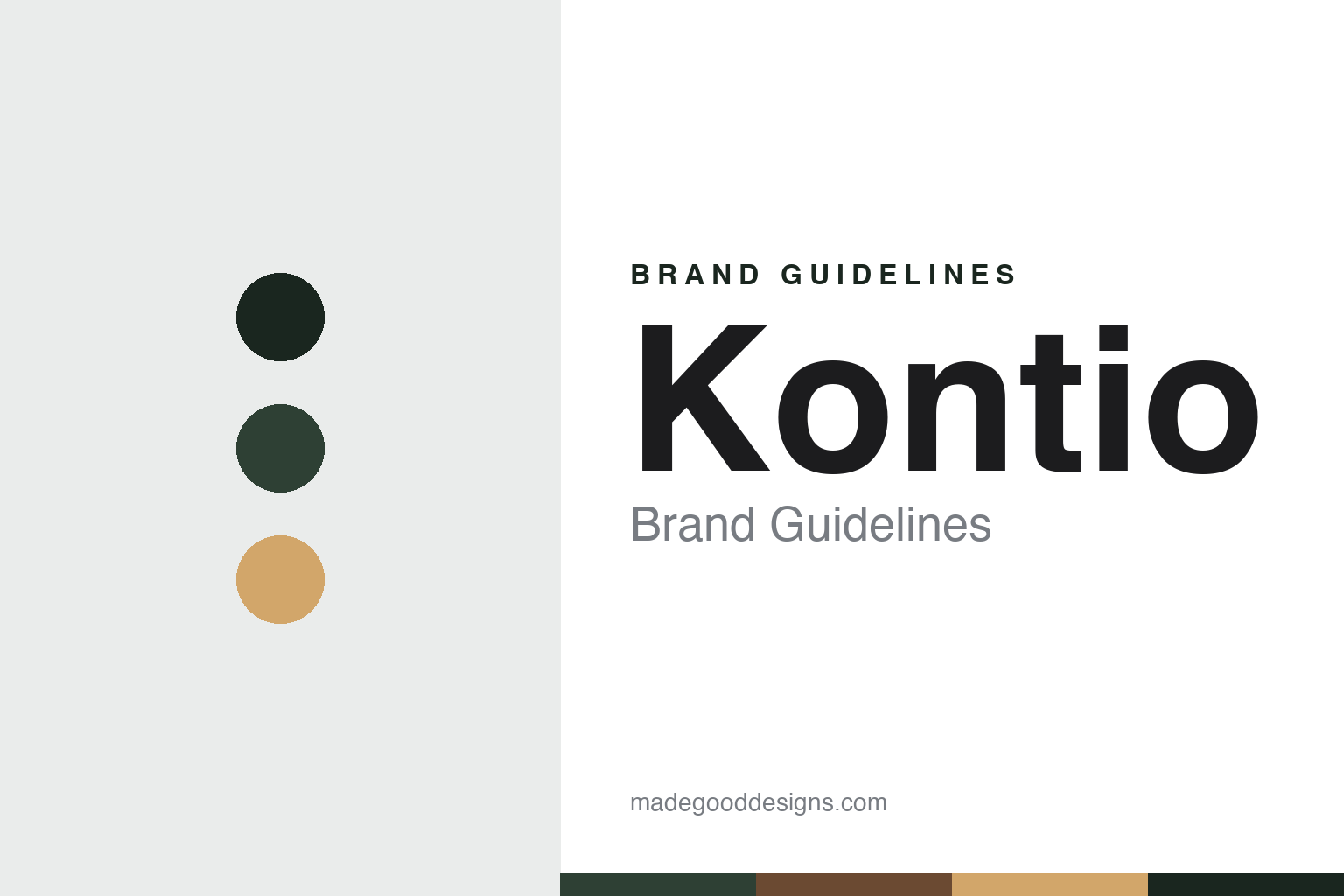
Kontio Brand Guidelines
The Pudasjärvi log-house maker with an old Finnish word for bear.
Aa
Two constants: a Kontio forest green and pine palette and a Warm serif register. Abstract homage — not a Kontio product or mark; no building, logo or nameplate is reproduced.
A field saw at Pudasjärvi
Timo Tiirola, 1973.
Kontio is the trading name of Kontiotuote Oy, a log-building maker at Pudasjärvi, in northern Finland. The name is an old word: Wiktionary records kontio as a literary, euphemistic Finnish synonym for karhu, the bear.
The company began small. According to a company profile published by the North Ostrobothnia entrepreneurs’ association, Pohjois-Pohjanmaan Yrittäjät, in December 2023, its story starts in 1973, when Timo Tiirola bought a field saw at Pudasjärvi. A business called Yhtymä Sahatuote moved to the present factory site that winter, and the first cabins were made in the mid-1970s. Finnish Wikipedia gives the same year and the same founder. Kontio’s own website now says more loosely that its journey as a log builder began in the 1970s.
The name came later. The Sahatuote business became Kontiotuote Oy in the early 1980s, the association’s profile says, and grew into a significant maker of log villas, though that growth brought financial difficulties.
In 1986 the company was bought by Pyhännän Rakennustuote Oy, a house builder from Pyhäntä, according to the history published by that group. Pyhännän Rakennustuote had begun in 1968 with saunas and holiday homes built from panels. It became PRT-Forest in 1997, and its own account says that buying Kontiotuote took it into the log market, and that by the end of the 1980s Kontio buildings had reached Sapporo in Japan. The association’s profile says Jalo Poijula, appointed chief executive after the purchase, led the company for the next 20 years.
The partnership lasted more than three decades. PRT-Forest’s history calls Kontiotuote the market leader in log building and the pillar that held the group up during a difficult 2010s. In spring 2022 its annual meeting decided to separate Kontiotuote into a group of its own; Finnish Wikipedia dates the separation to 1 June 2022.
Colour
From raw timber to a finished log.
Kontio’s central claim is about the whole chain. The company says its log houses, villas, saunas and other buildings are made “from raw timber into finished products” at its own factory in Pudasjärvi, and that it is the only company in its industry to manage the entire process. It calls this knowledge WoodHow. Its timber, it says, is slow-grown pine from northern Finland, which it calls Arctic pine, drawn from PEFC-certified or PEFC-controlled forests. It says its log houses are made under a European technical approval that allows CE marking.
It also calls itself the world’s largest manufacturer of log buildings. Finnish Wikipedia repeats that claim, measured by revenue, and the Oulu newspaper Kaleva gave it in August 2024 as the company’s own description. Kontio says it has delivered more than 50,000 log buildings over 50 years.
The product that defines the modern range is SmartLog, which the company describes as a non-settling log. The company says that traditional laminated logs settle, so buildings need allowances for it. In SmartLog, it says, part of the log’s lamellas run vertically, which stops the settling and makes large windows, split levels and complex roofs easier to design. It says all its turnkey homes use SmartLog, and that the structure is design-protected.
The collections sold today include Glass House, Sky House and Horizon, alongside chalet models with resort names such as Åre, Aspen and Levi. Larger work runs under the name Kontio PRO. The company’s references include Hotel Iso-Syöte in northern Finland, a primary school at Kuusamo, the Monio multipurpose building at Tuusula and a Montessori school extension in the Netherlands.
The public project it is known for is at home. Finnish Wikipedia records that in 2016 Kontiotuote received the Finnish Cultural Foundation’s Rantasalmi prize for developing log construction, and Puuinfo’s Wood Award as supplier of the log structures for the Pudasjärvi log campus. It lists the Olympic village at Lillehammer and a Japanese golf resort among the company’s work abroad.
Typography
Design and documentation.
Home builders that work in factories have an unusual problem of presentation. Their product is a house, a thing people expect to see standing on a street, yet much of what makes it distinctive happens indoors, long before anyone arrives on site. So the imagery of the category tends to start at the plant: walls moving along a line, panels stacked by size, roof sections waiting under a gantry. In a brochure, these pictures do the work that a craftsman’s portrait does elsewhere.
The second stage is the arrival. A section of house on a flatbed, a crane lifting a module over a hedge, a timber package unloaded in a clearing: these are the category’s most recognisable photographs. Log and timber makers add their own version, with stacks of numbered logs and yards of drying wood, so that the raw material becomes part of the sales story.
Then comes the place where buyers actually meet the product. Show villages and display parks let a family walk through several finished models in one afternoon, and sales lots do the same job along an American highway. Alongside them sits the catalogue, a storefront that travels by post. Its cover can show a single finished house, and its inside pages turn to cut-away drawings and floor plans, numbered and named like models of car.
That naming habit shapes the graphic side of the category. A plan may carry a code, a series title or a family name, and it has to sit comfortably beside a line drawing, a dimension table and a photograph. The result is a design language closer to a technical manual than a lifestyle magazine, softened by warm wood tones and a little domestic optimism. The guides that follow look at how individual builders have used it, and at the company history behind each one.
Aa
A warm serif — a name that means bear. (Specimen set in Fraunces, a serif STAND-IN; NOT the Kontio logo.)
Kontio
Hard years and a new owner.
Recent years have been difficult. In October 2022 the company opened employee negotiations that could lead to temporary layoffs or redundancies, Kaleva reported, with its chief executive, Mika Rytky, citing inflation, rising interest rates and low consumer confidence. In August 2024 Kaleva wrote that the slump in Finnish building and the collapse of trade with Russia had shaken the company, and that it had made a loss the previous year.
That same month Kontio announced the largest order in its history: a seven-year framework agreement to supply log structures for about 10,000 apartments at two sites, the first on the Mediterranean, Kaleva and the broadcaster Yle reported. The buyer was not named; Rytky told Yle only that the person appears on a Forbes rich list. Finnish Wikipedia says the deal was later delayed by changes required by the client.
Ownership changed soon after. On 4 February 2025 Kaleva reported that the investor Asko Schrey would become the largest shareholder through his company Schrey Invest, by subscribing in a share issue; Kontio’s own release confirmed it, naming Tero Ylinenpää as board chairman.
Kontio’s public face is now tied closely to architecture. It was the main partner of the Finnish Pavilion at the 2025 Venice Architecture Biennale, the wooden pavilion designed by Alvar Aalto’s office, and it keeps a show-house area at Nurmijärvi, north of Helsinki. Its website carries the line “The Answer Is Wood” alongside the coined word WoodHow.
For a design guide, Kontio shows how a company can build a brand on a single raw material and on control of the whole chain from log to building. Compare Honka, another Finnish log-home maker, and Lindal, the North American cedar-home maker that also sells abroad through local partners. For this guide we use a forest green and a pine tone with a serif, an unofficial interpretation; no product or logo is reproduced.
Explore & save
Keep Kontio’s identity on hand — save it to a board in the Made Good inspiration library.
Kontio identity set
Pin the Kontio forest green and pine palette and the Warm serif register to your own board.