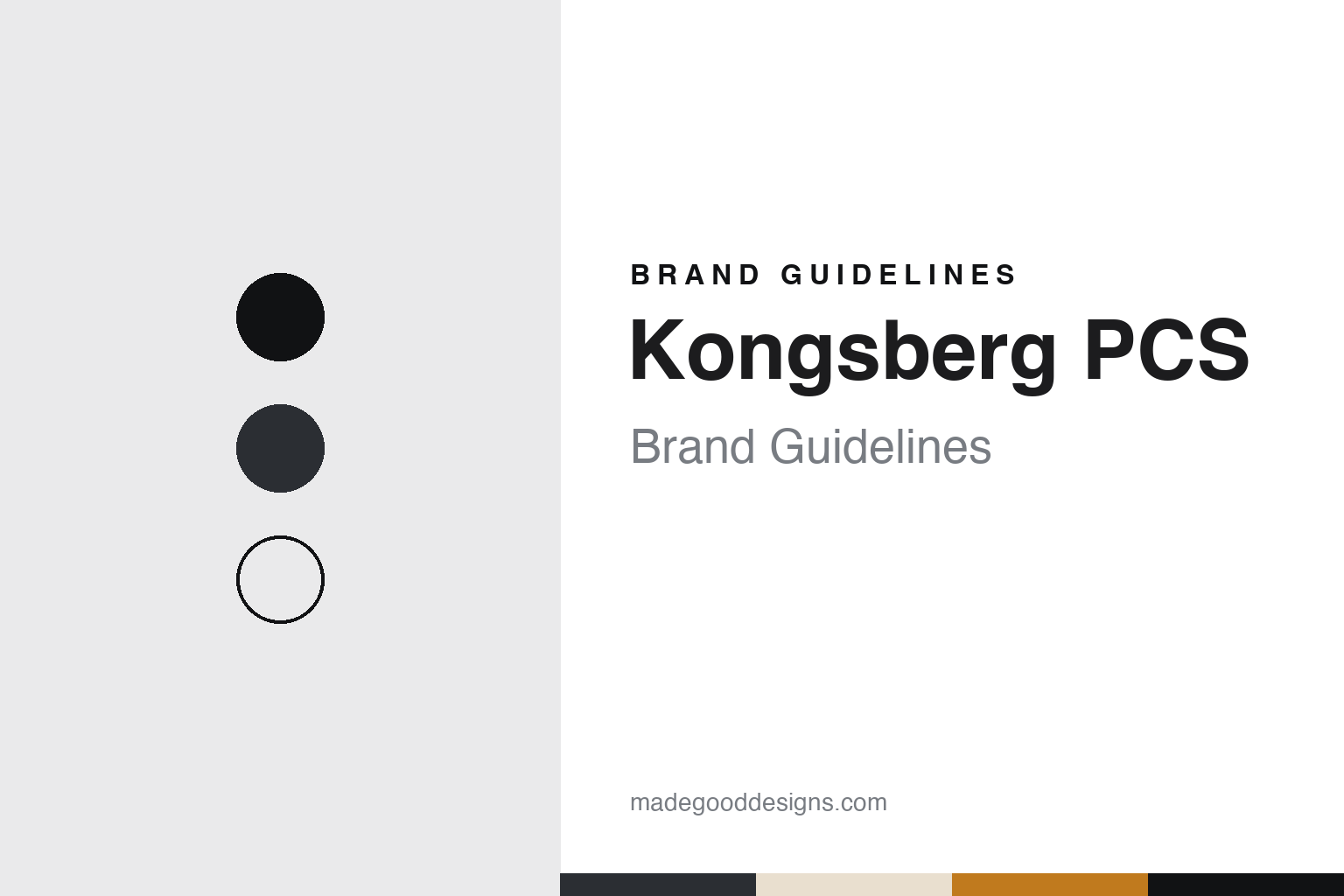
Kongsberg PCS Brand Guidelines
The Norwegian cutting-table name spun off from Esko.
Aa
Two constants: a Kongsberg graphite, kraft and amber palette and an Industrial sans register. Abstract homage — not a Kongsberg PCS product or mark; no machine, logo or nameplate is reproduced.
Kongsberg, Norway
A cutting-table name taken from a town.
Kongsberg Precision Cutting Systems, usually shortened to Kongsberg PCS, makes digital cutting tables: flatbed machines whose tool heads cut, crease and mill sheets of board, foam and plastic for packaging samples, point-of-sale displays and signs. The name is a place. The company says it was founded in 1965 in Kongsberg, a town in southern Norway, and that its research and development facility is still there; Esko’s announcement of December 2020 and the trade magazine Large Format Review, in April 2021, give the same founding year.
In 1998 the business was bought by the Belgian group Barco, according to Esko and to Australia’s Print21. When Barco’s graphics division merged with the Danish prepress maker Purup-Eskofot to form Esko-Graphics, announced in September 2001 and completed in March 2002, the Kongsberg tables went into the new Ghent company, the German trade magazine Druckmarkt reported in 2003.
That report gives a clear picture of what the tables were for at the time. Druckmarkt described Kongsberg sample tables designed for cutting, creasing, milling and inkjet printing prototypes and short runs of folding cartons and corrugated packaging. The Kongsberg DCM22, it said, could load board automatically and cut samples directly from CAM software, without the steel-rule cutting die that a production run would need. In the same Esko-Graphics range sat ArtiosCAD, the structural packaging design software.
Colour
An Esko spin-off, owned by OpenGate.
On 15 December 2020 Esko, then part of the American group Danaher, announced the planned sale of its Kongsberg digital-finishing business to OpenGate Capital, a private-equity firm headquartered in Los Angeles with a European office in Paris. The sale covered the original research and development facility in Kongsberg and the production facility in Brno, in the Czech Republic. Esko said it wanted to concentrate on end-to-end workflow for the packaging supply chain, and that the business would become a standalone company called Kongsberg PCS, led by Stuart Fox, one of the digital-finishing specialists moving across from Esko. Customers with Kongsberg systems could expect business as usual, Esko said, because most of the staff serving them would move with the business, and reseller relationships would transfer to the new company too. OpenGate, the announcement said, saw room to grow Kongsberg beyond packaging and to expand its tooling and consumables. Print21 reported the planned deal on 18 December 2020.
Kongsberg PCS started out as an independent company on 6 April 2021, Large Format Review reported, with about 400 people, many of whom had been with Kongsberg for more than 30 years. Fox told the magazine that sales, service, consumables and spare parts would continue as usual, and that the company would grow the Kongsberg brand beyond the packaging industry. In August 2021, the company says, it acquired MultiCam, whose range covers CNC routers, digital cutters and laser, plasma and waterjet cutting machines; the two names now appear together at trade shows.
The company’s geography is split across three countries. Its website gives the global head office and customer experience centre as Ghent, Belgium, the production site as Brno and research and development as Kongsberg, and states that it has been owned by OpenGate Capital since 2021. It also runs an office for the Americas in Ohio.
Typography
Design and documentation.
Wide-format printer and cutting-table makers sell machines that are easiest to understand in motion. Their brochures and stands show flatbed printers with a gantry of printheads passing over rigid boards, roll-to-roll machines feeding out lengths of printed vinyl and textile, and cutting tables whose heads trace shapes in corrugated board. The finished work — a shop-window graphic, a printed box, a length of fabric — usually carries the customer’s brand rather than the maker’s.
Many of these companies arrived from somewhere else. EFI began with the Fiery colour server, which turned office copiers into colour printers, and moved into inkjet when it bought VUTEk in 2005; Durst made photographic enlargers in Brixen for decades before turning to UV inkjet in the early 2000s, according to Wikipedia and the companies’ own histories. Their names, in other words, were built on one kind of machine and carried onto another.
Because the machines are large, makers invite buyers to see them running. EFI names customer experience centres in Londonderry, New Hampshire, in Castellón, Spain, and in Bergamo, Italy; Durst opened a customer experience centre of more than 5,700 square metres at its new Brixen headquarters in 2019, the German trade magazine Druckmarkt reported, saying it wanted customers to come there rather than rely only on trade fairs.
The fairs still set the calendar. The FESPA fair is where Durst added two P5 printers in 2019 and planned to show its Kyveris software in 2026, according to Druckmarkt and Large Format Review; at drupa 2016 in Düsseldorf, Druckmarkt noted, Koenig & Bauer and Xerox announced a digital folding-carton press. This guide sets out what can be checked about each maker — who founded it, who owns it and what it makes — and marks clearly what rests only on the company’s own word.
Aa
An industrial sans — a town’s name on a cutting table. (Specimen set in Archivo, a sans STAND-IN; NOT the Kongsberg PCS logo.)
Kongsberg PCS
Tables, tooling and a Red Dot.
The current range is organised in families. The company’s website lists the Ultimate, C Series, X Series and Entro Series tables, with automation such as feeders, stackers, roll feeders and material handlers, its own tooling, and the i-cut Production Console software. It groups its markets as signage and print, display and point of sale, folding carton, corrugated production, labels, protective packaging and flexographic plate production, and the materials it cuts range from cardboard and foam board to aluminium composite, wood and rubber.
The Ultimate is the table the company pushes hardest. It describes it as a cutting table dedicated to high-volume, multi-batch production for display and corrugated producers, encased in aluminium, and says it won a Red Dot: Product Design 2025 award in the Industrial Equipment, Machinery and Automation category, after a PRINTING United Alliance Pinnacle Product award in 2024 and an EDP award in the wide-format cutting category. Those awards are the company’s reports. Kongsberg PCS shows its tables at the trade fairs of the sector: in 2025 it exhibited the Ultimate at FESPA Global Print Expo in Berlin, and its 2026 news names FESPA, C!Print, ISA Sign Expo and PRINTING United.
In 2025 the company marked its 60th anniversary, with Fox, now president and chief executive, describing a business built on long customer relationships and uptime; the company’s own summary of its six decades is “innovation, craftsmanship, and a commitment to its customers.” The name has outlasted three owners: Barco, Esko within Danaher, and OpenGate Capital.
For a design guide, Kongsberg PCS shows how a town’s name can carry a machine brand through changes of owner. Compare Esko, its owner until 2021, and Zünd, another maker of digital cutting tables. For this guide we use a graphite, a pale kraft and an amber with a sans, an unofficial interpretation; no product or logo is reproduced.
Explore & save
Keep Kongsberg PCS’s identity on hand — save it to a board in the Made Good inspiration library.
Kongsberg PCS identity set
Pin the Kongsberg graphite, kraft and amber palette and the Industrial sans register to your own board.