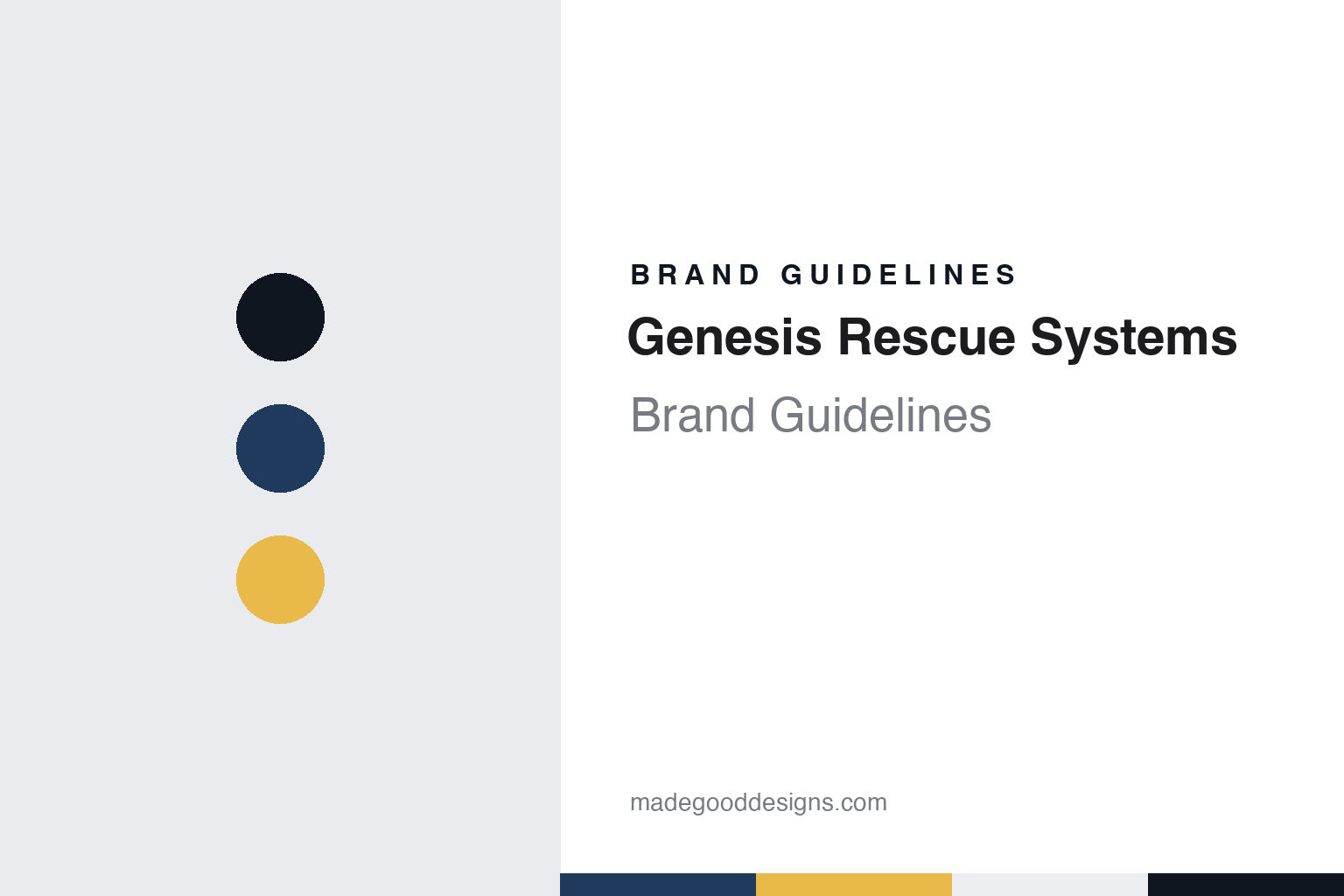
Genesis Rescue Systems Brand Guidelines
The Ohio extrication-tool maker allied with WEBER.
Aa
Two constants: a Genesis navy and amber palette and a Condensed sans register. Abstract homage — not a Genesis Rescue Systems product or mark; no tool, logo or nameplate is reproduced.
Kettering, Ohio
An American partner for a German maker.
Genesis Rescue Systems makes hydraulic rescue tools — cutters, spreaders, rams and the power units that drive them — for fire departments, chiefly in the United States. Its address is on Culver Avenue in Kettering, Ohio, a city on the southern edge of Dayton, and the trade site Firehouse lists the company at the same Kettering address.
The company tells its own origin story in terms of experience rather than a date. “A collective experience of 75 years in the fire and rescue industry gave birth to Genesis Rescue Systems,” its website says, and it describes itself as founded on the idea that “innovation, creativity, and delivery” mattered more than the bottom line. The page is headed “Quality people. Quality products.” and, beneath it, “The leaders in extrication” — both the company’s own words, set in capitals on its site.
What it does date is a partnership. In the autumn of 1992, the company says, shareholders of Genesis Rescue Systems partnered with Weber Hydraulik of Germany, bringing the German maker’s rescue equipment to the American market, and by mid-1993 the partnership was, in its words, a success. In 1999, it says, the two companies exchanged shares and formally began a joint venture, with the shares divided so that each held equal responsibility.
That link is documented outside the company’s own pages. English Wikipedia’s article on Weber-Hydraulik, the family-owned hydraulics group based in Güglingen, Baden-Württemberg, lists Genesis Rescue Systems in Kettering among the group’s locations, alongside the German and Austrian sites of its own rescue brand, WEBER RESCUE SYSTEMS.
Colour
From Overdrive to EFORCE.
Genesis says the joint venture let it buy machinery and begin manufacturing in the United States, which it describes as “100 percent American-made”; eight years later, it says, it invested again in manufacturing equipment, and it began exporting its American-built tools. We give those statements as the company’s own account.
Its first innovation, by its account, was Overdrive hydraulic pump technology, which it says lets rescuers raise a tool’s speed on demand, with the Mach III Outlaw power unit at the heart of the system. The company says it holds three patents for equipment made in the United States: an Angle V-Head push-pull ram attachment in the spring of 1998, an adjustable self-locking shoring strut in the winter of 2000, and an adjustable mounting bracket, filed in the autumn of 2007.
The trade press tracks its later products. In October 2012 Firehouse carried the launch of the E Force battery tools, which the company said used a commercially available battery from Milwaukee, and in the same month its NXTgen blade design. The magazine’s product-of-the-day features followed: the C-195 Nxtgen cutter for the Eforce 2.0 line in September 2017, and the 11C-BM1 RIT combination tool in September 2018, which the company described as cutting rebar, wood, chain and pipe as well as cars.
Today its website organises the range into EFORCE SLi and EFORCE SL3 battery tools, hose-bound hydraulic tools, stabilisation and tactical equipment, and power units, plus a hose decontamination system it calls HDS. Its technology page is headed “Powered by Milwaukee” and argues for non-proprietary batteries that a crew can buy at a local hardware store. The SLi tools pair with an app for phones and tablets that the company says offers a training mode, service alerts, a theft-protection feature that tracks a tool’s location, and a maximum-pressure indication.
Typography
Rescue and emergency equipment.
Rescue and emergency medical equipment is bought by people who will use it under pressure, so the makers in this field tend to present themselves through the equipment at work rather than through lifestyle imagery. The typical brochure shows a stretcher being loaded into an ambulance, a crew lifting a patient down a narrow stair, or a basket stretcher being lowered on ropes, with the product carrying most of the colour in the frame.
That colour is often functional before it is decorative. Orange and yellow stretchers, spine boards and evacuation chairs are meant to be seen against grey streets, snow or dark water, and product photographs often make those working colours the focus of the frame, set against equipment in dark navy, graphite or black. The language is technical: load ratings, materials, fastening systems and named product lines rather than adjectives.
Training is the other stage where these brands are seen. CPR manikins laid out in rows in a training room, hydraulic cutters and spreaders opening a scrapped car at a vehicle extrication drill, and ambulances and fire trucks parked with their doors open for inspection all serve as the industry’s own advertising. The photographs are rarely staged far from that reality, because the buyers are paramedics, firefighters and fleet managers who know the work.
Trade fairs give the category its calendar. Interschutz in Hannover, RETTmobil in Fulda and EMS World Expo in the United States are where makers show new stretchers, rescue tools and vehicles side by side, and where a stand’s colours and signage have to read from across a crowded hall. For a designer, the lesson of the category is that a brand earns its look from the job its equipment does: clear colour, clear type and the product shown in use.
Aa
A condensed sans — “The Next Generation of Extrication.” (Specimen set in Barlow Condensed, a sans STAND-IN; NOT the Genesis Rescue Systems logo.)
Genesis
“The Next Generation of Extrication.”
On manufacturing, Genesis is specific. Its website says all of its equipment is produced in a facility in Dayton, Ohio, certified to ISO 9001:2015, and adds that the certification is required by the NFPA 1960 standard in its 2024 edition. We give that as the company’s statement. In November 2025 the defence trade site Soldier Systems Daily published the company’s announcement that it had become fully compliant with the Berry Amendment, the United States rule that products bought by the defence department be sourced, made and assembled in the country, opening military and federal purchasing to it. The same release named Howell Rescue Systems as the exclusive Genesis master distributor for the eastern half of the United States.
The about page opens with a line attributed to the American football coach Vince Lombardi on individual commitment to a group effort, and the company sums itself up with the slogan “The Next Generation of Extrication,” and describes its values as quality, innovation, creativity and training. It runs demonstrations and extrication training for fire departments. It also names its German partner on its own pages: Genesis Rescue Systems and Weber Rescue, it says, “continue to push the limits” of battery hydraulic tools.
The palette here is our own interpretation, not a documented brand colour set.
For a design guide, Genesis Rescue Systems shows a regional maker that builds its identity around a partnership and a battery platform rather than a long company history. Compare WEBER RESCUE, its German partner, and Hurst Jaws of Life, another American maker of hydraulic rescue tools. For this guide we use a steel navy and a signal amber with a condensed sans, an unofficial interpretation; no product or logo is reproduced.
Explore & save
Keep Genesis Rescue Systems’s identity on hand — save it to a board in the Made Good inspiration library.
Genesis Rescue Systems identity set
Pin the Genesis navy and amber palette and the Condensed sans register to your own board.