Delfield Brand Guidelines
The 1949 Detroit maker of prep tables, now in Mount Pleasant.
Aa
Two constants: a charcoal, steel and teal palette and a workshop sans register. Abstract homage — not a Delfield product or mark; no counter, logo or nameplate is reproduced.
Del and field
Two partners, one name, a small building in Detroit.
The Delfield Company says it was founded in 1949 in a small building on the east side of Detroit by Paul DeLorenzo and Thomas Springfield. The name joins the two: the “Del” of DeLorenzo and the “field” of Springfield.
The company’s own history then moves north through Michigan. In early 1969, it says, a second manufacturing plant opened in Cadillac; at about the same time Springfield sold his share to DeLorenzo, and the business was bought by Clark Equipment. In 1971 a plant opened in Mount Pleasant, in the middle of the state, and the general offices moved there from Detroit. The Detroit site closed in 1974.
Ownership changed again in 1976, when, by the company’s account, Delfield was bought by Alco Standard Corporation. In 1985 the Cadillac plant closed and a new one opened in Covington, Tennessee. In August 1990 Alco announced that it would sell its food-service companies, and Delfield was bought by members of its management with an investor group led by Onex Corporation and The Diggs Group. That arrangement lasted four years.
Colour
From Scotsman to Enodis to Welbilt.
In 1994 Delfield joined Scotsman Industries, the ice-machine group based in Vernon Hills, Illinois; the company dates the purchase to May of that year. Gale’s International Directory of Company Histories, in its entry on Scotsman, records the 1994 acquisition and describes Delfield, then based in Mount Pleasant, as the largest maker of custom food preparation workstations in the world, a business that also made commercial refrigerators. The same entry lists what Delfield made under Scotsman: custom food preparation tables and serving-line equipment, mobile serving carts, self-contained kiosks and reach-in refrigerators. It tells how, when the Boston Market restaurant chain needed new serving-line equipment, Delfield produced prototypes in under six weeks and was named the chain’s sole supplier of that equipment.
The next owners were British. English Wikipedia’s article on Enodis says the London-based food group S&W Berisford bought the American Welbilt Corporation in 1995 and the Scotsman group in 1999, and changed its own name to Enodis in 2000; Delfield, which says it joined the Welbilt group of companies in August 1999, appears on Wikipedia’s list of Enodis brands as a maker of refrigerated units. Enodis then became a takeover target. The American trade magazine Foodservice Equipment & Supplies reported that in April 2008 Manitowoc — then a maker of cranes and ice machines — announced its purchase of Enodis, with brands including Garland, Frymaster, Delfield and Scotsman; English Wikipedia says the deal closed that October.
Manitowoc later separated its food-service arm. According to English Wikipedia, Manitowoc Foodservice became a separate company listed on the New York Stock Exchange in March 2016, and Foodservice Equipment & Supplies reported that it was renamed Welbilt in March 2017. Welbilt’s brands included Cleveland, Convotherm, Delfield and Merrychef.
The most recent change came in 2022. Foodservice Equipment & Supplies reported on 29 July 2022 that the Italian Ali Group had closed its purchase of Welbilt, whose shares stopped trading on the New York Stock Exchange on 28 July. To win regulatory approval, the magazine noted, the two had agreed to sell the Manitowoc Ice business, which Pentair bought in March 2022. Ali Group’s own history page marks the completion of the Welbilt purchase as a landmark for the group.
Typography
Cold rooms, cabinets and counters.
Commercial refrigeration is a trade that sells itself through equipment people rarely notice. In restaurant kitchens it appears as rows of stainless steel reach-in refrigerators and freezers, undercounter units and prep tables, built to be cleaned, opened hundreds of times a day and serviced on site. Its makers present those cabinets plainly: model numbers, door counts, capacities and finishes, with the brand name on a small badge or kick plate.
In shops the same makers face the customer. Glass-door merchandisers, open-air cases and curved glass display counters hold drinks, dairy and prepared food at the point of sale, and many carry the colours of a bottler or a grocer rather than the maker’s own. Ice machines sit between the two worlds: a machine that turns water into cubes, flakes or nuggets, usually above a bin, in a bar, hotel corridor or hospital kitchen.
The industry meets at trade fairs. The NAFEM Show in the United States, organised by the North American Association of Food Equipment Manufacturers, HOST in Milan and HostelCo in Barcelona are among the places where makers show new cabinets and ice machines to dealers, consultants and chain buyers. Restaurant association shows have played the same role for decades: True Manufacturing, for one, first showed its foodservice line at the National Restaurant Association show in 1972, according to a 2017 profile in the FCSI magazine.
Ownership varies widely across the names in this guide: some remain family companies, some are listed groups such as Japan’s Hoshizaki, and others now sit inside larger equipment groups. This guide sets out what can be checked about each brand — who founded it, who owns it and where it says its products are made — and marks clearly what rests only on the company’s own word.
Aa
A workshop sans for spec sheets and serving-line labels. (Specimen set in Work Sans, a sans STAND-IN; NOT the Delfield logo.)
Delfield
A Welbilt company inside Ali Group.
Delfield is still run from Mount Pleasant, Michigan, which its website gives as its headquarters. In a press release of May 2024, Ali Group described it as “Delfield, a Welbilt Company” and named Marcy Mathews as its president, announcing a new vice president for sales, marketing and product management. The same release describes Delfield’s offer as “premium serving, fabrication, and refrigeration solutions,” a phrase the company also uses on its website.
Those three words map onto its catalogue. Under serving, the website lists the EcoMark and Shelley lines; under fabrication, chef’s counters, hot food tables, display cases and work tables; and under refrigeration, drop-in units, reach-ins, refrigerated equipment stands, pizza and sandwich prep tables, worktops and undercounters, and a blast chiller. The site groups its customers into segments that include school kitchens, pizza restaurants and healthcare, and says its showroom video has been shown at events such as the New York School Nutrition Show. It also offers a configurator and a specification line it calls DSL.
The company describes itself today as one of the largest makers of custom stainless steel refrigeration equipment in the world; that is its own claim, though it echoes the description of Delfield’s custom workstations in Gale’s directory a quarter-century earlier. Its mission statement speaks of replacing “complexity with simplicity and stability” in the kitchen.
Across its owners since 1969 — Clark, Alco, its own managers with Onex, Scotsman, Enodis, Manitowoc’s food-service arm, Welbilt and Ali Group — Delfield has kept its name, and the company has been run from Mount Pleasant since 1971.
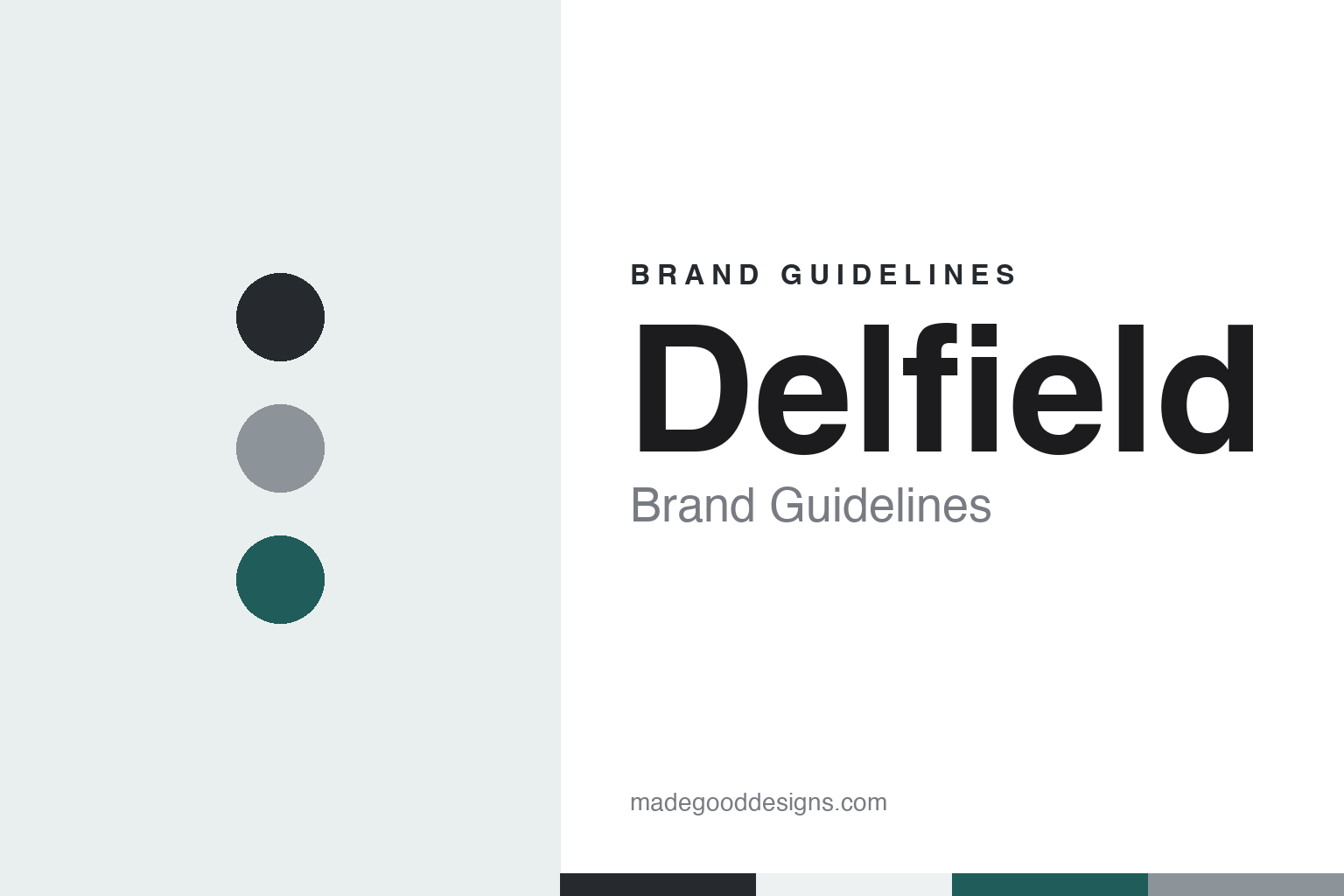
For a design guide, Delfield shows how a brand built from two founders’ names can outlast a long chain of corporate owners. Compare Scotsman, its owner in the 1990s, and Manitowoc Ice, a former stablemate under Welbilt. For this guide we use charcoal, brushed steel, cool white and a deep teal with a sans, an unofficial interpretation; no product or logo is reproduced.
Explore & save
Keep Delfield’s identity on hand — save it to a board in the Made Good inspiration library.
Delfield identity set
Pin the Delfield charcoal, steel and teal palette and the workshop sans register to your own board.