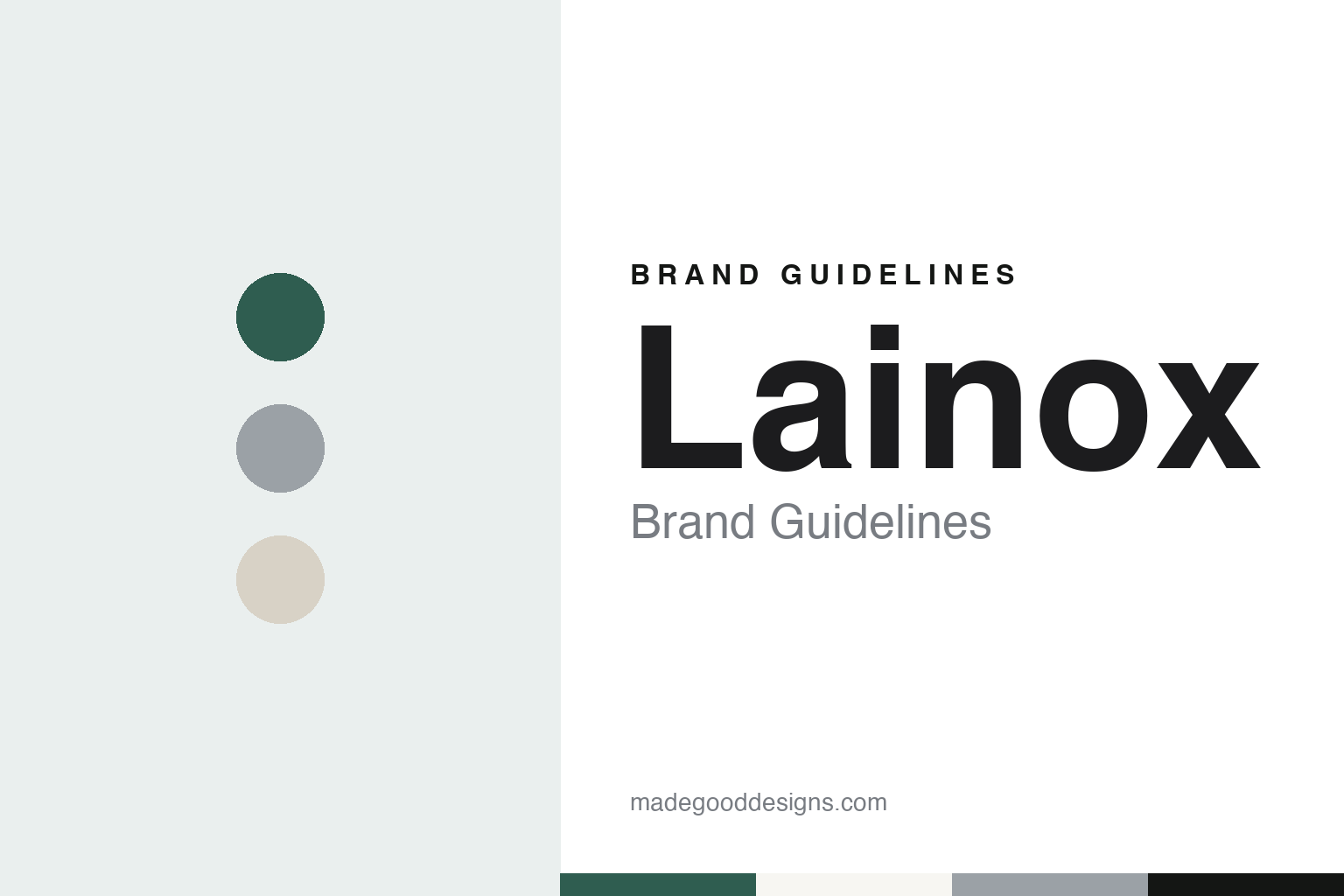
Lainox Brand Guidelines
The Vittorio Veneto combi-oven maker behind Naboo and Oracle.
Aa
Two constants: a Lainox green, steel and stone palette and a Kitchen sans register. Abstract homage — not a Lainox product or mark; no appliance, logo or nameplate is reproduced.
The Inox Valley
A combi-oven specialist from the foot of the Dolomites.
Lainox was founded in 1981 in Vittorio Veneto, in the province of Treviso in north-east Italy. The company says it specialised from the start in the design and production of equipment for professional catering, above all combination ovens. Its own history opens in 1981 with a fan-assisted hot-air oven, and continues in 1983 with what it calls its first-generation combi oven, a compact model offering both convection and steam cooking, able to run on gas or electricity and fitted with programmable digital controls.
Lainox places its founding in a regional story. Its headquarters page describes how, from the end of the 1960s, the area that runs from the foot of the Dolomites to Venice turned its experience in household appliances into a cluster of hundreds of companies supplying makers of kitchen equipment, a district it calls the “Inox Valley,” after the Italian word for stainless steel. Lainox says it was founded in that context, and it still gives its address in the San Giacomo di Veglia industrial zone of Vittorio Veneto.
The company came under new ownership within its first decade. The Ali Group, the Milan-area foodservice-equipment group, lists the “Acquisition of Lainox (Italy)” in 1987 in the timeline on its history page; the prose on the same page places Lainox among the acquisitions of 1989, alongside the gelato-machine maker Carpigiani and the cooking-equipment maker Ambach. Lainox’s headquarters page now gives the company name as LAINOX Ali Group S.r.l.
Colour
Oven generations, then speed.
Lainox tells its history as a sequence of oven generations. In 1991 it launched the Cucinatore, its second-generation combi oven, with automatic functions including an automatic humidity control it calls AUTOCLIMA, together with the “Lainox Cooking System,” a range of equipment built around the combi steamer for preparation, cooking, storage and reheating. In 2001 came The Cube, the third generation, with a control it calls Scroller; in 2006 the Heart range, with which, the company says, it added a touchscreen to its ovens for the first time and launched ICS, its Interactive Cooking System. A Heart Green range followed in 2011.
In 2013, Lainox says, it turned itself from a manufacturing company into an “Application Company” and launched Naboo, a new generation of combi ovens. Compact by Naboo, a unit 51 centimetres wide, followed in 2016, and in 2017 Nabook, which the company describes as a virtual assistant for organising and running a professional kitchen, offered free even to cooks who are not Lainox customers. Naboo 5.0 arrived in 2023, billed by the company as “the evolution of a species.”
The second strand is speed. In 2019 Lainox introduced Oracle, a compact high-speed oven. That August the FCSI, the Foodservice Consultants Society International, reported that Oracle, “manufactured by Lainox,” would make its debut in Britain with Falcon at the Restaurant Show in London, combining microwave, convection and impingement heating and fitted with ventless technology so it could stand front of house. In January 2020 the FCSI described Falcon, another Ali Group company, as the UK distributor for Lainox combination ovens. An “All in one” Oracle followed in 2022, combining combi and high-speed cooking, and an Oracle XS in 2025. In October 2024 an FCSI review of the FHA HoReCa show in Singapore named the Lainox Oracle among the front-of-house speed ovens on display.
Recent launches have widened the range. In 2024 Lainox introduced Puff and Foody, which it calls “Premium Budget” ranges; in 2025 the Compact range, styled “The Urban Combi,” and Zoom Evolution; and in 2026 a Cooking Station and a Bakery Station for large-scale retail. Beside its combi ovens, the Ali Group lists Lainox convection ovens, pastry and bakery ovens, blast chillers and shock freezers, and regeneration and holding cabinets.
Typography
Design and documentation.
Commercial ovens are bought by chefs, restaurant chains and kitchen designers rather than by shoppers, and their makers present them that way. Catalogues and websites lean on stainless steel product shots against plain backgrounds, close-ups of touch-screen control panels, and oven fronts photographed in working restaurant, bakery and convenience-store kitchens, often with a chef at the door.
The category covers several kinds of machine. Combi steamers join convection heat and steam in one cabinet; speed ovens pair fast-moving hot air with other sources of heat; conveyor and deck ovens serve pizza and baking; and charcoal ovens put live fire inside a closed box. Many makers sell more than one kind, and several of these names now sit inside larger equipment groups, Middleby of Elgin, Illinois, among them, rather than standing alone.
Much of the selling happens face to face. HostMilano in Milan, Internorga in Hamburg and the National Restaurant Association Show in Chicago are among the fairs where makers show new ovens, often with chefs cooking on the stand. Alto-Shaam says it first showed its Cook & Hold oven at the 1968 NRA Show, and the makers’ own websites still point buyers to test kitchens and live cooking demonstrations, where an oven can be judged by what comes out of it. TurboChef’s website offers a way to find one of its test kitchens, and Alto-Shaam’s lists demonstrations and virtual events under the name Taste of Alto-Shaam.
This guide sets out what can be checked about each brand — who founded it, who owns it now, and where its ovens are made — and marks clearly what rests only on the company’s own word.
Aa
A clean kitchen sans for a maker of named oven generations. (Specimen set in Barlow, a sans STAND-IN; NOT the Lainox logo.)
Lainox
Vittorio Veneto, inside the Ali Group.
Lainox’s home remains Vittorio Veneto, where, its website says, projects “take shape.” The company says the brand works with food-service operators in more than 100 countries, and the Ali Group’s brand page gives its mission as “Excellence in the kitchen,” with research, innovation and training named as the three main ingredients of its approach. The Lainox website is organised around the kitchens it serves, with sections for restaurants, bistros and bars, catering, supermarkets, and pastry and bakery, and it gives space to demonstrations, live cooking shows and trade fairs.
Inside the Ali Group, Lainox sits beside other combi-oven brands. The group’s history lists its acquisition of the British AGA Foodservice Equipment business in 2007, which brought the German maker Eloma into the group, and its completed takeover of Welbilt in 2022, which brought Convotherm. The same AGA purchase brought in Falcon, the Scottish cooking-equipment maker that the FCSI described in 2020 as the UK distributor for Lainox combination ovens.
Product names mark each stage of the company’s own account of itself: Cucinatore, The Cube, Heart and Naboo for the combi ovens, and Oracle for high-speed cooking. Its website sets out that history year by year, from the hot-air oven of 1981 to the retail cooking and bakery stations of 2026, and its headquarters page writes the company name in capitals, as LAINOX, with the registered-mark symbol.
For a design guide, Lainox shows how a maker can build a brand around product generations and a regional story, the “Inox Valley” between the Dolomites and Venice. Compare Eloma, its German sister brand in the Ali Group, and Convotherm. For this guide we use a deep green, a steel grey and a pale stone with a sans, an unofficial interpretation; no product or logo is reproduced.
Explore & save
Keep Lainox’s identity on hand — save it to a board in the Made Good inspiration library.
Lainox identity set
Pin the Lainox green, steel and stone palette and the Kitchen sans register to your own board.


