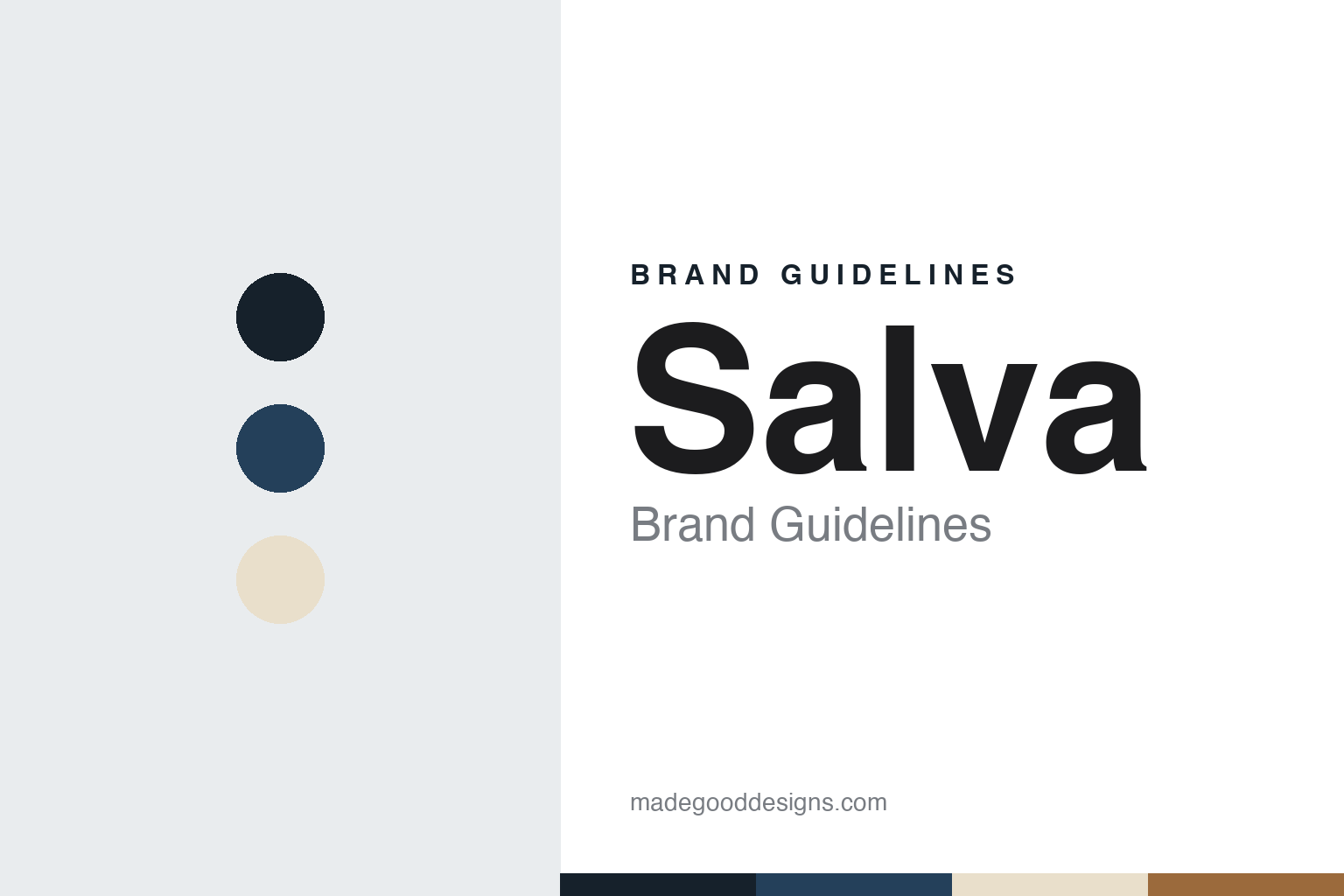
Salva Brand Guidelines
Bakery ovens from a Basque family firm founded in 1943.
Aa
Two constants: a slate, blue and flour palette and a slab serif register. Abstract homage — not a Salva product or mark; no oven, logo or nameplate is reproduced.
Hornos Eléctricos Salva
Two brothers and an electric oven.
Salva is a Basque maker of ovens and equipment for bakers and pastry cooks, based in Lezo, a town in Gipuzkoa near the port of Pasaia and the French border. The company says it was founded in 1943, when Jaime and Juan Llordés began making electric ovens for pastry shops and set up a business under the name Hornos Eléctricos Salva.
The company’s own timeline, published on its website, traces its growth through the decades that followed. In the 1960s and 1970s, it says, it launched the first modular oven on the Spanish market and the first convection oven on that market, the Kwik-Co. In the 1980s and 1990s it says it took its present name, opened a French subsidiary, Salva France, launched the Sirocco rotary oven and began making proving chambers for bakeries.
An official record from that period confirms the Lezo plant and two of those product names. The Spanish state gazette, the Boletín Oficial del Estado, published on 14 May 1993 two resolutions of the Basque government’s industry department, dated 2 April 1993, that approved gas-fired convection ovens of the Salva brand: the Kwik-Co K-4+V and its variants for industrial use, and the Sirocco SP-11 and its variants for catering use. Both resolutions name the maker as Industrial Salva, Sociedad Anónima, with its plant in Lezo, and record that the province’s industry office had reviewed the quality-control system built into its production.
The family has stayed at the centre of the business, according to the company. Salva says the third generation now runs the firm the Llordés brothers began in 1943.
Colour
Deck, rotary and convection.
Salva’s range is built around the oven types a bakery needs. On its website the company groups its ovens as convection, electric deck, rotary, ultra-fast and Boutique ovens, aimed at craft bakers and pastry cooks, hotels, neighbourhood shops, supermarkets and hypermarkets. The names from its timeline remain in use: the company says it renewed its Modular, Sirocco and Kwik-Co ranges in the early 2010s.
Around the ovens the company makes the rest of a bakery’s line. Its catalogue covers proving cabinets for direct and controlled fermentation, blast chillers and refrigeration, and machines including mixers, dough dividers, moulders, sheeters and bread slicers, along with water chillers, automatic lines and bakery accessories. The trade database Alimarket lists the firm as a maker of ovens for food and hospitality, and says it also makes proving cabinets, bakery furniture, counters, tools and trays.
Electronics have become part of the product. Salva says it took a stake in the electronics company Dicoel in the 2000s and, in the early 2010s, launched its own software, Salvalink, for remote control of bakery equipment. Its website now names features such as a touch control panel, a night-baking programme and an ultrasonic humidifier for proving rooms, each described in the company’s own terms.
The company has also grown by acquisition. In its timeline, Salva lists the purchase of the Spanish firm F.M. Mendoza among the events of the early 2010s, and says its central site in Lezo reached its present size in the 2000s. Sources describe that site differently: Salva gives it as 20,000 square metres, while Alimarket gives more than 15,000 square metres of installations and adds that the company has four production centres.
Typography
Ovens and the trade.
Commercial ovens are bought by chefs, restaurant chains and kitchen designers rather than by shoppers, and their makers present them that way. Catalogues and websites lean on stainless steel product shots against plain backgrounds, close-ups of touch-screen control panels, and oven fronts photographed in working restaurant, bakery and convenience-store kitchens, often with a chef at the door.
The category covers several kinds of machine. Combi steamers join convection heat and steam in one cabinet; speed ovens pair fast-moving hot air with other sources of heat; conveyor and deck ovens serve pizza and baking; and charcoal ovens put live fire inside a closed box. Many makers sell more than one kind, and several of these names now sit inside larger equipment groups, Middleby of Elgin, Illinois, among them, rather than standing alone.
Much of the selling happens face to face. HostMilano in Milan, Internorga in Hamburg and the National Restaurant Association Show in Chicago are among the fairs where makers show new ovens, often with chefs cooking on the stand. Alto-Shaam says it first showed its Cook & Hold oven at the 1968 NRA Show, and the makers’ own websites still point buyers to test kitchens and live cooking demonstrations, where an oven can be judged by what comes out of it. TurboChef’s website offers a way to find one of its test kitchens, and Alto-Shaam’s lists demonstrations and virtual events under the name Taste of Alto-Shaam.
This guide sets out what can be checked about each brand — who founded it, who owns it now, and where its ovens are made — and marks clearly what rests only on the company’s own word.
Aa
A slab serif for a bakery-oven maker founded in 1943. (Specimen set in Zilla Slab, a serif STAND-IN; NOT the Salva logo.)
Salva
From Lezo to export markets.
Salva has looked abroad for decades. After the French subsidiary of the 1980s and 1990s, the company says it opened Salva Middle East in the 2000s, and it now says it operates in 87 countries, has more than 150 staff and holds ISO 9001 certification. Alimarket lists offices abroad in Paris, Dubai, the United Kingdom and Mexico, and says about 70 per cent of the company’s production goes to export, with around 15 per cent going to the hospitality trade rather than to bakeries.
The ownership has stayed private. Alimarket lists the operating company, Salva Industrial, S.L.U., as wholly owned by a Spanish holding company, and the company’s website presents the business as a family firm in its third generation. Salva also describes itself as among the ten largest makers of its kind in Europe, a claim it makes on its own website.
The company’s recent investments have been at home. It says it added an 800-square-metre showroom for customers to its site in Lezo, and its website publishes customer case studies, a blog and job notices alongside the product catalogue, in Spanish, English, French, Russian and German.
Salva’s public identity is built around the capitalised SALVA name, which the company uses in running text across its website. No published brand guide or logo designer is named in the sources available, and the colours here are our own.
For a design guide, Salva shows how a family maker can keep a handful of long-running product names — Kwik-Co, Sirocco, Modular — at the centre of a brand for more than half a century; compare it with Doyon and Mibrasa. For this guide we use slate, harbour blue, crust and flour tones with a slab serif, an unofficial interpretation; no product or logo is reproduced.
Explore & save
Keep Salva’s identity on hand — save it to a board in the Made Good inspiration library.
Salva identity set
Pin the Salva slate, blue and flour palette and the slab serif register to your own board.


