STERIS Brand Guidelines
The Ohio steriliser start-up that bought AMSCO and moved its legal home to Ireland.
Aa
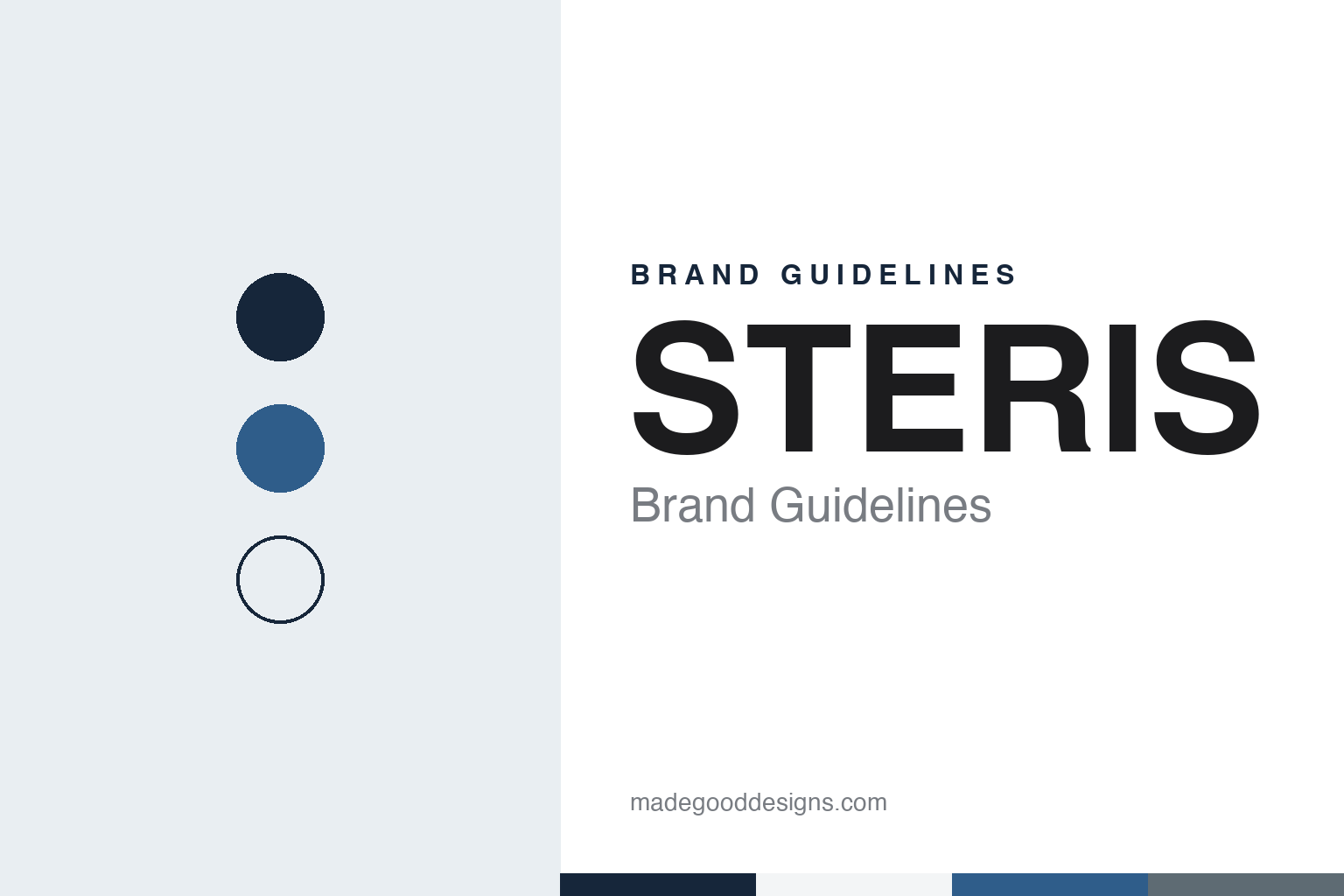
Two constants: a STERIS navy, wrap blue and steel palette and a Technical sans register. Abstract homage — not a STERIS product or mark; no instrument, logo or nameplate is reproduced.
Innovative Medical Technologies
A microbiologist and a liquid process.
STERIS began with a problem in the operating theatre. In the 1980s, the company says, minimally invasive surgery was spreading, and the instruments it relied on, such as endoscopes, could be damaged by steam, while gas sterilisation took a long time. The microbiologist Raymond Kralovic set out to build a low-temperature, liquid process for those heat-sensitive instruments.
The International Directory of Company Histories, in its profile of the company, says Kralovic left his employer, the Pittsburgh-based American Sterilizer Company, in 1985 to develop the idea. He first approached Primus Venture Partners, a Cleveland venture capital firm, which declined but pointed him to Bill Sanford, a health-care consultant. The company says Kralovic founded Innovative Medical Technologies in Mentor, Ohio, in 1985 with five employees, and that Sanford joined as president and chief executive in 1987, when the business was renamed STERIS Corporation.
The first product gave the company its footing. STERIS says the first unit of SYSTEM 1 was made and shipped in 1988. The Directory describes it as a tabletop, computer-controlled unit used with a single-use sterilant solution and a set of containers and trays, designed to be used at or near the site of the procedure. Because every machine needed the company’s own solution, the Directory notes, each sale brought repeat orders for consumables, and by 1995 the business was split almost evenly between equipment and consumables. STERIS says SYSTEM 1 is not available for sale in the United States today.
The company floated on the Nasdaq exchange in 1992 under the ticker STRL, and in 1998 moved its listing to the New York Stock Exchange as STE, the ticker it still uses. The company writes its name in capitals, STERIS.
Colour
Buying the old employer.
The decisive step came in December 1995, when STERIS announced it would buy Amsco International of Pittsburgh — the parent of the American Sterilizer Company, where Kralovic had worked. The International Directory of Company Histories calls Amsco a 100-year-old business and, in its words, “the nation’s leading manufacturer of steam and gas sterilizers, surgical tables and lights.” It was several times the size of STERIS, the Directory says, and the deal was completed in May 1996, adding some 300 items to the product line.
That purchase gave STERIS both halves of the trade: the large steam sterilisers used in hospital sterile services departments and the small low-temperature systems it had started with. More purchases followed in quick succession, according to the Directory: Calgon Vestal Laboratories, a maker of instrument decontamination products and surgical scrubs, from Bristol-Myers Squibb in 1996; Joslyn Sterilizer of Rochester, New York, in 1997; and Isomedix, a New Jersey contract sterilisation business working with irradiation, fumigation and electron beam, also in 1997. By early 1999, the Directory says, STERIS had about 20 production sites in Canada, Finland, Germany, Sweden and the United States.
The AMSCO name outlived its company. On STERIS’s current pages, the steam sterilisers it notes are “often referred to as autoclaves” are sold as the AMSCO 400, AMSCO 600 and AMSCO Evolution, sorted by how many instrument trays fit in one load, alongside the V-PRO low-temperature range. In 2004 the company added Albert Browne, and later purchases moved it further into instruments, endoscopy and services: US Endoscopy in 2012, the instrument-management firm IMS in 2014, Key Surgical in 2020 and, in 2023, a surgical-instrument portfolio from BD that included the V. Mueller name, the company says.
Typography
Design and documentation.
Sterilisation equipment is bought by hospital engineers, infection-control teams and the managers of sterile services departments — the rooms where used surgical instruments are washed, checked, packed and sterilised before they go back to the operating theatre. The makers describe their ranges in the order of that route. Getinge calls washer-disinfectors the first step in the reprocessing flow, then moves through sterilisers to the racks and trolleys that carry sterile goods back into the hospital.
The imagery of the category is practical rather than decorative: stainless-steel chambers, sliding or hinged chamber doors set into a wall, loading trolleys, wire baskets and instrument trays folded into blue sterilisation wrap. STERIS notes that its steam sterilisers are “often referred to as autoclaves” and sorts them by how many instrument trays fit in one load; Getinge groups its range into steam sterilisers, low-temperature sterilisers, loading equipment, and trays and baskets.
Many of the larger names grew by buying other companies, so their brands are layered. STERIS still sells steam sterilisers under the AMSCO name of the American Sterilizer Company, which it bought in 1996. Getinge folded Maquet, Atrium and other acquired names into a single Getinge brand in 2017, keeping some of them as product-family names. The makers in this set are based in the United States, Sweden, Switzerland, Spain, Germany, Italy, Israel and China.
The trade meets at a few large fairs. MEDICA, the medical-technology fair, is held in Düsseldorf. In Dubai, the show founded in 1975 as Arab Health now runs as World Health Expo Dubai, a new name announced at its 50th edition, TradeArabia reported; its 2026 edition moved to Expo City Dubai, Gulf News reported.
Aa
A technical sans — a capitalised name. (Specimen set in Archivo, a sans STAND-IN; NOT the STERIS logo.)
STERIS
Mentor, Swindon, Dublin.
The company’s legal home has moved twice. In October 2014 STERIS agreed to buy Synergy Health, a sterilisation-services company based in Swindon, in a deal that, The Guardian reported on 13 October 2014, would see the enlarged company incorporated in the United Kingdom while its operational headquarters stayed in Mentor, Ohio. The Guardian described it as a tax inversion, made despite political opposition on both sides of the Atlantic, and reported that Synergy sterilised more than 75 million surgical instruments a year for hospitals. The combined company took the name STERIS plc, and the deal was completed in November 2015, The Irish Times reported.
The second move followed Brexit. On 12 November 2018 The Irish Times, carrying a Bloomberg report, said STERIS planned to move its corporate base to Ireland, subject to shareholder approval, after its chief executive said significant benefits were at risk if it stayed domiciled in a country leaving the European Union. The paper noted that STERIS had created an Irish entity in December 2016 and already had Irish bases in Westport, County Mayo, and Tullamore, County Offaly. STERIS says it redomiciled from the UK to Ireland in 2019, the same year it joined the S&P 500; English Wikipedia describes it as legally registered in Dublin and run from Mentor.
A later purchase was Cantel Medical, a supplier of infection-control products for endoscopy, dental care and dialysis, completed in June 2021, the company says. In 2024 STERIS reorganised into three segments, Healthcare, Applied Sterilization Technologies and Life Sciences, and says it now has more than 18,000 employees.
For a design guide, STERIS shows how a company can keep an older maker’s name working as a product brand: the AMSCO mark of the business it bought now sits on its sterilisers. Compare Getinge, the Swedish steriliser maker that folded its acquired names into one brand, and Cantel Medical, now part of STERIS. For this guide we use a navy, a wrap blue and a steel grey with a sans, an unofficial interpretation; no product or logo is reproduced.
Explore & save
Keep STERIS’s identity on hand — save it to a board in the Made Good inspiration library.
STERIS identity set
Pin the STERIS navy, wrap blue and steel palette and the Technical sans register to your own board.