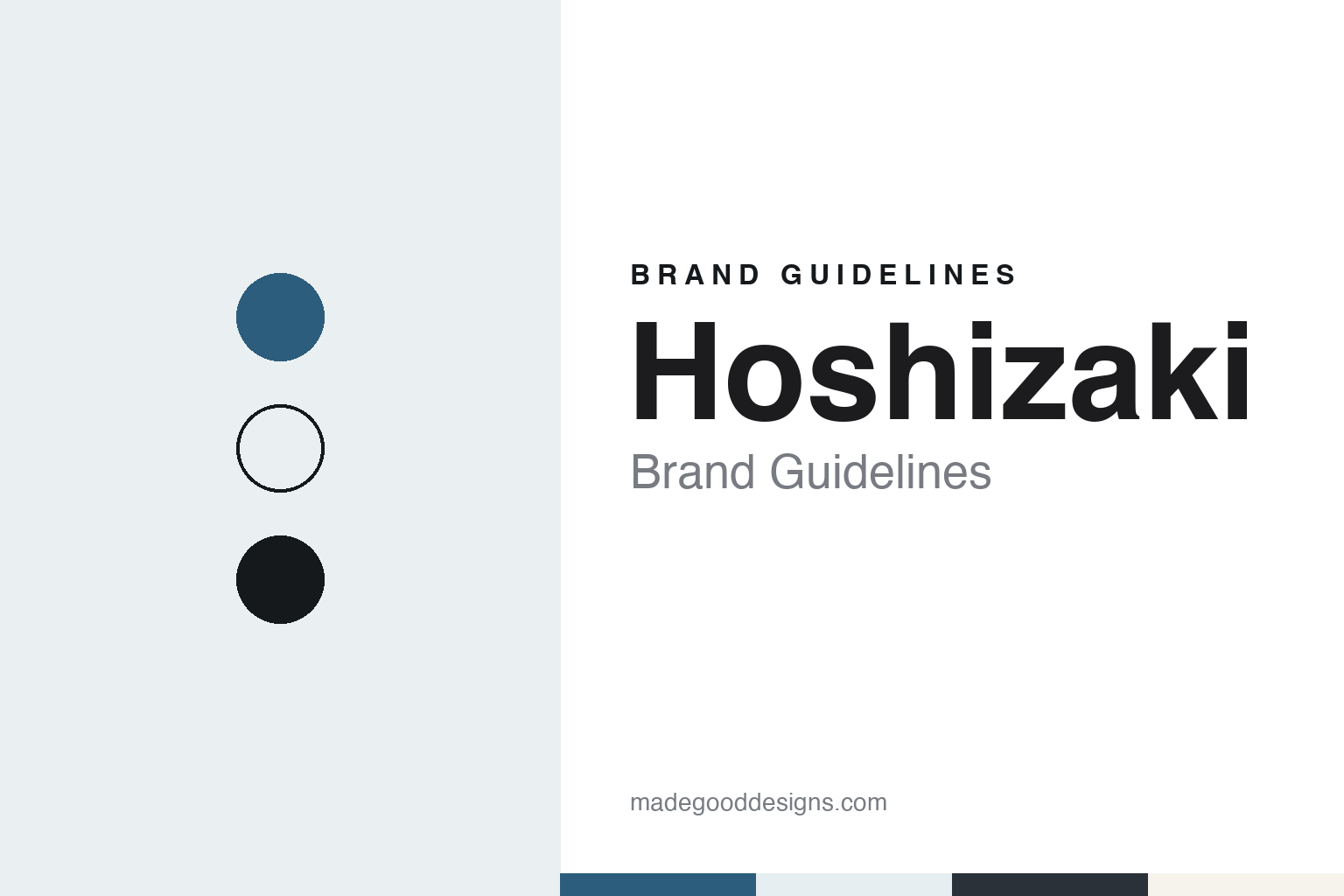
Hoshizaki Brand Guidelines
The Nagoya electrical firm that built its name on ice.
Aa
Two constants: a glacier blue, slate and ice palette and a Japanese gothic sans register. Abstract homage — not a Hoshizaki product or mark; no machine, logo or mascot is reproduced.
Hoshizaki Electric
From vehicle horns to juice fountains.
Hoshizaki was founded in February 1947 in Nagoya as Hoshizaki Electric Co., Ltd., according to the company’s own history, with its first office in the city’s Mizuho ward. Its American subsidiary names the founder as Shigetoshi Sakamoto, and Japanese Wikipedia lists him as the first president. One of the first electrical products the company made and sold was the vehicle horn, Hoshizaki America says; over the following decades it also made stoves, refrigerators, vending machines, water purifiers, servers and dispensers, as well as ice makers and refrigerated showcases.
The early years were spent inside Nagoya: the head office moved to Naka ward in April 1948, and a factory opened at Gokiso, in Showa ward, in October 1952. The company then moved in stages to Toyoake, in Aichi Prefecture. It opened a factory there in 1956, which it still calls its main factory, and moved its head office to the same site in 1963, its history says. In October 1957 it began selling juice vending machines. Japanese Wikipedia describes them as fountain-type machines sold as the “Oasis,” in which juice appeared to spray inside a clear dome on top while the drink itself was kept separate, and calls them the first juice vending machines made in Japan. It adds that a 1962 machine owned by the company was registered in October 2008 by Japan’s National Museum of Nature and Science as an essential historical material for science and technology.
The product that came to define the brand arrived in January 1965, when Hoshizaki began selling fully automatic ice machines; Japanese Wikipedia calls them the first made in Japan. Draft beer dispensers followed in 1970 and refrigerators in 1972, the company says. In 1970 it opened a factory in Kisuki, in Shimane Prefecture, first for cooking equipment; a second Shimane plant for prefabricated cold rooms followed in 1974, a main factory there for ice machines and dishwashers in 1986, and a beer dispenser factory in 1994.
Colour
Georgia, Amsterdam and beyond.
Hoshizaki went abroad through the United States. It set up Hoshizaki America in California in December 1981 and opened its main American factory in Georgia in October 1986, the company says; a refrigerator factory at Griffin, Georgia, followed in 2001. Hoshizaki America, now headquartered in Peachtree City, Georgia, says it designs and makes its products in two facilities, at Peachtree City and Griffin, with many parts made in those plants. Its range there covers machines for cubed, cubelet and flaked ice, reach-in refrigerators and freezers, ice and water dispensers and ice storage bins.
Europe came next. Hoshizaki Europe B.V. was founded in Amsterdam in 1992 and Hoshizaki Europe Ltd. in Shropshire, England, in 1994, according to the company’s history, and sales companies followed across Asia, from Singapore in 1999 to Vietnam in 2016 and the Philippines in 2017. In Japan the main factories are at Toyoake and in Shimane; Japanese Wikipedia lists further plants in the United States, the UK, Denmark, China, Brazil and India.
At home the company built a national network of regional sales companies, from Hoshizaki Tokyo in 1966 to Hoshizaki Okinawa in 1988, and in 2023 created a sales holding company, Hoshizaki Sales, by a company split. In December 1989 it changed the way its name is written in Japanese from kanji to kana, the company says, and in 2016 it took the name Hoshizaki Corporation. Japanese Wikipedia notes that the company uses the Adélie penguin in its logo and other materials.
Typography
How cold is sold.
Commercial refrigeration is a trade that sells itself through equipment people rarely notice. In restaurant kitchens it appears as rows of stainless steel reach-in refrigerators and freezers, undercounter units and prep tables, built to be cleaned, opened hundreds of times a day and serviced on site. Its makers present those cabinets plainly: model numbers, door counts, capacities and finishes, with the brand name on a small badge or kick plate.
In shops the same makers face the customer. Glass-door merchandisers, open-air cases and curved glass display counters hold drinks, dairy and prepared food at the point of sale, and many carry the colours of a bottler or a grocer rather than the maker’s own. Ice machines sit between the two worlds: a machine that turns water into cubes, flakes or nuggets, usually above a bin, in a bar, hotel corridor or hospital kitchen.
The industry meets at trade fairs. The NAFEM Show in the United States, organised by the North American Association of Food Equipment Manufacturers, HOST in Milan and HostelCo in Barcelona are among the places where makers show new cabinets and ice machines to dealers, consultants and chain buyers. Restaurant association shows have played the same role for decades: True Manufacturing, for one, first showed its foodservice line at the National Restaurant Association show in 1972, according to a 2017 profile in the FCSI magazine.
Ownership varies widely across the names in this guide: some remain family companies, some are listed groups such as Japan’s Hoshizaki, and others now sit inside larger equipment groups. This guide sets out what can be checked about each brand — who founded it, who owns it and where it says its products are made — and marks clearly what rests only on the company’s own word.
Aa
A Japanese gothic sans — clean, square and cold. (Specimen set in Zen Kaku Gothic New, a sans STAND-IN; NOT the Hoshizaki logo.)
Hoshizaki
A listed group built by acquisition.
Much of Hoshizaki’s growth since 2006 has come by acquisition, according to its history. It bought the Texas beverage dispenser maker Lancer in February 2006 and the Danish refrigerator maker Gram Commercial of Vojens in September 2008; Gram was merged into Hoshizaki Europe in 2020. Western Refrigeration of India, a dishwasher business in Kentucky now called Jackson WWS, and the Brazilian food service equipment maker Macom followed in 2013. In July 2022 Hoshizaki bought the Milan ice machine maker Brema, and in 2024 it took a stake in Fogel, a refrigerator maker in Panama.
The largest recent step came in the United States. In June 2025 the Hoshizaki Alliance, the group’s American arm, announced an agreement to buy Structural Concepts of Norton Shores, Michigan, a maker of refrigerated and heated food display cases, Foodservice Equipment Reports reported on 13 June 2025, describing an alliance that also includes Hoshizaki America, Lancer Worldwide and Jackson Warewashing Systems, as well as Fogel Group and Hoshizaki Macom. The magazine said the purchase would add refrigerated and heated food display to the group’s range for foodservice, supermarket and convenience-store customers. Japanese Wikipedia dates completion to 31 July 2025.
Hoshizaki is a public company. It listed on the first sections of the Tokyo and Nagoya stock exchanges in December 2008, and its shares now trade on the Tokyo Prime Market and the Nagoya Premier Market, the company says. Its head office remains in Toyoake, beside the factory it opened in 1956.
For a design guide, Hoshizaki shows how a single product, the ice cube, can carry a brand from a Nagoya workshop to factories in Asia, Europe and the Americas. Compare Epta, the Milan refrigeration group, and True Manufacturing. For this guide we use a glacier blue, a deep slate and a pale ice with a sans, an unofficial interpretation; no product or logo is reproduced.
Explore & save
Keep Hoshizaki’s identity on hand — save it to a board in the Made Good inspiration library.
Hoshizaki identity set
Pin the Hoshizaki glacier blue, slate and ice palette and the Japanese gothic sans register to your own board.