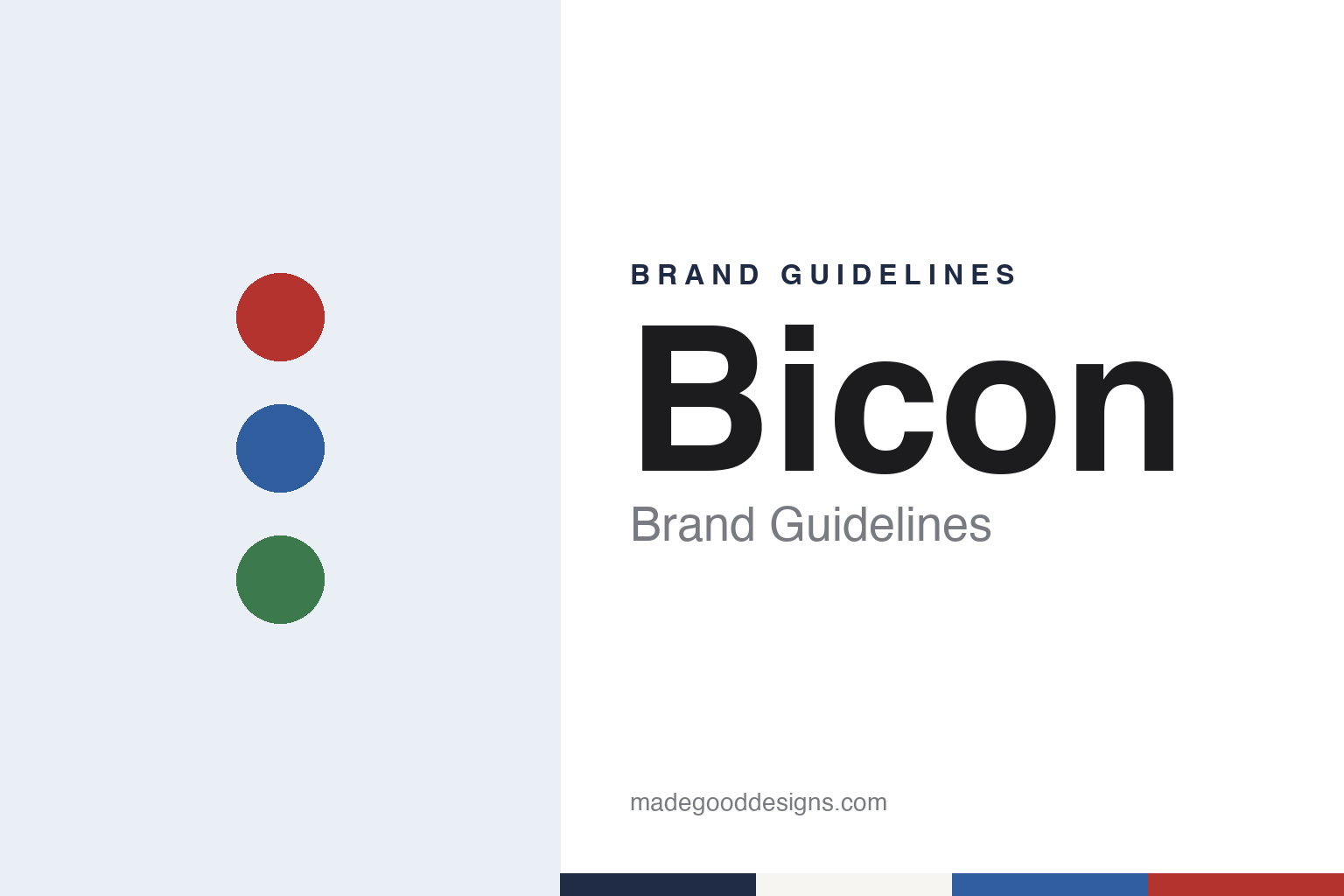
Bicon Brand Guidelines
The Boston implant maker that colour-codes its connections.
Aa
Two constants: a navy with red, blue and green palette and a clinical sans register. Abstract homage — not a Bicon product or mark; no implant, logo or packaging is reproduced.
Battelle, 1968
An Army-funded project, a fin and three owners.
Bicon’s story starts before the company. In 1968, the company says, the engineer Thomas Driskell began dental implant research at the Battelle Memorial Institute in Columbus, Ohio, with funding from the Dental Research Division of the US Army Medical Research and Development Command. English Wikipedia says the Army project was aimed at prosthetics for the facial injuries sustained by service personnel during the Vietnam War, and that it produced a multi-finned “plateau” design instead of the screw form used by most implants of the time. Bicon’s timeline adds that the research also turned, from 1970, to beta-tricalcium phosphate, a synthetic bone-graft material, a line the company later sold as SynthoGraft.
Driskell’s designs then moved through materials. Bicon dates the Synthodont, made of high-density aluminium oxide, to 1975, and the Titanodont, in titanium alloy, to 1982; Wikipedia places the Titanodont in the late 1970s. In the mid-1980s Driskell and partners formed a company to sell the system. The US Food and Drug Administration’s 510(k) database records Driskell Bioengineering receiving clearance for the “DB Precision Implant System” on 31 October 1985, followed by a 2000 Series in 1986 and hydroxyapatite-coated versions in 1988. Bicon treats 1985 as its starting point, and its website still opens with “Since 1985.”
The product line then changed hands. Wikipedia says it was owned by Driskell Bioengineering from 1985 to 1987 and by the Stryker Corporation of Kalamazoo, Michigan, from 1988 to 1994. Stryker, it says, was organised to sell to hospital purchasing departments rather than to dentists in private practice, and in late 1993 it planned to sell the system. A group formed by the dentist Vincent Morgan and business partners bought it, and the business has operated as Bicon since June 1994, according to Wikipedia.
Colour
A locking taper and a colour code.
The name explains the product. Wikipedia says “Bicon” joins the Latin “bi,” two, with “con,” for the two-part connection between implant and abutment. Instead of the internal screw that holds most abutments in place, Bicon uses a 1.5-degree locking taper, which the company says lets the abutment be turned to any position through 360 degrees. Its implants are short and finned, with a sloping shoulder, and the company sells them under names such as SHORT, NARROW and MAX 2.5.
FDA records trace the range’s growth under the Boston owners. Bicon, Inc. received 510(k) clearance for a two-part abutment system and a 6.0 by 8.0 millimetre implant in 1997, for a 5.0 by 6.0 millimetre implant in 2004, and for 5.0 by 5.0 and 6.0 by 5.0 millimetre implants in 2008, by which time the applicant was named Bicon, LLC. Bicon’s own timeline adds the Integrated Abutment Crown in 2001, the Brevis overdenture system and a new formulation of SynthoGraft in 2005, and a new clinical and teaching building in 2007. It marked the 25th anniversary of the design in 2010, and says its 4.5 by 5.0 millimetre SHORT implant received FDA clearance and the CE mark in 2017.
Bicon moved into digital dentistry with TRINIA, which it describes as a metal-free CAD/CAM material and dates to 2012; the FDA cleared TRINIA in March 2014 and fibre disks and blocks under the same name in June 2015. The company dates a keyless guided-surgery system to 2013 and a Universal Abutment System to 2015.
The clearest piece of visual identity is functional. Bicon says its abutments are colour-coded by connection diameter: red for 2.0 millimetres, blue for 2.5 and green for 3.0. On its website the products sit beside long-term radiographs, case studies and a short video series, The Bicon Minute, under the line “Perfectly Simple.”
Typography
Implants, scanners and software.
Dental implant and digital-dentistry companies sell to a narrow, expert audience, and their pictures show it. The typical product image is a small titanium screw shot on a white or pale grey ground, often beside its abutment and the driver that seats it, and lit to show the thread and the surface. Packaging tends to follow the same order: clean white boxes, colour codes for sizes, and the product line’s name set larger than the company’s.
Digital dentistry adds a second set of images. Intraoral scanners appear as slim wands next to a laptop or a cart, and the screen matters as much as the hardware: a coloured three-dimensional render of an arch, a planned implant position inside a CT slice, or a crown being shaped in design software. Milling machines and printers are shown with the blocks and discs they cut, and finished work is usually photographed as a single milled crown or bridge on a neutral surface.
The third subject is the clinician. Implant makers run training courses, symposia and hands-on sessions, and their brochures and press releases often show lecture halls and dentists at practice models rather than patients. Trade fairs carry much of that presentation: IDS, the International Dental Show in Cologne, and the congresses of the European Association for Osseointegration are where companies set up large stands, launch product lines and gather speakers.
The result is a category that looks clinical and orderly, with white space, steel greys and one or two accent colours carrying most of the identity. The companies in this guide include implant makers from South Korea, Europe, Brazil and the United States, alongside firms in intraoral scanners, lasers and CAD/CAM software. Each guide sets out who founded the company, who owns it now and what it says about where its products are made, separating documented facts from the company’s own claims.
Aa
A clinical sans for a company that labels its parts by colour. (Specimen set in Archivo, a sans STAND-IN; NOT the Bicon logo.)
Boston
A private company in Jamaica Plain.
Bicon remains a privately owned company, Wikipedia says, with its headquarters in Jamaica Plain, a neighbourhood of Boston; the FDA database lists every Bicon clearance since 1997 under a Boston address. Wikipedia says Bicon implants have been made in the United States for more than 30 years and are offered in over 100 countries. The company says it works through more than 77 distributors and subsidiaries in six regions, among them a subsidiary in Beijing and Bicon Europe. Its website also carries an online store, a prescription service for dental laboratories and digital libraries that laboratories can download for design software.
Teaching is part of the brand. Bicon runs hands-on and live surgical courses, which its website lists in Phoenix, in Cartagena in Colombia, and in Rome and Cisterna in Italy, along with a dental-laboratory service and a course for technicians. It publishes the Bicon Bulletin and a book on its short implants, and its video episodes feature clinicians including Vincent Morgan. Wikipedia records that Bicon has been called “the smallest of the large implant companies.”
For a design guide, Bicon shows how a small company can make a technical feature, a colour code for its connections, into the most recognisable part of its look. Compare Straumann, a larger implant maker with its own long history, and Dentsply Sirona, another American dental company. For this guide we use a navy with red, blue and green and a paper white with a sans, an unofficial interpretation; no product or logo is reproduced.
Explore & save
Keep Bicon’s identity on hand — save it to a board in the Made Good inspiration library.
Bicon identity set
Pin the Bicon navy, red, blue and green palette and the clinical sans register to your own board.