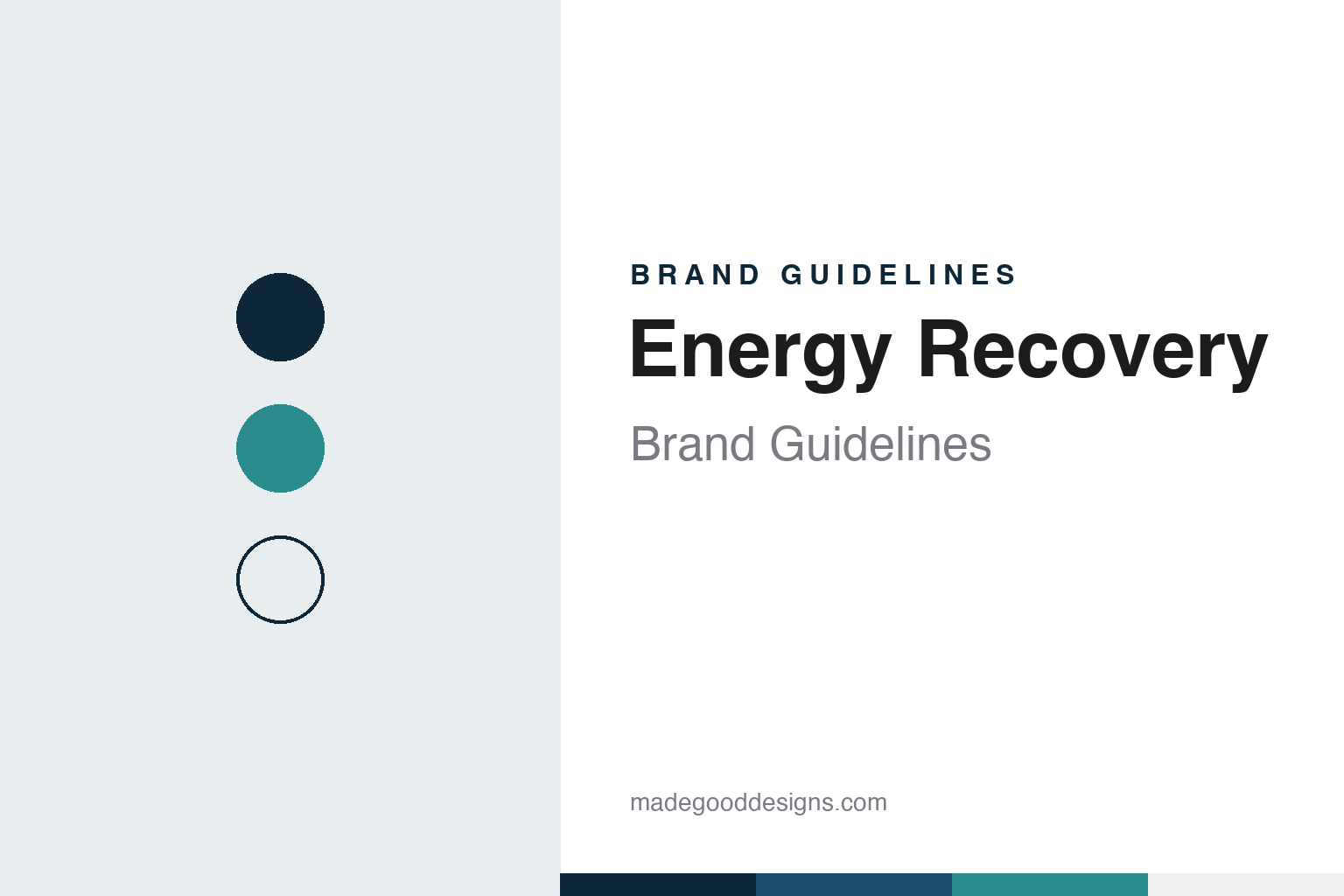
Energy Recovery Brand Guidelines
A ceramic rotor that hands the sea’s pressure back to the plant.
Aa
Two constants: a deep sea blue, teal and ceramic white palette and an engineering sans register. Abstract homage — not an Energy Recovery product or mark; no device, logo or nameplate is reproduced.
The pressure exchanger
One device, built around a spinning ceramic rotor.
Energy Recovery was founded in 1992 by Leif and Marissa Hauge and incorporated in Virginia, according to English Wikipedia; it was reincorporated in Delaware in 2001. The business grew from one idea, the rotary pressure exchanger: a device that takes the pressure left in the salty reject stream of a reverse osmosis desalination plant and passes it to the incoming seawater, so that the plant’s high-pressure pumps have less work to do.
The company began selling its PX Pressure Exchanger for seawater reverse osmosis in 1997 and went public in 2008, Wikipedia says; its shares trade on Nasdaq under the ticker ERII. Its press releases are datelined San Leandro, California, and the company says it is headquartered in the San Francisco Bay Area, with manufacturing and research facilities throughout the state.
The PX is the centre of the story. The company describes it as an isobaric device with a single moving part, a rotor made of alumina ceramic, and says its pressure exchanger technology has been at the heart of its products for more than 30 years. The general principle is set out in Wikipedia’s article on pressure exchangers: a cylindrical rotor with ducts running parallel to its axis spins inside a sleeve between two end covers, and pressure passes directly from one stream to the other inside those ducts, with a little fluid left in each duct acting as a barrier between the two streams.
In a reverse osmosis plant, the same article explains, the high-pressure concentrate leaving the membranes is sent to the pressure exchanger, which uses it to pressurise a stream of low-pressure seawater; a circulation pump then merges that stream with the flow from the main high-pressure pump to feed the membranes, while the spent concentrate leaves at low pressure, pushed out by the incoming feed.
Colour
From seawater plants to supermarkets, and back again.
Desalination is a cyclical market, and Energy Recovery’s history follows it. In September 2013 WWi magazine (Water & Wastewater International) interviewed Tom Rooney, who had joined as chief executive in 2011 after earlier work at the pipe-rehabilitation company Insituform, where he had built a reputation for turnarounds, when the company faced a slowing desalination market and new competition; the magazine noted that in 2009 the pump and valve group Flowserve had bought the Swiss company Calder to supply energy recovery devices. Rooney described a plan to cut costs, make manufacturing more efficient and move into new markets. Part of that plan, WWi reported, was moving the manufacture of turbocharger pumps from an acquired Michigan facility to California, where the pressure exchangers were made.
The same interview named the PX as the company’s flagship, and Rooney told the magazine that a client request for a quieter device had led the company to reduce the noise its pressure exchangers made.
The range has since reached from desalination into wastewater. Wikipedia describes pressure exchangers built for several pressure ranges, among them the Ultra PX for ultra-high-pressure reverse osmosis in industrial wastewater treatment. In March 2026 the company launched the PX Q650, which it presents as the next generation of the PX, following the PX Q400.
For several years the company also took the pressure exchanger into commercial refrigeration, with the PX G1300 for carbon dioxide systems in supermarkets. The company says the device was named Refrigeration Product of the Year at the 2024 ACR News Awards in London. In its shareholder letter for the fourth quarter of 2025, published in February 2026, Energy Recovery announced that it was winding down that CO2 retail grocery business with immediate effect, saying that wide adoption would take more time, investment and risk than it judged worthwhile, and that some engineering staff would move to its water business.
Typography
Desalination and documentation.
Desalination and industrial water companies sell things that few people ever see up close. Their customers are utilities, governments, refineries, mines and factories, and what they buy is rarely a boxed product: it is a plant, a process, a long operating contract or a membrane that will sit inside a pressure vessel for years. That shapes how these companies present themselves.
The plant is usually the hero. Company websites and annual reports in this field tend to lead with aerial photographs of coastal desalination works, with intake pipes running out to sea and long halls beside the shore. Inside, the familiar image is a row of white or grey pressure vessels holding reverse-osmosis membranes, stacked rack upon rack, or the polished casings of pumps and pressure exchangers that recover energy from the brine stream. Engineers in hard hats and high-visibility jackets on site, checking a control screen or walking a pipe gallery, give the pictures a human scale.
The vocabulary is technical and often trademarked. Membranes, energy-recovery devices and treatment processes carry their own names, and companies list reference plants, countries and project counts the way consumer brands list stockists. Awards from the water trade press and industry bodies are often displayed prominently.
The industry also meets in person. Trade fairs such as IFAT in Munich and Singapore International Water Week bring utilities, contractors and equipment makers to the same halls, and the stands there, with their models, membrane cut-aways and video walls, are one of the few places where these brands show themselves to each other. This guide sets out what can be checked about each company and marks what rests on its own word.
Aa
An engineering sans for a company named after the job its device does. (Specimen set in IBM Plex Sans, a sans STAND-IN; NOT the Energy Recovery logo.)
Energy Recovery
A name that describes the job.
The company’s most recent moves point back towards desalination. In May 2026 it named board member Alex Buehler, its chief financial officer from 2011 to 2014, as interim president and chief executive while it searched for a permanent appointment. In July 2026 it announced a lease for a manufacturing facility near Dammam Second Industrial City in Saudi Arabia, its first in the kingdom, expected to open in 2027 and to carry out key stages of PX manufacturing alongside its operations in California. The company linked the move to demand in the Middle East and North Africa and to Saudi Arabia’s Vision 2030 programme.
Its identity is that of an engineering supplier rather than a consumer brand. The company’s name describes the job its products do, and its website presents the device under the registered marks PX and Pressure Exchanger, with a Chinese-language version alongside the English one. Its press releases describe it as a global leader in energy-efficient technology for affordable, reliable water and reduced emissions; that is the company’s own description, and the releases name desalination and wastewater as its main markets.
For a design guide, Energy Recovery shows how a component maker can build a brand around one named device. Compare Hydranautics, whose membranes work in the same reverse osmosis plants, and IDE Technologies, another name in desalination. For this guide we use a deep sea blue, a teal and a ceramic white with a sans, an unofficial interpretation; no product or logo is reproduced.
Explore & save
Keep Energy Recovery’s identity on hand — save it to a board in the Made Good inspiration library.
Energy Recovery identity set
Pin the Energy Recovery deep sea blue, teal and ceramic white palette and the engineering sans register to your own board.


