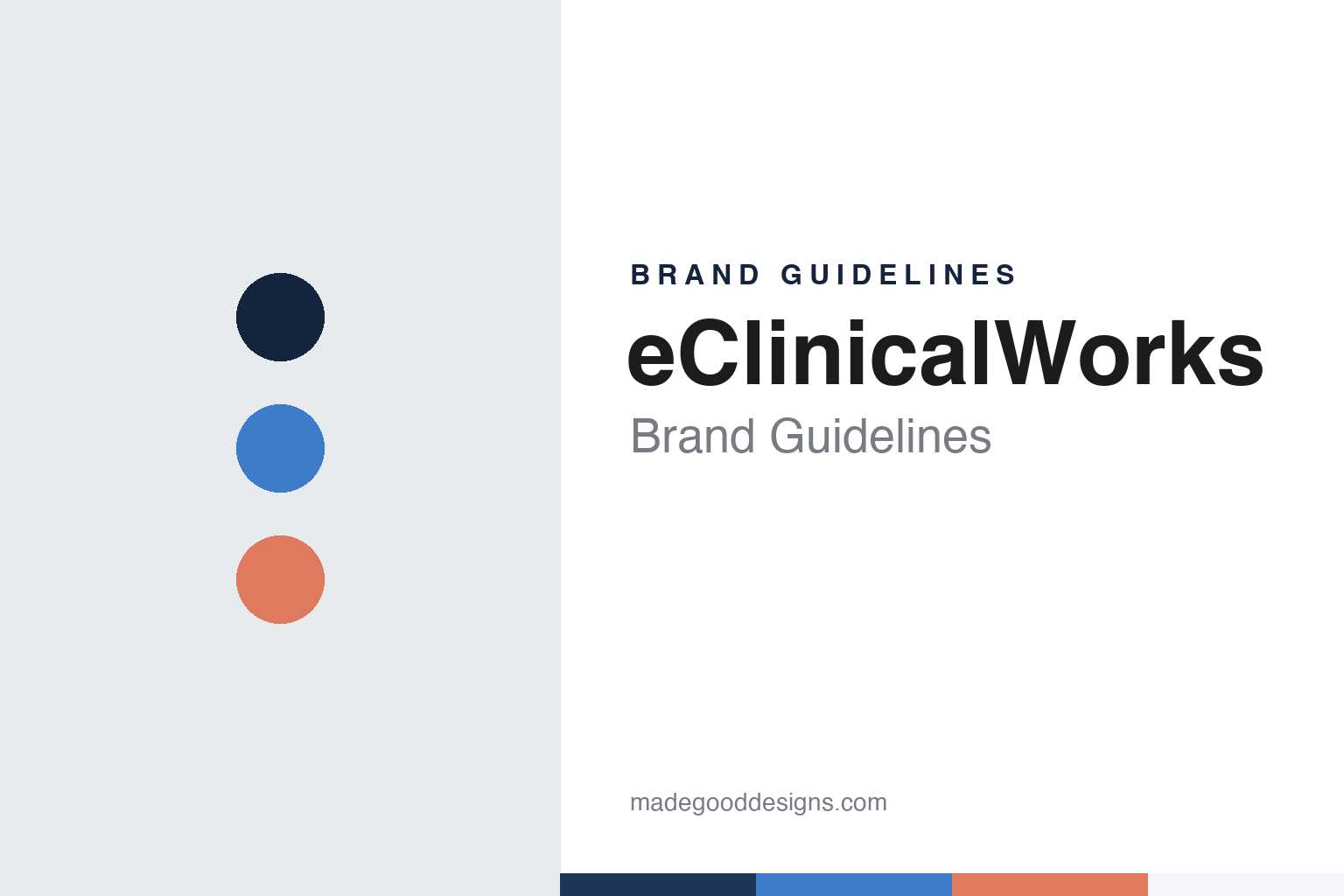
eClinicalWorks Brand Guidelines
The Massachusetts record maker that grew without outside investors.
Aa
Two constants: a navy, blue and coral palette and a rounded geometric sans register. Abstract homage — not an eClinicalWorks product or mark; no screen, logo or app icon is reproduced.
Paper charts, 1999
A record maker that refused outside money.
eClinicalWorks began in 1999, and its own company profile still tells the story in a single line: it was “founded in 1999 to help digitize paper charts for ambulatory practices.” Its co-founder and chief executive is Girish Navani. In a 2015 profile in Healthcare Informatics, Navani said the idea came after he heard a conference presentation in Geneva about the potential of health information technology and then talked to his own primary care doctor about how the practice was run. Comparing medicine with fields such as finance and semiconductors, he told the magazine, one had digitised itself completely and the other was still on paper.
The founders made an unusual choice for the dot-com years: they took no money from outside investors. Navani told Healthcare Informatics that the company wanted to bootstrap, focus on recurring revenue and fund its growth through the success of its customers, and that it was comfortable with slow growth in the early phases. In their first years, he said, he and his co-founders spent a lot of time studying how care was delivered and where the pain points were, aiming to digitise the whole workflow rather than only progress notes, prescriptions and lab results.
The magazine described the company as privately held and based in Westborough, Massachusetts, and noted that several of the other co-founders still worked there. Navani said he was reluctant to take the company public, because a listing would pull his focus from technology and customers towards shareholders.
A turning point, Navani said, was the Primary Care Information Project in New York City, whose choice of eClinicalWorks put more than 5,000 doctors on its system in one city. The 2015 profile also reported that the company had about 4,000 employees, more than 100,000 physicians and 600,000 users, and roughly half of the market among federally qualified health centers.
Colour
The record, healow and an AI scribe.
eClinicalWorks sells electronic health records and practice management software for ambulatory care. In its company profile it says it serves practices, specialists, health centers, urgent care facilities and hospital systems, helping them manage their revenue cycle, patient relationships and population health work. In an April 2025 release it called itself “the largest ambulatory cloud EHR” and said more than 180,000 providers and 1 million medical professionals rely on what it calls the eCW Cloud; those are the company’s own figures.
Patient-facing tools sit under a second name, healow, written in lower case. Healthcare Informatics wrote in 2015 about the healow patient portal and Messenger, a tool that sends patients appointment reminders by email, text message or voice mail. By April 2025 the company was describing healow CHECK-IN, kiosks and healow Pay at an 83-provider health center in western New York, alongside Sunoh.ai, an AI medical scribe that drafts clinical notes and works inside the eClinicalWorks record, according to the release.
The 2015 profile also recorded ambitions beyond the US and beyond the outpatient clinic. The company had picked up customers in 12 countries in the previous year, having until recently concentrated on the American market, and Navani said he did not intend to remain only an ambulatory vendor in the long term. A KLAS research director quoted in the same article said customers rated the company’s technology highly, and named customer support as its weak side.
Typography
Records, practices and patients.
Health-record software is hard to photograph. The product is a database and a set of screens used by clinicians, so the companies that make it tend to show the people around the software instead: a nurse or doctor with a tablet at a bedside, a patient checking a phone, a team gathered around a monitor. Where the software itself appears, it is usually as a clean chart, schedule or dashboard screenshot with invented patient details.
The patient portal has become one of the most visible parts of these brands. Phone screens showing test results, appointment bookings and messages to a care team are now a standard image in the category, because the portal is often the only part of a hospital’s system that patients ever see under the software maker’s own name.
Headquarters matter too. Several of the larger companies built campuses in their home towns and use them in their storytelling, from themed office buildings in Wisconsin to office parks in Kansas City. Those campuses host training, customer visits and, in some cases, the companies’ own user-group meetings, such as Epic’s UGM, which its website lists among its events.
The rest of the category’s public face is shaped by conferences. Trade gatherings such as HIMSS and HLTH bring vendors, hospitals and investors together each year, and companies stage their own events alongside them, like the Oracle Health and Life Sciences Summit. Booths, keynote stages and product demonstrations at these events supply much of the imagery the industry uses to present itself. This guide sets out what can be checked about each company: who founded it, who owns it today and what it says about its own software.
Aa
A rounded geometric sans for a software brand. (Specimen set in Plus Jakarta Sans, a sans STAND-IN; NOT the eClinicalWorks logo.)
Settlement and after
A 2017 case and a corporate integrity agreement.
In May 2017 eClinicalWorks settled a federal False Claims Act case. Health Data Management reported on 1 June 2017 that the Department of Justice had alleged that the company falsely certified that its EHR met government criteria, failed to test its software adequately and to correct problems promptly, and paid customers to recommend its product; the suit had been filed by a whistleblower in 2015. The company disputed the allegations, said in its statement that they were “allegations only” with no determination of liability, and said it had settled to avoid the cost and uncertainty of protracted litigation. It said its software remained certified and that it had discontinued its customer referral program.
Three of its founders were jointly liable under the settlement, and the company entered a five-year corporate integrity agreement with the Office of Inspector General of the Department of Health and Human Services. In July 2018 Health Data Management reported that the inspector general had imposed a penalty under that agreement because the company had not reported certain software patient-safety issues as reportable events in time; the company said it had sought to report such events completely and promptly.
In 2025 Navani was still chief executive. The company’s 2025 releases describe a turn towards AI tools built into the record, with Navani quoted as saying that its AI-powered solutions, including Sunoh.ai, are designed to streamline clinical documentation.
For a design guide, eClinicalWorks shows a software company that carries two names — eClinicalWorks for the record and healow for patients — with a lower-case “e” and a capital “C” inside the company name. Compare athenahealth, another ambulatory record vendor, and NextGen Healthcare. For this guide we use a deep navy, a clear blue and a warm coral with a sans, an unofficial interpretation; no product or logo is reproduced.
Explore & save
Keep eClinicalWorks’s identity on hand — save it to a board in the Made Good inspiration library.
eClinicalWorks identity set
Pin the eClinicalWorks navy, blue and coral palette and the rounded geometric sans register to your own board.


