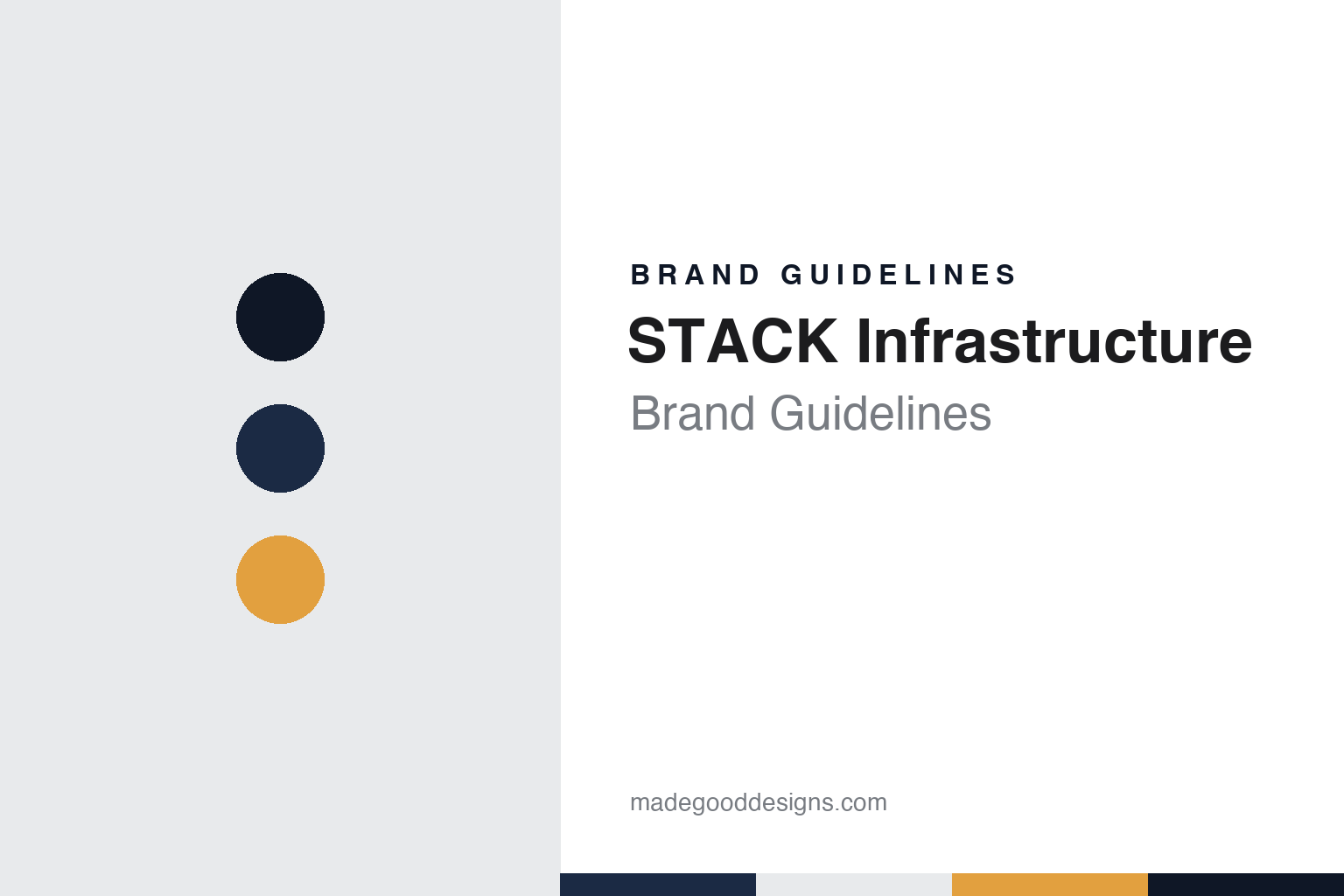
STACK Infrastructure Brand Guidelines
A data-centre platform assembled from two portfolios in 2019, and named in capitals.
Aa
Two constants: a navy, steel and amber palette and a geometric sans register. Abstract homage — not a STACK Infrastructure asset or mark; no building, logo or signage is reproduced.
Infomart and T5
Two portfolios, one new name, January 2019.
STACK Infrastructure was launched in Denver on 15 January 2019. The company’s release from that day describes a new data-centre platform “sponsored by IPI Partners,” an investor in data centres and other technology-related real assets, which combined operating data centres in six US markets: Atlanta, Chicago, Dallas/Fort Worth, Northern Virginia, Portland and Silicon Valley. The release put the starting portfolio at more than 100 megawatts of capacity and about 1.5 million square feet, and said the company also owned development land in five of those markets for future campuses and build-to-suit projects.
Data Center Knowledge, reporting the launch the same day, explained where the buildings came from. The owners of the Infomart Data Centers assets left over after Equinix bought Infomart’s Dallas carrier hotel had combined them with some of the T5 Data Centers portfolio. The Virginia, Portland and Silicon Valley sites were former Infomart buildings, while Atlanta, Chicago and Dallas came from T5; not every T5 data centre went to the new company, the magazine noted. It described IPI as a joint venture between the real-estate investor Iron Point Partners and Iconiq Capital, and counted eight data centres in all.
The first chief executive was Brian Cox, who had joined the previous October, according to the release. Data Center Knowledge said he had been chief operating officer of Cologix before running Infomart, and that the board was chaired by Phil Koen, who had been Infomart’s interim chief executive. Several of the senior team, the magazine added, came from Infomart and, before that, from Digital Realty.
Colour
Hyper, Ready and Power — then three regions.
From the start STACK sold itself through three named offers, each built on its own name. The 2019 release lists HYPER STACK for hyperscale campuses and build-to-suit data centres, READY STACK for immediately available wholesale colocation and private data suites, and POWER STACK for powered-shell options. The customers it named were “rapidly scaling enterprises and hyperscale companies”; in recent years, Data Center Knowledge wrote at the launch, most multi-megawatt leases of that kind had been signed by cloud giants.
The name spread beyond the United States in two steps. On 13 October 2021 Capacity reported that STACK had opened a regional headquarters in Singapore and named Pithambar (Preet) Gona, formerly of Bridge Data Centres and Blackstone, as chief executive for Asia Pacific, with Tokyo and Osaka as its first targets and Hong Kong, South Korea and Australia among later ones. Then, on 1 March 2022, STACK announced that two European businesses IPI had bought in 2021 — SUPERNAP Italia in Milan and DigiPlex in the Nordics — would operate under the STACK name as a new region, STACK EMEA. The company’s release dates those purchases to February and August 2021; Capacity, reporting the rebrand on 4 March 2022, put the DigiPlex deal in July. STACK said the move took it to 16 markets on three continents, and it launched a new website alongside.
Buildings in Asia Pacific followed. In a release dated August 2023 STACK said it had completed its first data centre in the region, a 36-megawatt building on a 72-megawatt campus in Melbourne. In October 2024 it reported the first facility on a 36-megawatt campus at Inzai in Greater Tokyo, developed in partnership between IPI and Oaktree Capital Management, and in January 2025 it announced a 220-megawatt campus at Iskandar Puteri in Johor Bahru, Malaysia, with initial delivery scheduled for the fourth quarter of 2026. Its website now lists locations from Calgary and Toronto to Geneva, Zurich, Osaka and Sydney.
Typography
How data-centre operators present themselves.
Data-centre operators sell something most of their customers will rarely see in person. The product is space, power, cooling and connections inside buildings that are secure by design, so the industry has built a recognisable visual language to stand in for the real thing. Long white halls lined with rows of server racks, often lit in a cool blue, are the most common image on websites, in reports and on trade-show stands.
The second stock image is the campus from the air. Aerial photographs show low, windowless buildings set out in a grid, with car parks, substations and fenced yards around them. Close-ups fill in the detail: banks of cooling towers or chillers on a roof, rows of backup generators, cable trays crowded with fibre and power cords, and engineers in hi-vis vests checking a tablet between the racks. The pictures are meant to suggest scale, order and control rather than any single product.
Names and marks tend to follow the same logic. Many operators use short coined names, initials or plain descriptive words, set in clean sans-serif type, and organise their sites with city or airport codes and numbers. Colour schemes lean on blues, greys and one sharper accent, and campaigns talk about capacity, connectivity and growth in measured, technical language. Because the buildings look alike, the difference is often carried by naming, maps of locations and the way a company describes its customers.
Much of this identity is presented in person at industry gatherings such as Datacloud Global Congress and PTC, where operators, investors and network companies meet. Stands, keynote slides and printed site maps there tend to repeat the same visual cues as the websites: hall photography, campus renders and lists of markets. The guides in this group look at how individual operators use those shared conventions.
Aa
A geometric sans for a name set in capitals. (Specimen set in Space Grotesk, a sans STAND-IN; NOT the STACK Infrastructure logo.)
STACK
A new sponsor and a name in capitals.
The investor behind STACK changed hands at the start of 2025. On 6 January 2025 the New York-listed asset manager Blue Owl Capital announced that it had completed its acquisition of the business of IPI Partners, the digital-infrastructure fund manager that sponsors STACK; IPI’s managing partner, Matt A’Hearn, became head of Blue Owl’s digital-infrastructure strategy. STACK’s releases since then describe events organised with “Blue Owl’s Digital Infrastructure team,” such as a women’s leadership summit held in Washington, D.C., in May 2025.
The company runs as three regions, each with its own leadership: STACK’s January 2025 release names Preet Gona as chief executive of STACK APAC, and its team page lists Jim Smith as chief executive of STACK EMEA. Its 2019 and 2022 releases are datelined Denver. In its own copy the name is set in capitals — STACK — while trade titles such as Data Center Knowledge and Capacity often write “Stack.” The 2019 release played on the word, describing a company built to address “the full stack” of its clients’ infrastructure needs, and the website’s tagline does the same: “The world runs on data. Data runs on STACK.”
For a design guide, STACK Infrastructure shows how one short word can name a company, a product line running from HYPER STACK to POWER STACK, and three regions at once. Compare Vantage Data Centers, another hyperscale developer, and Princeton Digital Group, which is also building in Johor. For this guide we use a deep navy, a steel grey and an amber with a sans, an unofficial interpretation; no product or logo is reproduced.
Explore & save
Keep STACK Infrastructure’s identity on hand — save it to a board in the Made Good inspiration library.
STACK Infrastructure identity set
Pin the STACK Infrastructure navy, steel and amber palette and the geometric sans register to your own board.