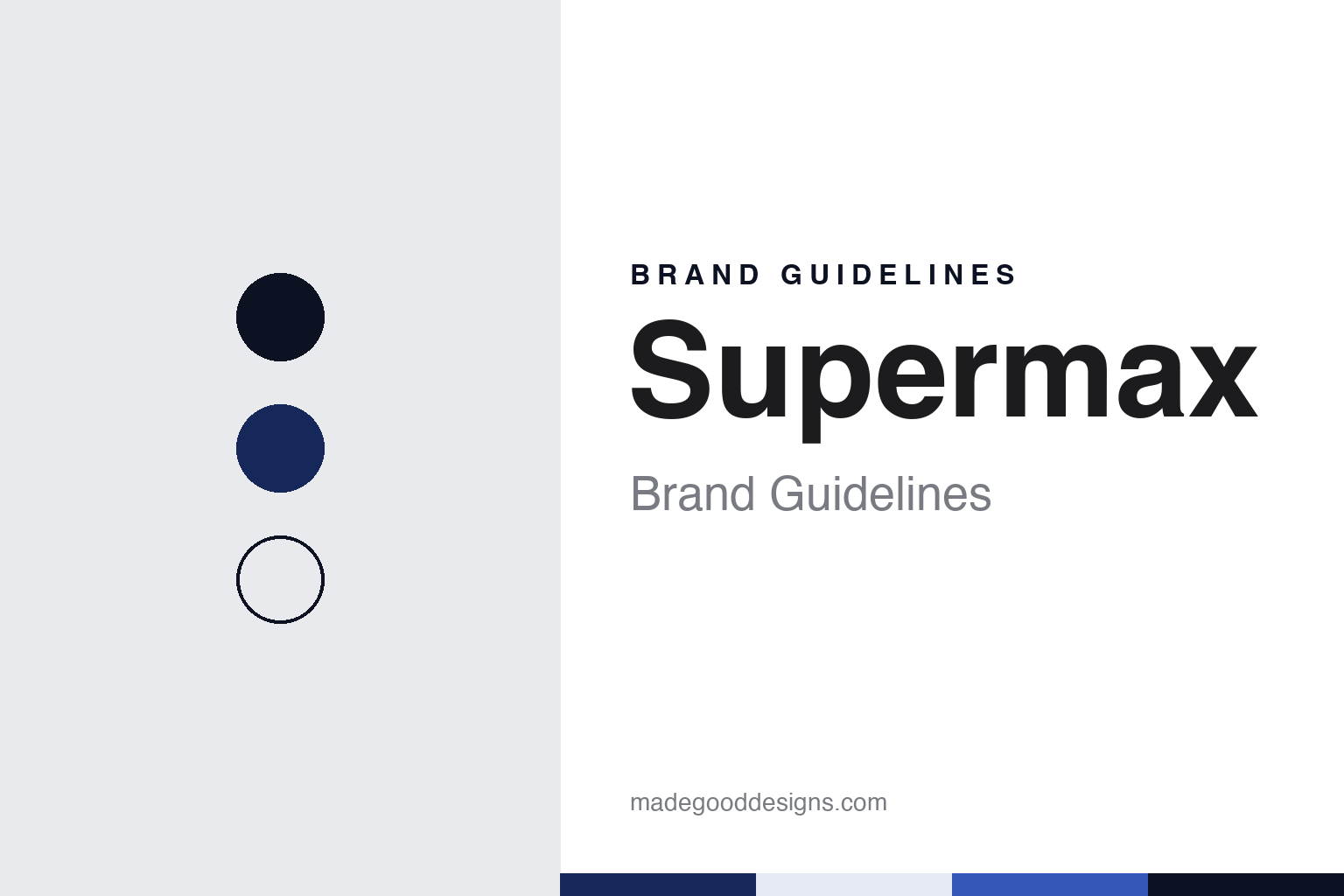
Supermax Brand Guidelines
The 1987 glove trader behind Aurelia and Maxter.
Aa
Two constants: a Supermax deep navy and cobalt palette and a Rounded sans register. Abstract homage — not a Supermax product or mark; no glove, box, logo or nameplate is reproduced.
From trader to maker
Founded in 1987 to sell latex gloves.
Supermax started by selling gloves rather than making them. Its website says the Supermax Group was founded in 1987 as a trading business distributing latex gloves, and that in 1989 it opened its first manufacturing facility, with a small team. English Wikipedia gives the same two dates — trading and exporting latex gloves from 1987, manufacturing from 1989 — and names the founders as Stanley Thai and Cheryl Tan.
The company’s next step was branding. Supermax says that, answering the Malaysian government’s call to brand Malaysian products, it became the first own-brand manufacturer of latex gloves in Malaysia when it launched its first brand, SUPERMAX, and that brand embodiment and creative packaging helped it win a share of the world market. The awards list on its website includes a Best Branding Company award in 2004 and certificates of excellence for product branding and for export in the Industry Excellence Awards of 2008 to 2010.
The parent company, Supermax Corporation Berhad, is listed on Bursa Malaysia. Its corporate headquarters is in Sungai Buloh, Selangor, north-west of Kuala Lumpur, and its Malaysian glove factories — run by the subsidiaries Supermax Glove Manufacturing, Maxter Glove Manufacturing and Maxwell Glove Manufacturing — are in Klang, according to its website, which says the group’s plants are centralised there.
Colour
Supermax, Aurelia and Maxter.
Supermax calls itself an own-brand manufacturer. Its website names three glove brands — Supermax, Aurelia and Maxter — and says about 70% of its output is sold under its own brands, with the remaining 30% made under contract for other companies. English Wikipedia says the own brands have a strong presence in Canada, the United States, the United Kingdom and Brazil, and that almost all of its production is exported to medical and dental buyers.
The range covers natural rubber latex and nitrile. The company lists powder-free nitrile examination gloves in a spread of colours — cobalt blue, purple blue, black, orange, white, teal and pink among them — and in several thicknesses; latex examination gloves, powdered and powder-free, including a green, peppermint-scented version and a textured finish it calls Honeycomb; and sterile latex surgical gloves. It says it sells to hospitals, dental practices, home healthcare, laboratories and food services, and to the tattoo and beauty trades.
Distribution is part of the model. Supermax says it runs eight distribution centres and offices of its own — in the United States, Canada, Brazil, the United Kingdom, Ireland, Hong Kong, Singapore and Japan — and works with more than 1,200 independent distributors. Its contact pages show its US company selling under the Aurelia name from Illinois and its UK company based in Peterborough, while the Maxter name also appears on its Singapore and Texas operations.
It has gone beyond gloves. The company says it became Malaysia’s first home-grown contact lens manufacturer, commissioning its first lens factory in 2016 after research and development carried out in the UK, and that its lenses now reach more than 60 countries; its current range is sold under the name Aveo.
Typography
How glove makers present themselves.
Disposable gloves are among the most anonymous products in healthcare. They arrive in plain dispenser boxes, are worn for minutes and are thrown away, and most of the companies that make them sell to distributors, hospital buyers and other brands rather than to the public. Their visual identities are therefore built less around the product in use and more around the factory, the material and the scale of output.
The pictures repeat across the category. A gloved hand in blue or purple nitrile is held against a white ground; long dipping lines carry rows of ceramic hand-shaped formers through tanks of latex or nitrile; finished gloves are stripped, stacked and boxed; and dispenser boxes are piled into walls of colour, each size and material given its own shade. Cleanroom and hospital scenes supply the setting, with gowned staff, stainless steel and soft, even light.
Geography is part of the story. Malaysia and Thailand, both rubber-growing countries, are home to many of the makers in this series, and corporate material from the region often opens with aerial views of factory complexes, rows of long white sheds, alongside figures for lines, plants and annual capacity. Makers in China, Europe and elsewhere use the same vocabulary of automation, testing laboratories and certificates.
Trade fairs are where many of these brands meet their buyers. Stands at MEDICA in Düsseldorf and at the Dubai healthcare show long known as Arab Health tend to show stacked boxes, glove samples and product walls, with a company name in a clean sans and a colour that can carry from carton to booth. The guides in this series look at how individual makers handle that shared language.
Aa
A rounded sans for an own-brand glovemaker. (Specimen set in Manrope, a sans STAND-IN; NOT the Supermax logo.)
Supermax
An import order, its lifting and a Texas plant.
In October 2021 Supermax became the subject of a withhold release order from US Customs and Border Protection. From 21 October 2021, CBP officers at all US ports of entry were to detain disposable gloves made by the subsidiaries Maxter Glove Manufacturing, Maxwell Glove Manufacturing and Supermax Glove Manufacturing; CBP said its investigation had identified 10 of the International Labour Organization’s 11 indicators of forced labour, according to its announcement as published by the American Journal of Transportation that day.
Other buyers responded. In January 2022 Supermax confirmed that its Canadian subsidiary had agreed with Canada’s federal government to end two existing contracts for the supply of nitrile gloves by mutual consent, while its other contracts for protective equipment stayed in place, Bernama reported in the Malay Mail; the company said it had been working towards ILO standards on migrant workers since 2019. In June 2022 Norges Bank, which manages Norway’s Government Pension Fund Global, placed Supermax Corp Bhd under observation for two years, citing an unacceptable risk that the company contributed to serious violations of human rights; its Council on Ethics had recommended exclusion.
The restrictions were later lifted. On 18 September 2023 CBP announced that it had modified the order after what it called the successful remediation of forced labor indicators in the company’s supply chain, and that gloves from Supermax and its wholly owned subsidiaries could enter the United States again. On 9 October 2024 Norges Bank ended the observation, saying the company had reported several measures to improve conditions and that the risk was no longer considered unacceptable.
Supermax has meanwhile built in the United States. Its website says production began in the first quarter of 2025 at a plant on a 215-acre campus in Brazoria County, Texas, the first of four planned phases, and its contact page lists a manufacturing office there for Maxter Healthcare.
For a design guide, Supermax shows a company whose brand names were the plan from the start, built on a trading business before it owned a factory. Compare Top Glove, another Malaysian glovemaker, and Ansell. For this guide we use a deep navy, a cobalt and an ice grey with a sans, an unofficial interpretation; no product or logo is reproduced.
Explore & save
Keep Supermax’s identity on hand — save it to a board in the Made Good inspiration library.
Supermax identity set
Pin the Supermax deep navy, cobalt and ice grey palette and the Rounded sans register to your own board.