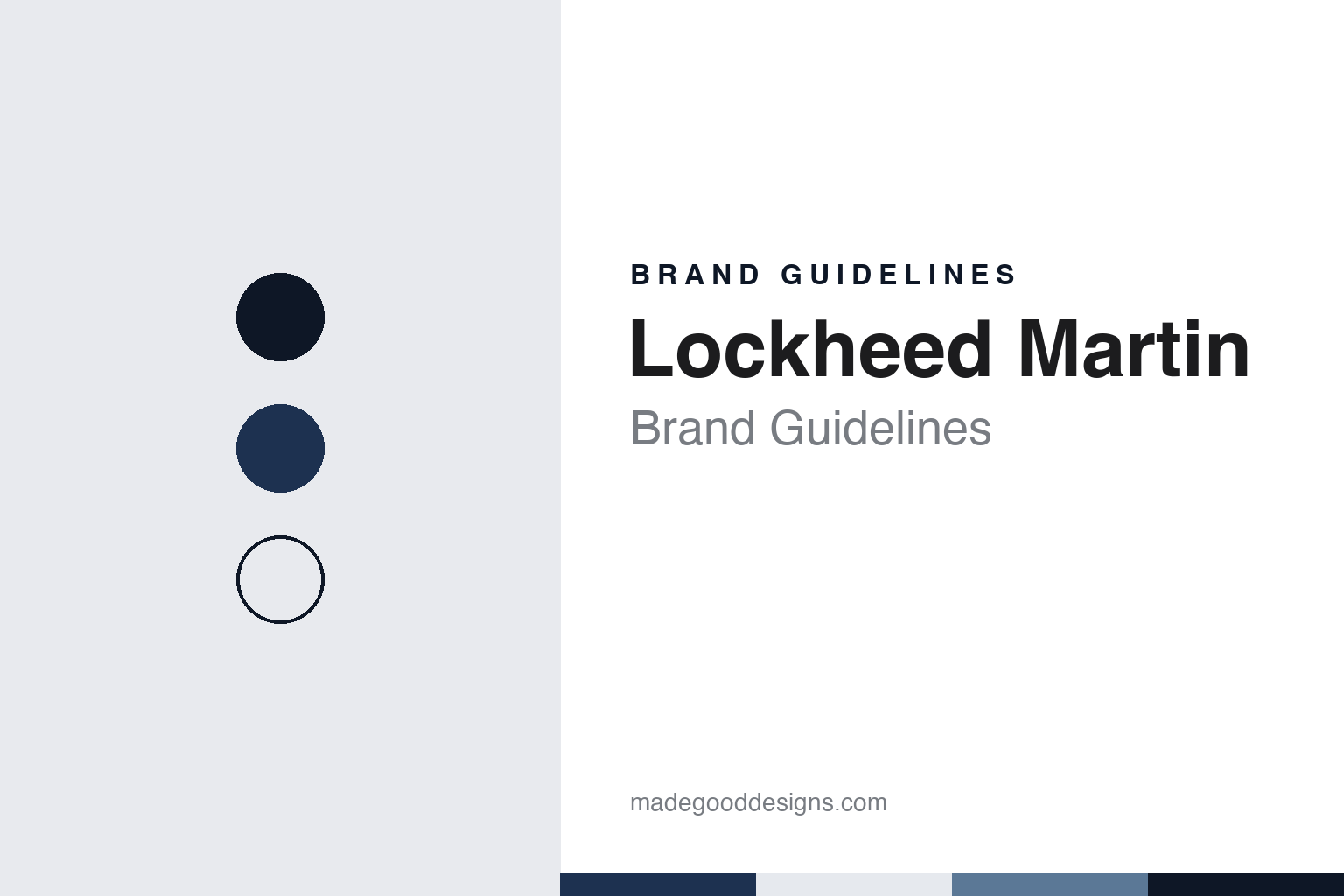
Lockheed Martin Brand Guidelines
Two 1912 seaplane makers, a comic-strip nickname and a 1995 star.
Aa
Two constants: a Lockheed Martin navy, steel and silver palette and a Modernist sans register. Abstract homage — not a Lockheed Martin product or mark; no aircraft, logo or star is reproduced.
Two Californian Seaplanes
Glenn Martin and the Loughead brothers, 1912.
Lockheed Martin traces its roots to two aviation businesses started in California in 1912. The company’s own history feature, published in October 2020, says Glenn L. Martin incorporated the Glenn L. Martin Company on 16 August 1912, a few months after flying a seaplane from Newport Bay to Catalina Island, and that the brothers Allan and Malcolm Loughead incorporated the Alco-Hydro Aeroplane Company in San Francisco on 19 December 1912 to build their Model G seaplane, which first flew over San Francisco Bay in June 1913. The brothers later changed the spelling of their surname to Lockheed, the way it was pronounced, and the company name changed with it.
English Wikipedia’s article on the Lockheed Corporation says that first Loughead venture ran from 1912 to 1920. The Lockheed Aircraft Company itself was formed in Hollywood on 13 December 1926 by Allan Loughead, John Northrop, Kenneth Kay and Fred Keeler, moved to Burbank in 1928 and built the Vega monoplane. After the Depression pushed its parent into receivership, a group led by the brothers Robert and Courtlandt Gross, with Walter Varney, bought the business in 1932; it became the Lockheed Aircraft Corporation, and in 1977 the Lockheed Corporation. Its aircraft included the Electra airliners, the P-38 Lightning and the Hudson, both built in large numbers during the Second World War, the Constellation airliner developed with TWA, and, from 1954, the C-130 Hercules transport, which Wikipedia notes is still in production.
The Martin side moved east. The Glenn L. Martin Company was based in Baltimore, and in 1961 it merged with American-Marietta, a Chicago maker of paints, chemicals and construction materials, to form Martin Marietta, Wikipedia records. Martin Marietta built the Titan rockets, the Viking Mars landers and the Space Shuttle external tank. In 1982 it survived a hostile bid from Bendix by bidding for Bendix in turn, and in 1993 it bought GE Aerospace and General Dynamics’ space systems division, maker of the Atlas launch vehicles.
Colour
Skunk Works, hard years and a merger of equals.
Lockheed’s most famous internal name came from a comic strip. The company says its Skunk Works division was conceived in 1943 under its chief engineer Clarence “Kelly” Johnson to build an American jet fighter, the P-80 Shooting Star, which his team delivered as a prototype in 143 days, and that the name was inspired by a place in Al Capp’s strip Li’l Abner. Its formal name became Advanced Development Programs, and the company places it at Palmdale, California; Lockheed Martin now prints Skunk Works with a registered-trademark sign. Wikipedia lists its later designs as including the U-2 of the 1950s, the SR-71 Blackbird and the F-117 Nighthawk.
The company’s postwar record also includes difficult years, which Wikipedia covers in detail. Cost overruns on the C-5 Galaxy transport and the L-1011 TriStar airliner left Lockheed short of money, and in 1971 Congress approved an emergency loan guarantee for the company; the loan was paid off in 1977. In 1975 and 1976 a U.S. Senate subcommittee concluded that members of Lockheed’s board had paid officials of foreign governments to secure aircraft contracts, and those payments, made from the late 1950s to the 1970s, became known as the Lockheed bribery scandals.
The merger came out of the shrinking of defence budgets after the Cold War. Lockheed Martin’s account of it, published in October 2020, says Lockheed’s chief executive Daniel Tellep telephoned Martin Marietta’s Norman Augustine in March 1994 to propose “a merger of equals.” Wikipedia records that the plan was announced on 30 August 1994 and completed on 15 March 1995, when shareholders approved it, with the head office at Martin Marietta’s base in Maryland. Units that the new company did not keep became the core of L-3 Communications, and the aggregates business was later spun off as Martin Marietta Materials.
Typography
How defence contractors present themselves.
Aerospace and defence contractors sell to a small number of governments and agencies, yet they still build public identities with care. Their brand work usually leans on engineering rather than on lifestyle imagery: aircraft photographed on test flights, ships on sea trials, spacecraft on the pad or in the clean room, each shown as a finished piece of engineering with the company name in plain type beside it.
People are the second pillar. Contractors of this size employ large engineering workforces, and their websites and reports give space to portraits of engineers, technicians and assembly teams, often in hangars and workshops. Careers pages, apprenticeship schemes and internship programmes carry much of the visual identity, because recruiting skilled staff is a constant task, and STEM outreach with schools and universities is presented as part of the same story.
Public appearances follow a familiar pattern. Air shows and trade exhibitions bring large branded stands, full-scale models and static displays, where a logo has to work at the size of a building and on a lanyard. Annual reports and sustainability reports, written for investors as much as for customers, are among the most consistently designed documents these companies publish, with set colour palettes, house typefaces and long heritage timelines.
Heritage itself is a recurring theme. Many of today’s large contractors are the product of mergers, and they present their predecessor companies, founders and historic programmes as part of their identity. This guide keeps combat imagery out and looks at names, marks, colour and type, and at how each company describes its own history.
Aa
A modernist sans for a merged name. (Specimen set in Archivo, a sans STAND-IN; NOT the Lockheed Martin logo.)
Lockheed Martin
A star logo for a merger of equals.
The merged company needed a new mark. Lockheed Martin’s merger history says it was launched with a “newly designed star logo”, and that the name order was chosen because “Martin Lockheed” sounded too much like the name of a person. Lockheed executives moved to Martin Marietta’s headquarters, and the company says its four original sectors were balanced between managers from both sides.
Since 1995 Lockheed Martin has kept buying and selling businesses. Wikipedia records the purchase of Loral’s defence electronics business in April 1996, the combination of its information-technology arm with Leidos in August 2016, and the agreement announced on 20 July 2015 to buy the helicopter maker Sikorsky from United Technologies, which received its final regulatory approval in November 2015; Sikorsky now appears as a Lockheed Martin business on the company’s website. Two larger plans did not go ahead: a merger with Northrop Grumman was dropped in July 1998 after government objections, and the purchase of Aerojet Rocketdyne, announced in December 2020, was abandoned in February 2022 after regulators opposed it.
Today the company is headquartered in North Bethesda, Maryland, Wikipedia says, and is organised into four business areas — Aeronautics, Missiles and Fire Control, Rotary and Mission Systems, and Space — the same four its website lists. Its named programmes include the F-35 Lightning II, whose contract it won in 2001, the C-130, and the Orion crew capsule it builds for NASA under a contract first awarded in August 2006. Wikipedia counts six Collier Trophies for the company, including the 2001 award for the F-35B lift-fan propulsion system. James Taiclet has been chief executive since June 2020.
For a design guide, Lockheed Martin shows how a merged company can carry two founders’ names, a comic-strip nickname and a new star mark at once. Compare Northrop Grumman, formed by a merger the year before, and Boeing, another American aircraft maker with a long civil and military record. For this guide we use a deep navy, a steel blue and a cool silver with a modernist sans, an unofficial interpretation; no product or logo is reproduced.
Explore & save
Keep Lockheed Martin’s identity on hand — save it to a board in the Made Good inspiration library.
Lockheed Martin identity set
Pin the Lockheed Martin navy, steel and silver palette and the Modernist sans register to your own board.