Meralco Brand Guidelines
Manila’s 1903 railroad and light company and a 1989 logo.
Aa
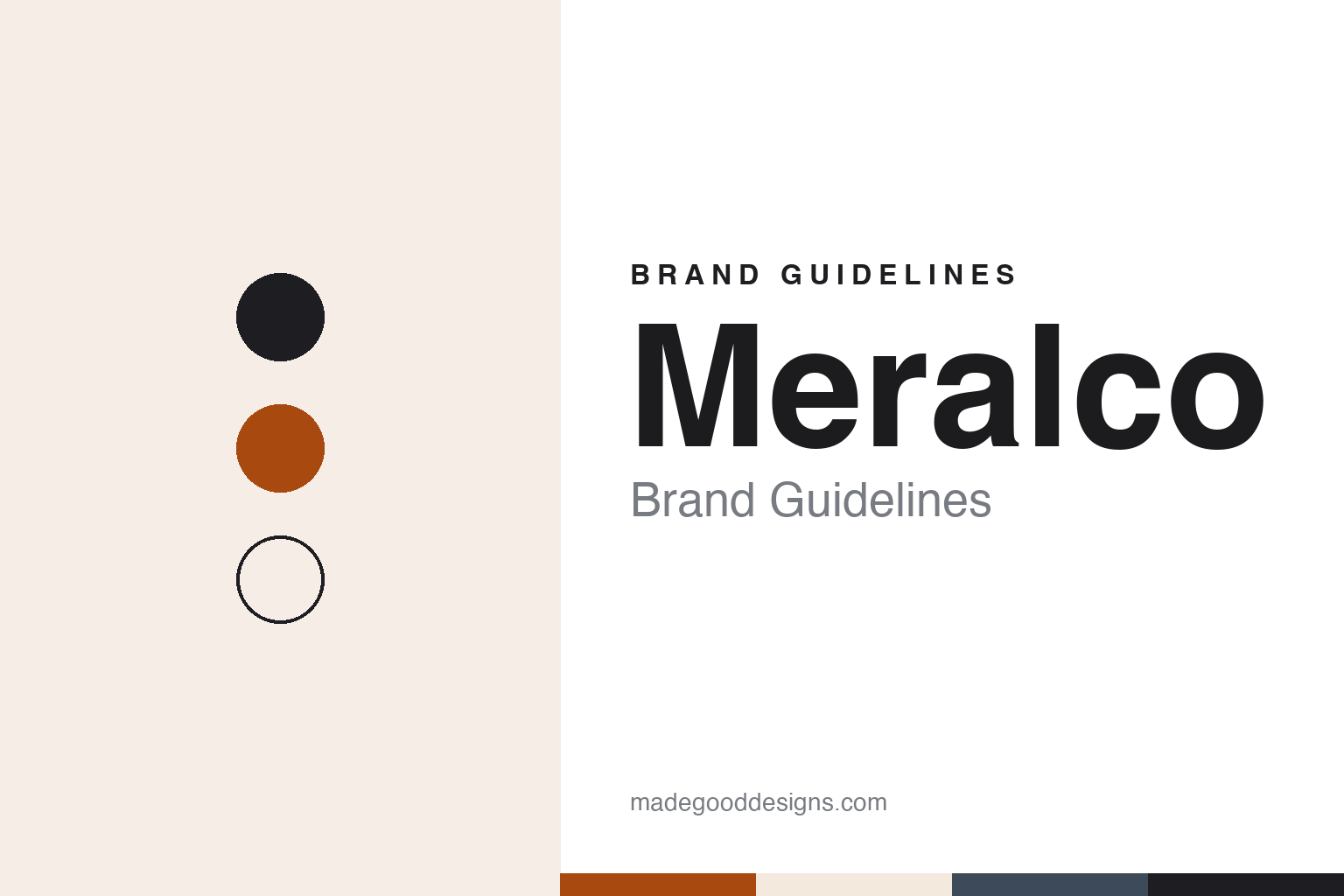
Two constants: an orange, charcoal and cream palette and a heavy capital sans register. Abstract homage — not a Meralco asset; no logo, streetcar livery or nameplate is reproduced.
Railroad and Light
A Detroit bidder, a franchise and Manila’s streetcars.
Meralco dates itself to 24 March 1903. English Wikipedia, citing a 1998 history in Japan Railway & Transport Review, says the Second Philippine Commission began accepting bids to run Manila’s electric service in October 1902, and that the Detroit entrepreneur Charles M. Swift, the only bidder, was granted the franchise on that date, which the company still marks as its anniversary. The name is a contraction of the Manila Electric Railroad and Light Company, its official title until 1919, when it became the Manila Electric Company.
It began with two jobs. The company says it was established to provide electric light and power and an electric street railway to Manila and its suburbs, and that its facilities were for many years the largest single investment of American private capital and know-how in East Asia. It took over La Electricista, the Spanish-era company whose streetlights were first switched on in January 1895, and the Compañía de los Tranvías de Filipinas, which had run horse-drawn trams since 1882, English Wikipedia says. In 1906 Swift won a further franchise for a suburban line from Paco to Fort McKinley and Pasig, and that company merged into Meralco in 1919.
For a little more than four decades, Meralco says, its electric streetcars gave Manila its first modern mass public transport, supplemented by buses from the 1920s. In 1925, English Wikipedia says, the company was acquired by the American utility holding company Associated Gas and Electric, and by 1930 it had completed the Botocan hydroelectric station, which the encyclopedia calls the country’s first hydroelectric plant. The sources used for this guide do not say how Meralco was run during the Japanese occupation of 1942–1945. Meralco says the Second World War destroyed the railway system beyond rehabilitation, so after the war it gave up transport to concentrate on electricity; English Wikipedia says its bus franchise was sold to Halili Transport.
Colour
The Lopez group, First Pacific and a 2025 franchise.
The company passed into Filipino hands in 1962. English Wikipedia, citing First Philippine Holdings, says Eugenio Lopez Sr. assembled Meralco Securities Corporation, which acquired Meralco and made it wholly Filipino-owned; Meralco itself calls it the first major American enterprise to be “Filipinized.” The company says the new management built generating and distribution facilities at an unprecedented pace, with loans from lenders including the export-import banks of the United States and Japan, and that Meralco became the first billion-peso company in the Philippines. The Meralco Building on Ortigas Avenue in Pasig, designed by the architect José María Zaragoza, dates from this period; the Meralco Theater inside it opened in March 1969, English Wikipedia says.
Ownership changed again in the 1970s. English Wikipedia says the Lopez family sold its controlling share of Meralco Securities late in 1973 to the newly formed Meralco Foundation, that Meralco Securities was renamed First Philippine Holdings in 1977, and, citing The Philippine Star in 2002, that the shares returned to the Lopez group in 1991. In the same years the government made it policy to own the major generating plants: Meralco says it sold its plants to the National Power Corporation, and electricity distribution became its core business. At the government’s request, the company says, it organised and ran Manila’s first elevated light rail line, between Baclaran and Caloocan, before handing it over at the end of the 1980s.
A new contest for the company came in 2009. On 14 March 2009 The Philippine Star reported that the PLDT group had bought a 20 percent stake in Meralco from the Lopez group, which had been the largest shareholder with about 34 percent; the purchase lifted the PLDT group’s holding to just over 30 percent, while San Miguel Corporation held 27 percent. English Wikipedia says the Lopez group had reduced its holding to under 4 percent by 2012, and that the First Pacific group, through Metro Pacific Investments Corporation, now holds the largest share, followed by the Gokongwei family’s JG Summit group.
Meralco is the sole electricity distributor in Metro Manila, with a franchise covering 39 cities and 72 municipalities, according to English Wikipedia, which says Republic Act No. 12146, signed on 11 April 2025, renewed that franchise for 25 years from its expiry in 2028. Its subsidiaries include the generation arm Meralco PowerGen and a majority stake in PacificLight Power, which runs gas-fired plants on Singapore’s Jurong Island, and its name is carried by sports teams including the Meralco Bolts of the PBA.
Typography
Design and documentation.
Electricity utilities in Asia rarely sell a product people can hold, so their public image is built from places and services. The most common picture is the city at night: a skyline of lit towers seen across a harbour, offered as proof that the supply works. Out of town the pictures change to substations, transmission pylons striding over paddy fields and hills, and power stations set on coasts and islands.
Much of the visible design work now sits on screens. Customer-service apps and web pages handle accounts, bills, payments and outage notices, and many utilities also run electric-vehicle charging services and reward schemes inside the same apps. The bill itself is a design object: a page of tariffs, fuel charges and usage graphs that households read every billing period.
Campaigns are the other public face. Energy-saving drives, school programmes and community events give a utility a friendlier voice than its engineering does, and they often carry the brand into kitchens, classrooms and housing estates. Alongside them sit transition plans, with dates for running down coal-fired units, adding gas, wind or solar capacity and reaching longer-term climate targets, usually presented as timelines and charts.
The most complete record of how these companies see themselves is often the annual report. For listed and state-owned utilities alike it gathers the plants, the networks, the customer numbers and the plans in one document, with photography and typography chosen to match. The guides in this group look at the history behind each name, and at how that history shows up in the way the company presents itself today.
Aa
A heavy capital sans, for a name the encyclopedia says is written in capitals. (Specimen set in Work Sans, a sans STAND-IN; NOT the Meralco logo.)
Meralco
An acronym written in capitals.
The current mark dates from 18 March 1989, when Meralco unveiled a new corporate logo, English Wikipedia says, citing a report in the Manila Standard two days later. The encyclopedia notes that the name is styled in capitals, MERALCO, a reminder that it began as an acronym of the company’s first title. Meralco’s own heritage page frames the brand through continuity rather than graphics: streetcars before the war, the light rail line of the 1980s, and a series of internal drives under names such as TQM, re-engineering and the Meralco Transformation Program, which it says share emphases including customer satisfaction, efficiency and transparent governance.
The heritage page also presents the company’s partnerships as part of its story, saying that major stock transactions brought it together with two other large Philippine groups, PLDT and San Miguel. Its anniversary on 24 March still looks back to the 1903 franchise.
For a design guide, Meralco shows how an acronym coined for a streetcar and lighting company can outlast the streetcars it was named for and still carry the business. Compare TNB, Malaysia’s utility that grew from a 1949 electricity board, and CLP, the Hong Kong electricity company. For this guide we use an orange, a charcoal and a pale cream with a sans, an unofficial interpretation; no product or logo is reproduced.
Explore & save
Keep Meralco’s identity on hand — save it to a board in the Made Good inspiration library.
Meralco identity set
Pin the Meralco orange, charcoal and cream palette and the heavy capital sans register to your own board.