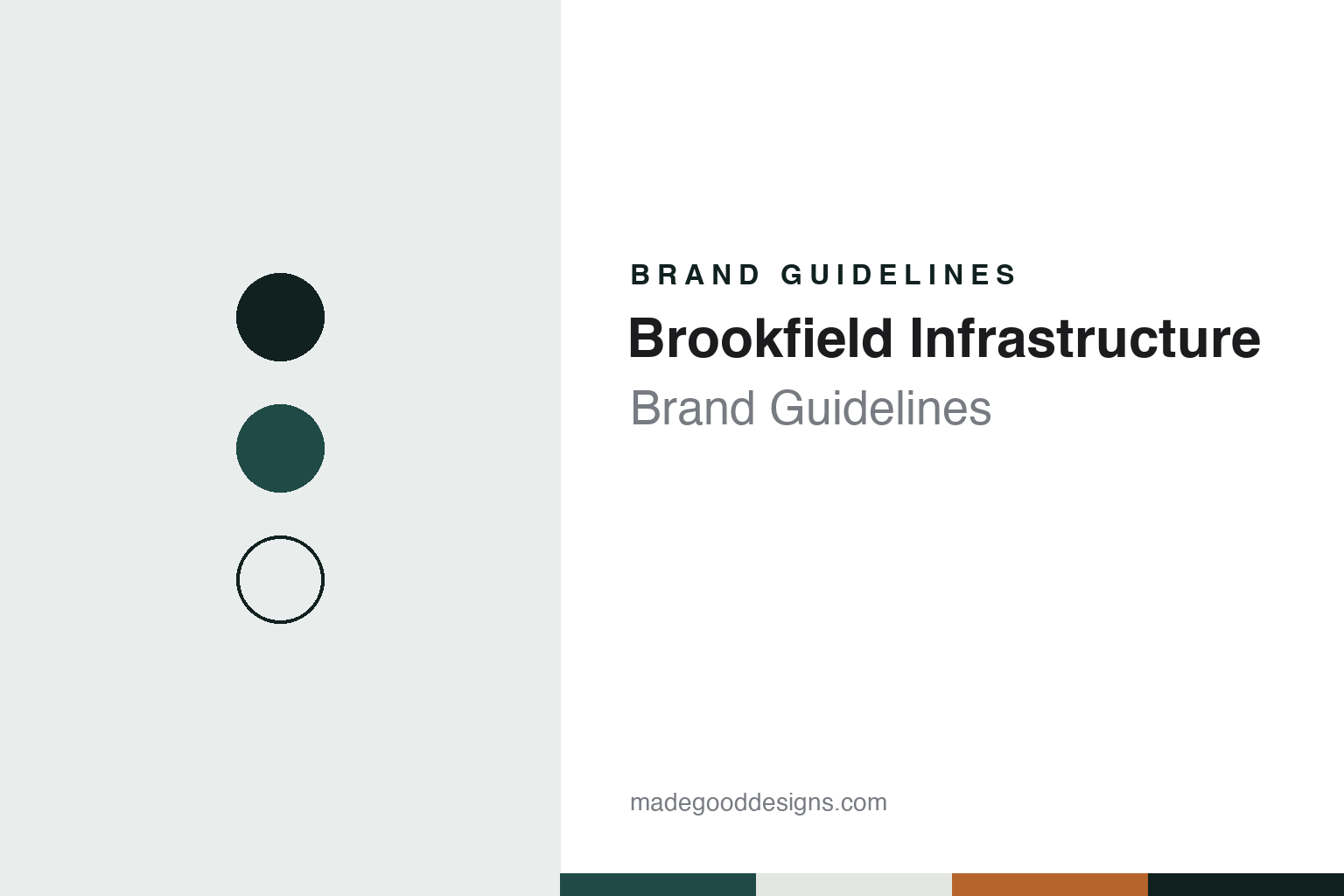
Brookfield Infrastructure Brand Guidelines
A spin-off that owns the roads, ports and wires.
Aa
Two constants: a green, concrete and rust palette and an engineering sans register. Abstract homage — not a Brookfield asset or mark; no logo, map or photograph is reproduced.
A spin-off
An operating unit becomes a listed partnership.
Brookfield Infrastructure began inside another company. English Wikipedia says that until a spin-off in January 2008 it was an operating unit of Brookfield Asset Management, the Canadian alternative-asset group, which kept about 30 percent and acts as the partnership’s general manager. The listed vehicle, Brookfield Infrastructure Partners L.P., is a limited partnership based in Bermuda, with its corporate headquarters in Toronto, according to English Wikipedia.
The first portfolio was small and mixed. English Wikipedia says the new partnership started with timber properties and electricity transmission lines, then announced in September 2008 that it would buy infrastructure holdings from Babcock & Brown, the Australian group then in difficulty, and in 2010 completed a merger with the Australian company Prime Infrastructure, in which it already held a minority interest.
By 2012 it was reshaping the mix. In July 2012 The Globe and Mail reported that Brookfield Infrastructure was adding toll roads and utilities while selling timber and other non-core assets. The paper described a plan with the Spanish group Abertis to take 60 percent of the toll-road operator Obrascon Huarte Lain Brasil, the purchase of the rest of the AVN toll road that circles Santiago in Chile, and a deal for most of Inexus, a UK owner of gas and electricity connections; it also noted that the Brookfield parent was buying shares to keep its interest of roughly 30 percent. The same report said Brookfield saw room to buy more infrastructure from European companies choosing to focus on their home markets.
Later deals named by English Wikipedia include a half share of the French telecommunications units of TDF in 2014, and, in 2016, the port assets of the Australian rail and port group Asciano, bought with Qube Holdings and other partners: the container ports stayed under the Patrick name in a joint venture with Qube, while the bulk and automotive port businesses became Linx Cargo Care Group. In the same year it agreed with partners to buy a 90 percent stake in a Brazilian natural-gas pipeline business from Petrobras.
Colour
Two securities for one portfolio.
For most of its life Brookfield Infrastructure has had an unusual shape for a listed company. In March 2020, English Wikipedia says, the partnership created Brookfield Infrastructure Corporation, or BIPC, so that investors unable to hold a Bermuda limited partnership could own the same portfolio through a corporation paying dividends rather than partnership distributions; BIPC began trading in Toronto and New York on 31 March 2020. The company’s own releases describe the pair as two ways into one business: BIP, the Bermuda partnership, and BIPC, a Canadian corporation.
That structure is now being folded into one. On 21 July 2026 Brookfield Infrastructure announced that it intended to simplify its corporate structure. BIP unitholders approved the plan at a virtual meeting on 14 October 2026, the company said, and on 5 November 2026 it announced that it had received all required approvals, including a final order of the Supreme Court of British Columbia. The plan combines BIP and BIPC into Brookfield Infrastructure Partners Inc., with holders receiving one class A share for each unit or share they own; the company expects it to close on 19 November 2026, with trading under the symbol BIP from about 23 November 2026. It was not completed at the time of writing. TipRanks, writing in The Globe and Mail’s market pages in October and November 2026, summarised the same steps.
The portfolio itself is described in four segments. On its website the company says it owns and operates utilities, transport, midstream and data assets, with natural-gas pipelines, electricity transmission lines and roughly 10 million utility customers, and ports, railways, toll roads and logistics networks on the transport side. It counts about 57,000 operating employees.
Typography
How infrastructure investors present themselves.
Infrastructure investors sell something hard to picture: long-term ownership of things other people use every day. Their websites therefore lean on the assets themselves. Macquarie Asset Management’s pages open on named portfolio companies, from a New Zealand telecoms provider to an onshore wind farm in north-eastern Brazil, and Brookfield Infrastructure sorts its portfolio into utilities, transport, midstream and data, with ports, railways, toll roads and pipelines named as the things it owns and runs.
The language is consistent too. Brookfield Infrastructure speaks of “critical infrastructure” and long-life assets with contracted and regulated revenues; Macquarie Asset Management says it seeks results “over the long term.” Responsible-investment wording sits alongside it: Macquarie’s purchase of the former UK Green Investment Bank in 2017, renamed Green Investment Group, came with a green “special share” held by independent trustees, according to the UK government’s announcement of the sale.
Listed vehicles add another layer of documents. Brookfield Infrastructure publishes quarterly results, supplemental information, letters to unitholders and investor-day presentations, and in 2026 it set out a plan to fold its two listed securities into one. Parent groups publish annual reports and history timelines; Macquarie’s runs from a three-person Sydney office in 1969 to the motorway deal of 1994 that it calls the start of its infrastructure business.
Trade rankings are part of the picture. Infrastructure Investor’s II 100 list of managers placed GIP, by then part of BlackRock, at the top in November 2024, and noted that Macquarie, first in every earlier edition, had dropped to fourth. This guide sets out what can be checked about each firm — who founded it, who owns it and how it presents its portfolio — and marks clearly what rests only on the company’s own word.
Aa
An engineering sans for an owner of networks. (Specimen set in Archivo, a sans STAND-IN; NOT the Brookfield logo.)
Brookfield Infrastructure
The flagship listed arm of a larger manager.
Brookfield Infrastructure presents itself as part of a family of Brookfield names. Its releases call it “the flagship listed infrastructure company” of Brookfield Asset Management, a global alternative-asset manager headquartered in New York, and its website groups it with other listed Brookfield affiliates, including Brookfield Renewable and Brookfield Business. The company calls itself “a leading global infrastructure company” and says it focuses on assets with contracted and regulated revenues.
Data has become its most talked-about segment. In 2022, English Wikipedia says, the company announced an initiative with Intel to invest jointly in a chip-manufacturing plant in Chandler, Arizona, and its third-quarter 2026 results, as summarised by TipRanks in The Globe and Mail, credited the Intel partnership and a US fibre network bought in 2025 for growth in the data segment.
For a design guide, Brookfield Infrastructure shows how an owner of very physical things — pipelines, ports and toll roads — explains itself mostly through structure, segments and results. Compare Brookfield Asset Management, the parent it was spun out of, and Macquarie Asset Management, another manager whose infrastructure business grew out of a wider financial group. For this guide we use a deep green, concrete grey and a rust orange with a sans, an unofficial interpretation; no product or logo is reproduced.
Explore & save
Keep Brookfield Infrastructure’s identity on hand — save it to a board in the Made Good inspiration library.
Brookfield Infrastructure identity set
Pin the Brookfield Infrastructure green, concrete and rust palette and the engineering sans register to your own board.