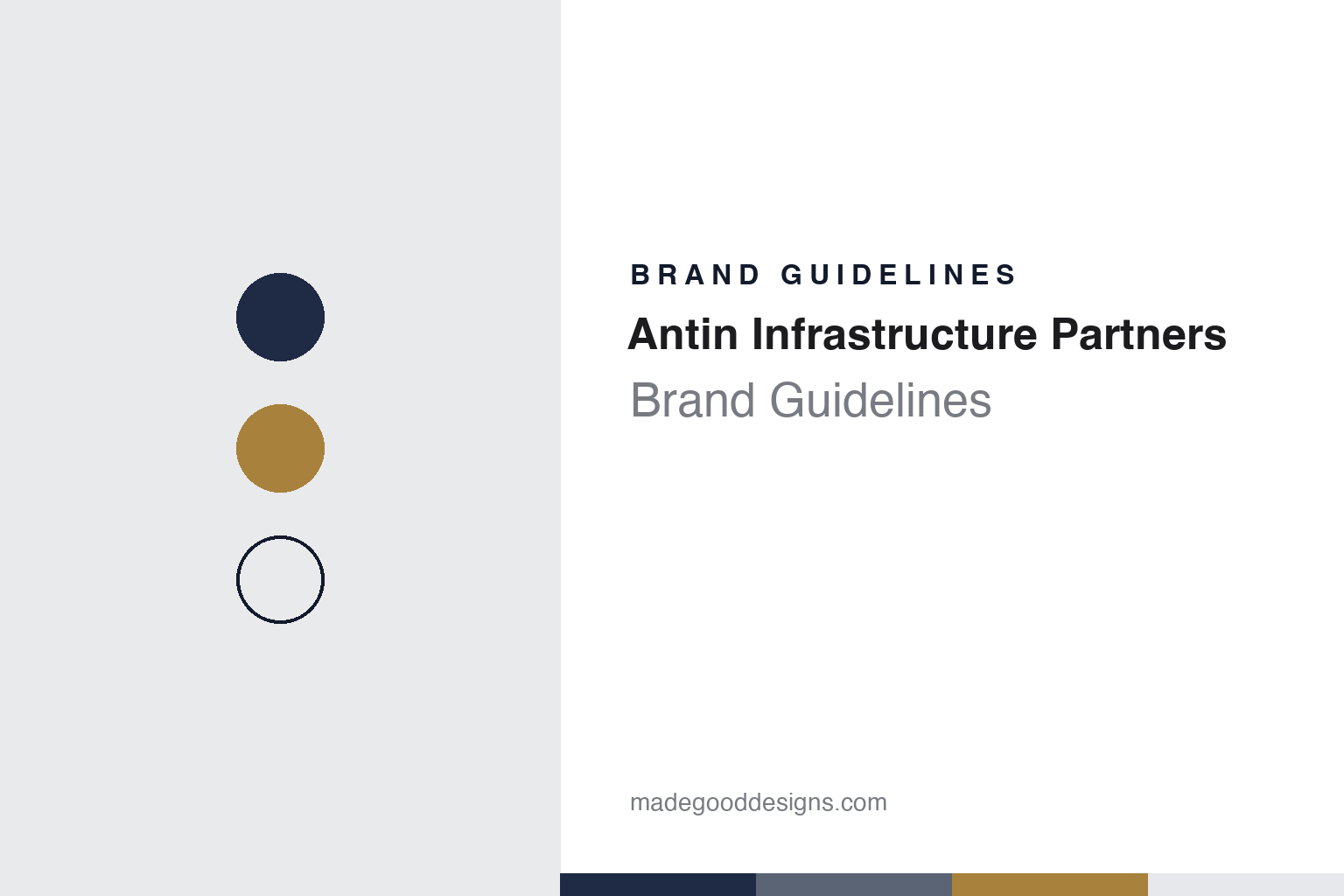
Antin Infrastructure Partners Brand Guidelines
A 2007 Paris partnership that listed its own shares in 2021.
Aa
Two constants: a navy, slate and brass palette and an institutional sans register. Abstract homage — not an Antin asset or mark; no logo or portfolio image is reproduced.
A Paris partnership
Two founders, a bank sponsor and a stock listing.
Antin Infrastructure Partners was founded in Paris in 2007 by Alain Rauscher and Mark Crosbie, the company says, beginning as a small team with the idea of applying a value-added investment strategy to infrastructure in Europe. English and French Wikipedia both record that the firm was initially sponsored by BNP Paribas, and that in 2012 it bought out the bank’s 40 per cent stake, leaving the partnership independent.
Its own timeline reads as a list of fund closes. Fund I launched in 2008 and reached its final close in 2010; Fund II launched in 2013 and closed in 2014; Fund III had its first and final close in 2016; and Fund IV closed in 2020. A Mid Cap Fund I followed in 2021, a NextGen Fund I in 2023 and Flagship Fund V in 2024. Today the company groups its funds into three strategies, which it calls Flagship, Mid Cap and NextGen, and invests in Europe and North America across energy and environment, digital, transport and social infrastructure.
In September 2021 Antin listed its own shares on Euronext Paris; French Wikipedia dates the first day of trading to 24 September 2021. It has stayed majority-owned by its partners. In September 2026 The Globe and Mail, carrying a TipRanks report, described it as a Paris-listed, majority partner-owned manager with more than 250 staff in six offices, and noted that its free float had widened for the second time since the listing after current and former partners placed shares with investors. Rauscher is chairman and chief executive and Crosbie vice chairman, the company says, and it names offices in Paris, London, New York, Seoul, Melbourne and Luxembourg.
Colour
Pipelines, trains, heat networks and nurseries.
Antin’s portfolio reads as a tour of essential services. English Wikipedia records investments in the Andasol 1 and 2 solar plants in Spain in 2011, sold in 2017; the UK motorway-services company Roadchef in 2014; the Central Area Transmission System, a North Sea gas pipeline system bought from BG Group in 2014 and 2015; the German laboratory group Amedes in 2015; the French clinic group Almaviva Santé in 2017; and the Norwegian wellboat operator Sølvtrans from 2018. In 2018 it also bought the French energy-services company Idex and invested in the UK fibre builder CityFibre. In August 2019 it sold a minority stake in Eurofiber, a Dutch fibre-optic network it had bought in 2015, to PGGM. In 2014, the encyclopedia adds, it owned a third of the rolling stock on Britain’s railways.
Later deals widened the mix. In late 2019 Antin carved out Veolia’s district-energy business in the United States to create Vicinity Energy, based in Boston, which now serves buildings in 12 American cities, the company says. In late 2020 it bought the French nursery operator Babilou, and in 2021 Pulsant, a data-centre provider. In June 2024, English Wikipedia says, Shepherd Building Group sold its Portakabin business to Antin. French Wikipedia adds two sales: the psychiatric-clinic group Inicea to Korian in October 2020, and Amedes in 2021.
The firm also puts its name to academic work. English Wikipedia notes that it sponsors a research chair in private equity and infrastructure at HEC Paris and a chair in infrastructure finance at Bocconi University in Milan.
Typography
How infrastructure investors present themselves.
Infrastructure investors sell something hard to picture: long-term ownership of things other people use every day. Their websites therefore lean on the assets themselves. Macquarie Asset Management’s pages open on named portfolio companies, from a New Zealand telecoms provider to an onshore wind farm in north-eastern Brazil, and Brookfield Infrastructure sorts its portfolio into utilities, transport, midstream and data, with ports, railways, toll roads and pipelines named as the things it owns and runs.
The language is consistent too. Brookfield Infrastructure speaks of “critical infrastructure” and long-life assets with contracted and regulated revenues; Macquarie Asset Management says it seeks results “over the long term.” Responsible-investment wording sits alongside it: Macquarie’s purchase of the former UK Green Investment Bank in 2017, renamed Green Investment Group, came with a green “special share” held by independent trustees, according to the UK government’s announcement of the sale.
Listed vehicles add another layer of documents. Brookfield Infrastructure publishes quarterly results, supplemental information, letters to unitholders and investor-day presentations, and in 2026 it set out a plan to fold its two listed securities into one. Parent groups publish annual reports and history timelines; Macquarie’s runs from a three-person Sydney office in 1969 to the motorway deal of 1994 that it calls the start of its infrastructure business.
Trade rankings are part of the picture. Infrastructure Investor’s II 100 list of managers placed GIP, by then part of BlackRock, at the top in November 2024, and noted that Macquarie, first in every earlier edition, had dropped to fourth. This guide sets out what can be checked about each firm — who founded it, who owns it and how it presents its portfolio — and marks clearly what rests only on the company’s own word.
Aa
An institutional sans for a listed partnership. (Specimen set in Manrope, a sans STAND-IN; NOT the Antin logo.)
Antin
Four pillars and a year of exits.
2026 has been a year of exits for Antin. In July it agreed to sell a minority stake in Sølvtrans to GLIL, and its third-quarter update of 5 November 2026 says the sale of that 30 per cent stake closed during the quarter. Two larger exits are pending. On 5 August 2026 Antin entered exclusive negotiations with the Infrastructure Investments Fund for the full sale of Idex, a company founded in 1963 and based near Paris; the November update expects completion in the first quarter of 2027. On 30 September 2026 it agreed to sell a majority stake in Vicinity Energy to Harrison Street Asset Management, which the same update expects to close in the first half of 2027. Neither sale was completed at the time of writing.
The firm describes itself in plain, institutional terms. Its founding-principles page names four pillars — partnership, accountability, discipline and entrepreneurship — and says that team members invest their own money alongside fund investors, that investment decisions are reviewed by all managing partners and partners, that the same team stays with each investment from acquisition to sale, and that it invests in fewer than one in ten of the opportunities it reviews. Its strategy page speaks of operational improvement, active capital management and “downside protection.”
For a design guide, Antin Infrastructure Partners shows how a listed manager can present pipelines, trains, heat networks and nurseries as the work of one disciplined partnership. Compare EQT, another European manager that listed its own shares, and Ardian, a fellow Paris investor. For this guide we use a deep navy, a slate and a brass with a sans, an unofficial interpretation; no product or logo is reproduced.
Explore & save
Keep Antin Infrastructure Partners’s identity on hand — save it to a board in the Made Good inspiration library.
Antin Infrastructure Partners identity set
Pin the Antin navy, slate and brass palette and the institutional sans register to your own board.