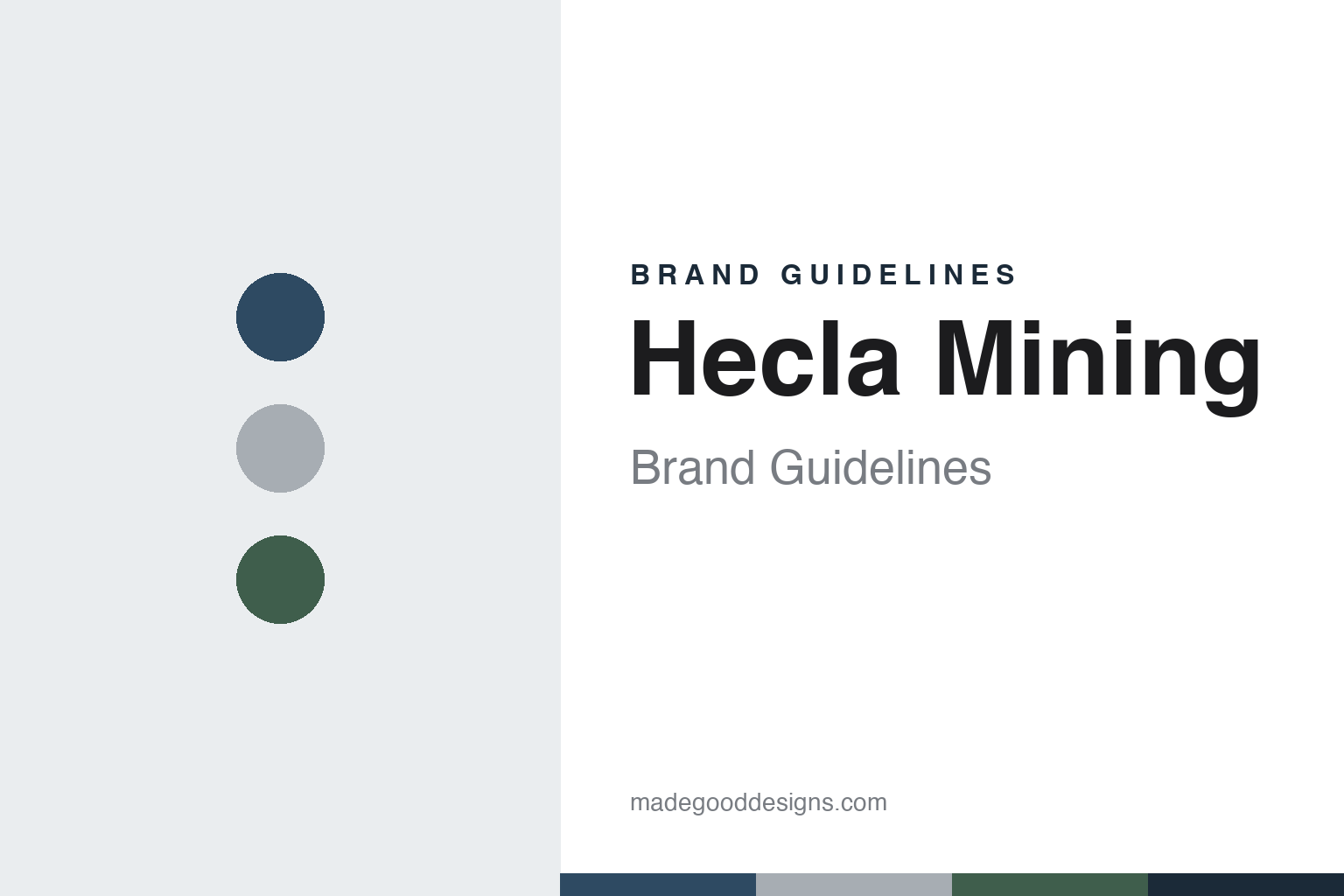
Hecla Mining Brand Guidelines
An 1891 Idaho silver company, told through shafts, districts and dates.
Aa
Two constants: a slate blue, silver and spruce palette and a mining sans register. Abstract homage — not a Hecla Mining product or mark; no logo, mine image or nameplate is reproduced.
Burke, 1891
A claim, three partners and the Silver Valley.
Hecla Mining is one of the oldest names in American mining. The company says it was founded in 1891 by Amasa Campbell, Patsy Clark and John Finch in Burke, Idaho, in the Coeur d’Alene Mining District of the Silver Valley, and was incorporated in Idaho on October 14, 1891. English Wikipedia traces the Hecla claim itself to May 1885 and says Clark, who owned it outright by the middle of 1891, formed the company that September. A new Hecla Mining Company was incorporated in Washington State on July 12 — in 1898 according to the company’s own timeline, in 1899 according to Wikipedia.
The early decades followed the fortunes of the district. Hecla paid its first dividend in July 1900, moved its offices from Spokane to Wallace, Idaho, in 1904, and on September 23, 1915 its shares began trading on the New York Curb Exchange, later the American Stock Exchange, the company says. Wikipedia records a fire in July 1923 that burned most of Burke’s business district and Hecla’s surface plant, which was rebuilt in concrete and steel, and the start of Hecla’s control of the Polaris mine in 1930; in 1934, it adds, Newmont took a 10 percent share of the Polaris company. The last ore was hoisted from the original Hecla mine in July 1944.
The mine that would carry the company forward was the Lucky Friday, near Mullan. According to Wikipedia, the Lucky Friday Silver-Lead Mines Company was organised in 1939 and shipped its first ore in January 1942; Hecla began buying its shares in 1958 and merged with it in 1964. On December 21, 1964 Hecla moved its listing to the New York Stock Exchange, after 49 years on the American Stock Exchange. Later mergers brought in Day Mines in 1981 and Ranchers Exploration in 1984; Hecla reincorporated in Delaware in 1983 and in 1986 opened a head office north of Coeur d’Alene, Wikipedia says.
Colour
Greens Creek, Lucky Friday and Keno Hill.
Hecla describes itself as the largest silver producer in both the United States and Canada and the oldest silver company on the NYSE; English Wikipedia also calls it the largest silver mining company in the United States. Its operations are three underground mines. The Greens Creek mine on Admiralty Island, about 20 miles south of Juneau, Alaska, lies within the Admiralty Island National Monument and is reached by boat; Wikipedia dates its discovery to the mid-1970s and its first concentrate production to 1989. Hecla took full ownership in 2008 by buying the Rio Tinto subsidiaries that held the rest of the joint venture, and reports that Greens Creek produced 8.7 million ounces of silver in 2025, along with gold, zinc and lead.
The Lucky Friday in Idaho is a deep silver, lead and zinc mine whose concrete-lined Silver Shaft, Wikipedia says, reaches about 6,200 feet. The company says its internal #4 Shaft reaches 9,600 feet below the surface, and that the mine produced 5.26 million ounces of silver in 2025. In 2023 Hecla received the Society for Mining, Metallurgy & Exploration’s Robert E. Murray Innovation Award for 2022, for the Underhand Closed Bench mining method it developed at the mine and has patented in the United States, the company says.
The third mine, Keno Hill in Canada’s Yukon, came with the purchase of Alexco Resource Corp., announced on July 5, 2022 and completed on September 7, 2022, according to Hecla. The company says the district lies within the traditional territory of the First Nation of Na-Cho Nyak Dun, with whose development corporation it has business agreements, and that Keno Hill produced 3.02 million ounces of silver in 2025. The exploration properties listed on its website range from the Silver Valley and Republic, Washington, to San Juan Silver in Colorado and the Rackla district of the Yukon.
Typography
How silver miners present themselves.
Silver miners speak mainly to investors, governments and the communities around their mines, and their visual identities tend to follow from that audience. Palettes lean on metallic greys and silvers, often paired with a deep blue or slate, sometimes warmed by an earth tone drawn from rock or desert. Typography is usually a plain sans or a sober serif, set for long reports rather than for packaging, because there is no consumer product on a shelf to sell.
Photography carries much of the identity. Company websites and annual reports tend to show mills, headframes, haul roads and open pits set against mountain or desert landscapes, alongside portraits of workers in protective gear and views of nearby towns. Maps matter too: a miner’s portfolio is a set of places, and operation pages are commonly organised mine by mine and country by country, each with its location, ownership share, processing facilities and expected mine life.
Numbers form a second visual language. Mineral reserves and resources statements, quarterly production reports and guidance tables are published on fixed calendars, and their charts, tonnages and grades are repeated across press releases and investor presentations. Because these figures are regulated disclosures, they tend to look alike from company to company, and the brand shows mostly in the colour of a chart or the cover of a report.
The third strand is sustainability. Most listed miners keep pages on water, tailings management, energy use, community relations and human rights, often with downloadable reports and lists of the standards they say they follow. For a designer, the category is a study in restraint: a consistent palette, a clear type hierarchy and careful photography do most of the work, and the identity must hold together across a website, a technical report and a slide shown to analysts.
Aa
A plain, sturdy sans for a company that tells its story in dates and depths. (Specimen set in Archivo, a sans STAND-IN; NOT the Hecla Mining logo.)
Hecla Mining
A gold detour, a valley’s record and a narrower focus.
For a time Hecla was also a gold producer. It bought Aurizon Mines in 2013, taking full ownership of the Casa Berardi gold mine in Quebec, and in March 2018 acquired Klondex Mines, with the Fire Creek, Midas and Hollister mines in Nevada, according to the company and Wikipedia. It then narrowed again. On January 26, 2026 Hecla announced the sale of the subsidiary that owned Casa Berardi to Orezone Gold, and on March 25, 2026 it said in a press release that the sale had been completed.
The Silver Valley’s mining past is also part of the record. In 1983 the Environmental Protection Agency designated the area a Superfund site because of contamination from a century of mostly unregulated mining, English Wikipedia says. A suit filed in 1991 by the Coeur d’Alene Tribe under the federal Superfund law, later joined by the United States and the state of Idaho, was settled by Hecla in June 2011, with the settlement funds dedicated to restoration and remediation in the Coeur d’Alene Basin. In 2023, Wikipedia adds, Hecla agreed to take corrective action to settle Environmental Protection Agency findings, from inspections beginning in 2019, about the disposal of lead-containing items at Greens Creek.
Today Hecla is based in Coeur d’Alene, Idaho. Its website, in English and French, is organised by mine, with production figures, reserves and resources tables, sustainability pages on water, tailings and community relations, and investor presentations; its homepage opens with the word “Established” and a legacy dated to 1891.
For a design guide, Hecla Mining shows how a company of more than 130 years can tell its story through dates, shafts and districts rather than a single image. Compare Coeur Mining, another United States silver producer, and Newmont, which took a share of the Polaris company in 1934. For this guide we use a deep slate blue, a silver grey and a spruce green with a sans, an unofficial interpretation; no product or logo is reproduced.
Explore & save
Keep Hecla Mining’s identity on hand — save it to a board in the Made Good inspiration library.
Hecla Mining identity set
Save the Hecla Mining slate blue, silver and spruce palette and the mining sans register to your own board.


