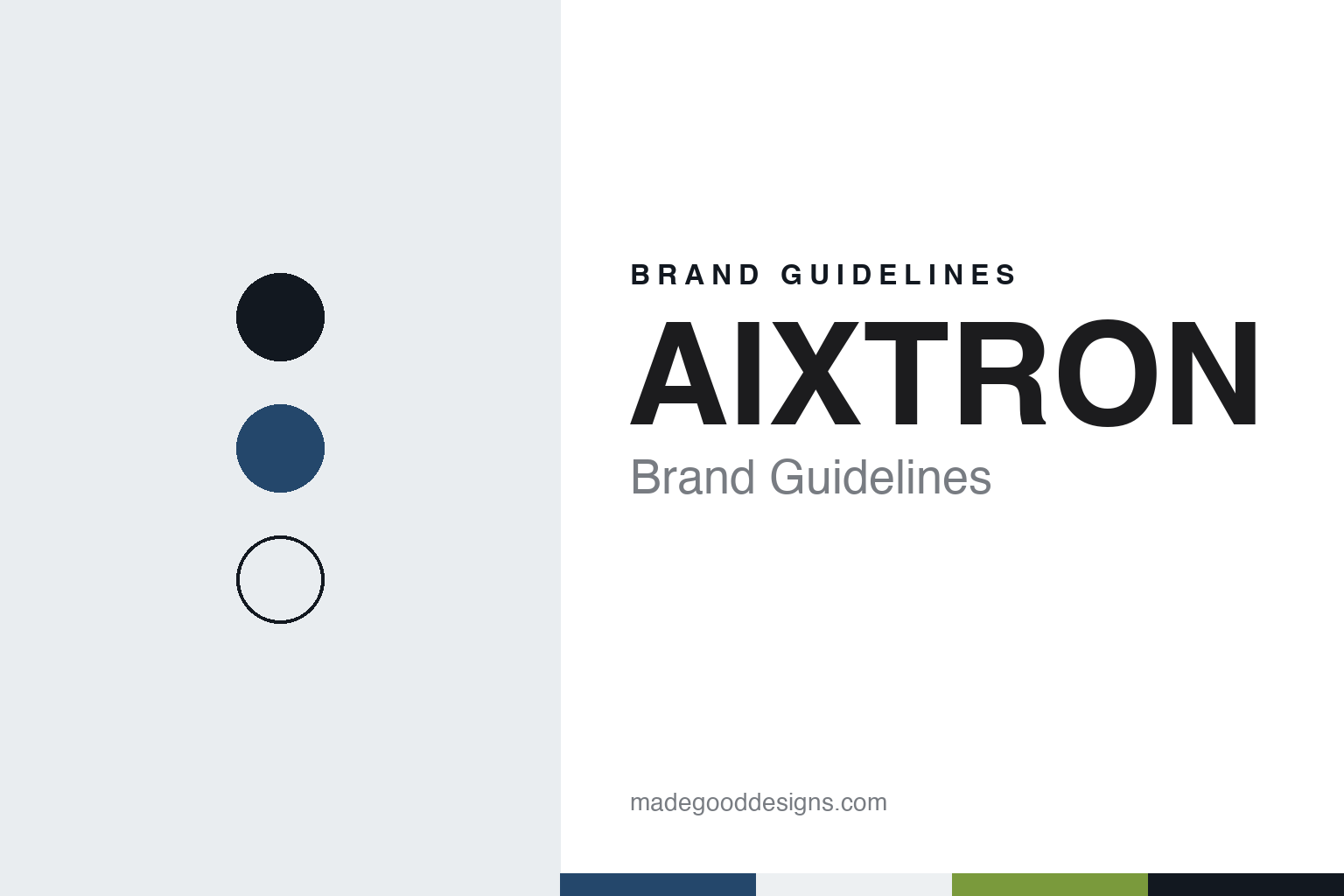
AIXTRON Brand Guidelines
An Aachen university spin-off that built reactors for compound semiconductors.
Aa
Two constants: an AIXTRON blue, silver and green palette and a technical sans register. Abstract homage — not an AIXTRON product or mark; no reactor, logo or nameplate is reproduced.
Aix-la-Chapelle and electronics
A spin-off from RWTH Aachen.
AIXTRON came out of a university laboratory. The company says it was founded in 1983 by staff of the Institute for Semiconductor Technology at RWTH Aachen University, and it names three founders: the physicist Holger Jürgensen, Meino Heyen and Heinrich Schumann. German Wikipedia names Jürgensen as founder and gives Aachen as the place the company began; English Wikipedia also describes it as a spin-out from the university. Jürgensen’s motto, as the company quotes it, was “The future belongs to optoelectronics.”
The name is a piece of local geography. According to the company, “AIXTRON” joins Aix-la-Chapelle, the French name for Aachen, with “electronics.” The company writes the name in capitals, and German Wikipedia notes the capitalised spelling as the company’s own; the legal name is Aixtron SE.
Its business was a method called metal-organic chemical vapour deposition, or MOCVD, in which gases are used to grow thin crystal layers of compound semiconductors such as gallium arsenide and indium phosphide on a wafer. The company says Jürgensen and Heyen built the first MOCVD research system at RWTH Aachen “for a market that did not even exist at the time,” and that the first AIXTRON MOCVD system was commissioned in 1985. German Wikipedia says the range was extended in the early 1990s to systems for gallium nitride, which German Wikipedia links to power and high-frequency electronics, and the company says it delivered its first deposition system for producing blue LEDs in 1994.
Colour
Planetary reactors and showerheads.
Two reactor designs run through AIXTRON’s history. In 1989 the company took an exclusive licence from Philips for Planetary Reactor technology, it says, and English Wikipedia explains the principle: gases are deposited on wafers that revolve as they are coated. In 1999 it bought the scientific equipment division of the British firm Thomas Swan, bringing in the “Close Coupled Showerhead” method, and the same year it took over Epigress of Sweden, which added silicon carbide deposition; both still operate as AIXTRON subsidiaries, according to the company.
More purchases followed. In March 2005 AIXTRON merged with Genus, an American maker of atomic layer deposition equipment, and in 2007 it bought Nanoinstruments, a nanomaterials developer spun out of the University of Cambridge, English Wikipedia says. In 2017 it sold its memory-chip deposition line, made in Sunnyvale, California, to the Korean company Eugene Technology. The organic LED business was placed in a subsidiary, APEVA, in October 2017; German Wikipedia says APEVA’s operations ended in 2022.
The company lists milestones as it tells them: a German industry innovation award in 1988, the 2,000th MOCVD system delivered to Changelight in 2011, and industry awards for the G5+ reactor in 2013. In 2023 it launched the G10-GaN and G10-AsP systems, which it says completed its G10 family alongside the G10-SiC. Its products are used to make LEDs, lasers and power electronics, according to German Wikipedia.
Manufacturing sites are in Herzogenrath, near Aachen, and in Cambridge in Britain, English Wikipedia says. The company says it opened a 16,000-square-metre research and development centre in Herzogenrath in 2010 and an Innovation Center there in 2024.
Typography
Machines behind glass.
Semiconductor equipment makers sell to a small circle of customers: the chip manufacturers that run wafer fabs. Their machines deposit, etch, measure, test and package, and they are rarely seen outside a cleanroom. That shapes how these companies present themselves. The product is a large enclosed tool, and what happens inside it takes place at a scale no camera can show directly.
So the pictures tend to repeat. Corporate sites and annual reports show tools standing in rows behind glass, with panelled housings in white, pale grey or blue, and cleanroom staff in full gowns, hoods and gloves. A polished wafer held up to the light in a gloved hand is a familiar image, because it stands in for the chips the machines help to make. Fab interiors, lit evenly and seen down long corridors, give a sense of size and order.
Words do much of the work that pictures cannot. Makers describe their processes by name — atomic layer deposition, epitaxy, metal-organic chemical vapour deposition, wire bonding, wafer inspection — and give their tool ranges short product names and model numbers. Company histories, milestone lists and timelines are common, since many of these firms began as university spin-offs, sales agents or divisions of larger groups, and changed hands or split along the way.
Trade fairs remain a meeting point for this industry. SEMICON West and SEMICON Taiwan are among the shows where equipment makers set up stands, present new tools and meet customers. For a design guide, the pattern is a disciplined, technical register: cool colours, precise product names and photographs of clean, closed machines.
Aa
A technical sans for a capitalised name. (Specimen set in Archivo, a sans STAND-IN; NOT the AIXTRON logo.)
AIXTRON
A listing, a bid and an order.
AIXTRON went public in November 1997 on the Frankfurt Stock Exchange’s Neuer Markt, a segment that no longer exists, and German Wikipedia says its shares were also listed on Nasdaq from March 2005 until 30 December 2016. In December 2010 it converted from a German Aktiengesellschaft to a European company, a Societas Europaea, to reflect its international nature, English Wikipedia says. The company says it joined the MDAX index in 2020.
In 2016 the company agreed to be bought by a German subsidiary of a Chinese fund, Fujian Grand Chip Investment Fund. According to a Dechert client alert of 14 December 2016, the German economics ministry reopened its review of the deal after security concerns were passed on by the United States, and on 2 December 2016 President Barack Obama issued an order, on the recommendation of the Committee on Foreign Investment in the United States, blocking the purchase of AIXTRON’s American business. The order covered only the American business, but the buyer announced on 8 December that it was abandoning the whole purchase. Dechert noted that it was only the third time a US president had blocked an acquisition on national security grounds since the committee was set up in 1975.
The company stayed independent and listed. It is based in Herzogenrath, in North Rhine-Westphalia, and has research labs and branch offices in China, Britain and the United States, with sales and service offices in Japan, Korea and Taiwan, it says. The company says it switched its power supply entirely to renewable energy in 2019.
For a design guide, AIXTRON shows how a name built from a city’s French form and a technical suffix can carry a university spin-off into a listed company. Compare ASM International, another European deposition-equipment maker, and Applied Materials. For this guide we use a mid blue, a pale silver and a green with a sans, an unofficial interpretation; no product or logo is reproduced.
Explore & save
Keep AIXTRON’s identity on hand — save it to a board in the Made Good inspiration library.
AIXTRON identity set
Pin the AIXTRON blue, silver and green palette and the technical sans register to your own board.