Anna Atkins made a book in which the plants draw themselves. Instead of hiring an engraver, she pressed seaweeds flat on treated paper, left them in the sun and washed the sheet in water. What came back was a white shape on a field of strong blue, with every frond and filament at full size. For designers, Anna Atkins is a lesson in how one process, one colour and one rule of layout can carry a whole publication, and her plates still read as clean, modern graphics.
For more cleared works from museum collections, browse the MGD museum inspiration collection.
Who was Anna Atkins?
Encyclopaedia Britannica gives her birth as Anna Children on 16 March 1799 in Tonbridge, Kent, and her death on 9 June 1871 at Halstead Place in Kent; the Metropolitan Museum of Art and the J. Paul Getty Museum both record her dates as 1799–1871. Her father, John George Children, was a scientist, and Britannica notes that he was secretary of the Royal Society and associated with the British Museum. The Getty’s scholarly essay on her fern album describes him as her scientific partner as well as her father.
According to Britannica, she made drawings in her early twenties for her father’s translation of Lamarck’s Genera of Shells (1823), and her main interest was botany. She married John Pelly Atkins in 1825. Britannica also says that, through her father’s links with the Royal Society, she knew of the photographic experiments of William Henry Fox Talbot and the astronomer and chemist Sir John Herschel.
The cyanotype process, in plain terms
Britannica dates Herschel’s cyanotype process to 1842 and explains how it works. Paper is coated with ferric ammonium citrate and potassium ferricyanide. An object laid on the sheet blocks the light; the exposed areas, once the paper is washed in plain water, turn a deep blue, while the covered areas stay pale. Britannica adds that the same chemistry later became blueprinting, the standard way to copy architectural and engineering drawings.
There is no camera and no negative. The Cleveland Museum of Art describes Atkins placing plants directly on light-sensitive paper and exposing them, producing what it calls cameraless photographs, later known as photograms. For a botanist, the gain was accuracy: the outline, branching and texture of a specimen are recorded at true size, with nothing interpreted by a draughtsman’s hand.
Photographs of British Algae: how the book was made
Britannica says the first part of the work appeared in 1843 and that by 1850 she had produced twelve further parts; over the next three years she completed it with 389 captioned photograms and several pages of text. The Met dates its copy to 1843–53. Britannica counts about a dozen known copies, and the Getty essay notes that the algae book, unlike her later fern album, was made in multiple copies and given to friends and institutions.
The Cleveland Museum of Art calls the 1843 book the first illustrated with photographs and the earliest use of photography in a scientific publication. Britannica frames it more broadly, as the first sustained effort to show that photography could be both scientifically useful and pleasing to the eye. Whichever way it is put, the design achievement is the same: a whole book printed by sunlight, sheet by sheet.
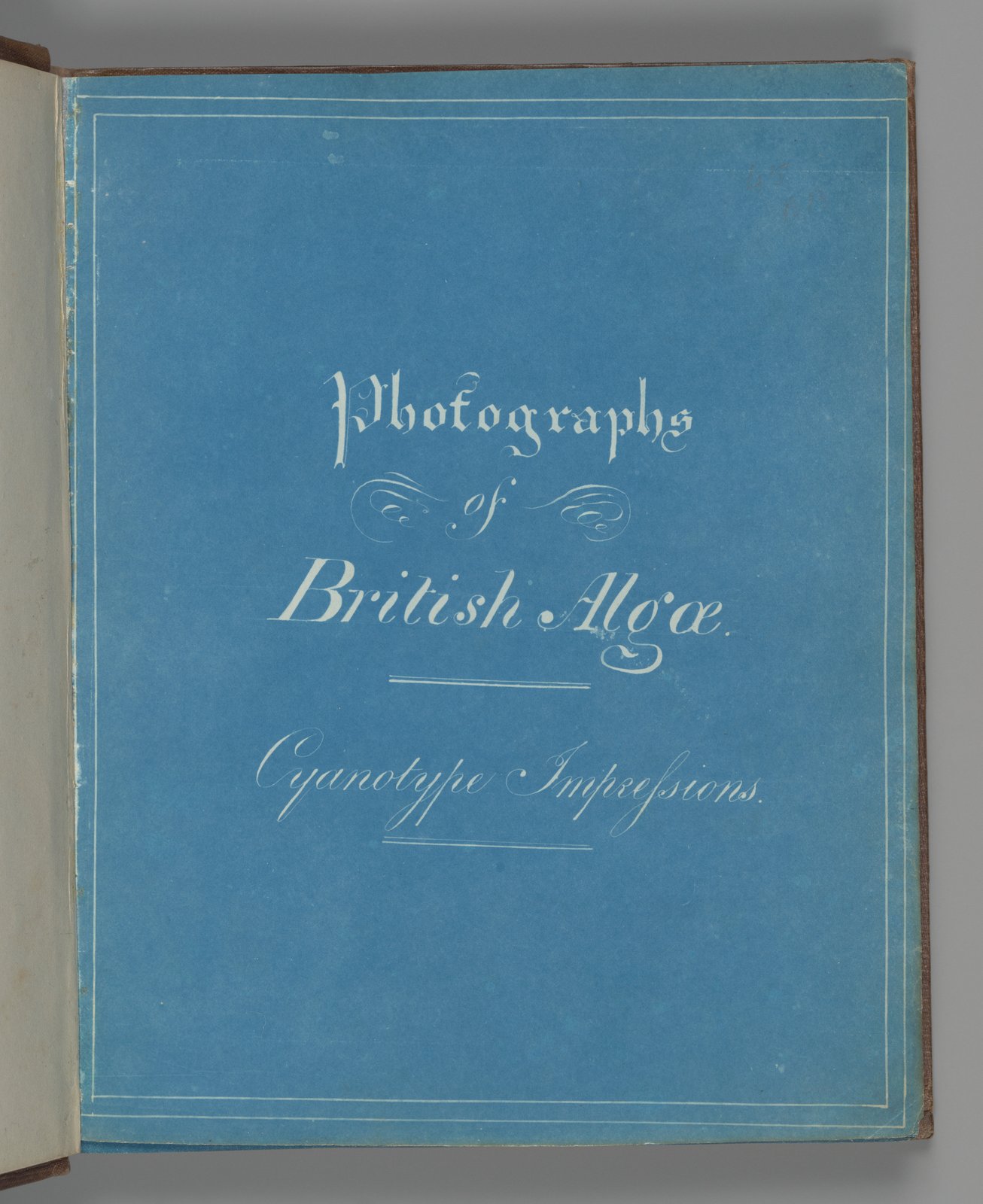
Look at the title page above. Atkins did not set type. The lettering, a looping script for Photographs and British Algæ with a smaller, lighter line for Cyanotype Impressions, comes out white on blue, which means it was made the same way as the plates: something opaque blocked the light where each letter falls. The Met’s copy also includes cyanotype pages for the contents, an appendix, errata and a two-page dedication, so even the book’s apparatus shares the single colour of the plates.
What to look at in her plates
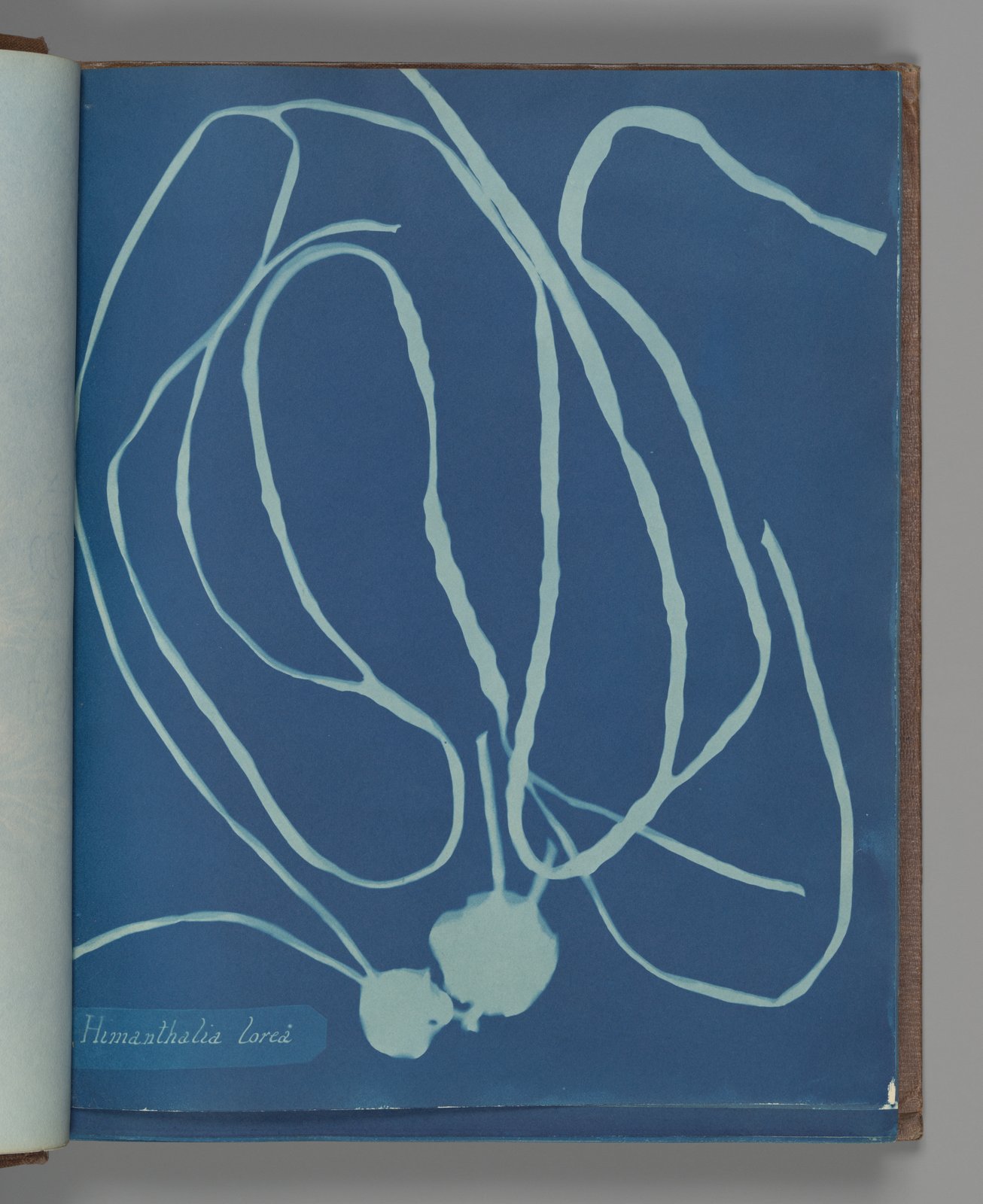
The silhouette is the drawing. In Himanthalia lorea, long straps of seaweed loop across the page like a single unbroken line. Where a frond is thicker, less light got through and the shape is whiter; where it thins, the blue creeps in. The result is a drawing with built-in tonal variation, not a flat cut-out.
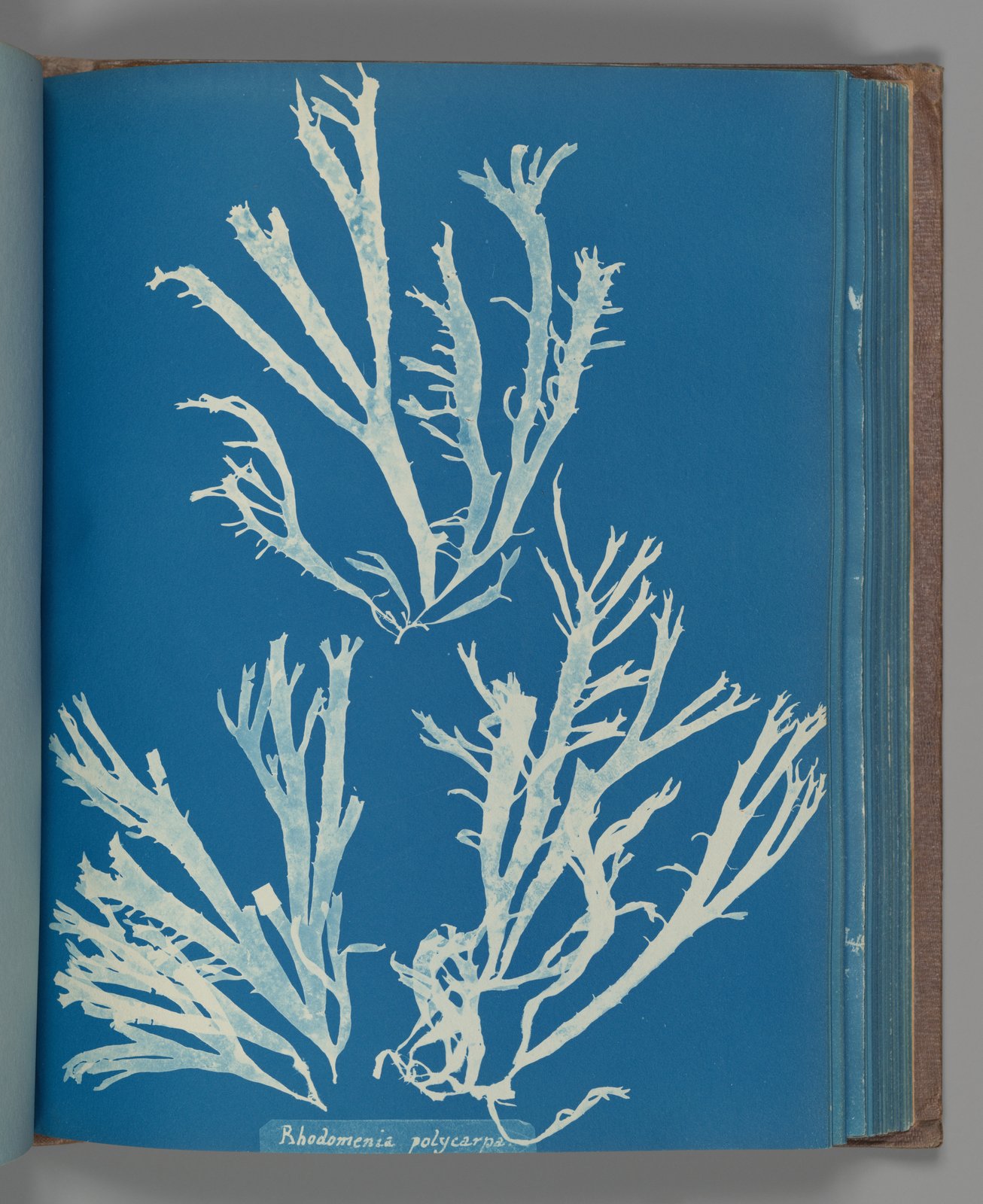
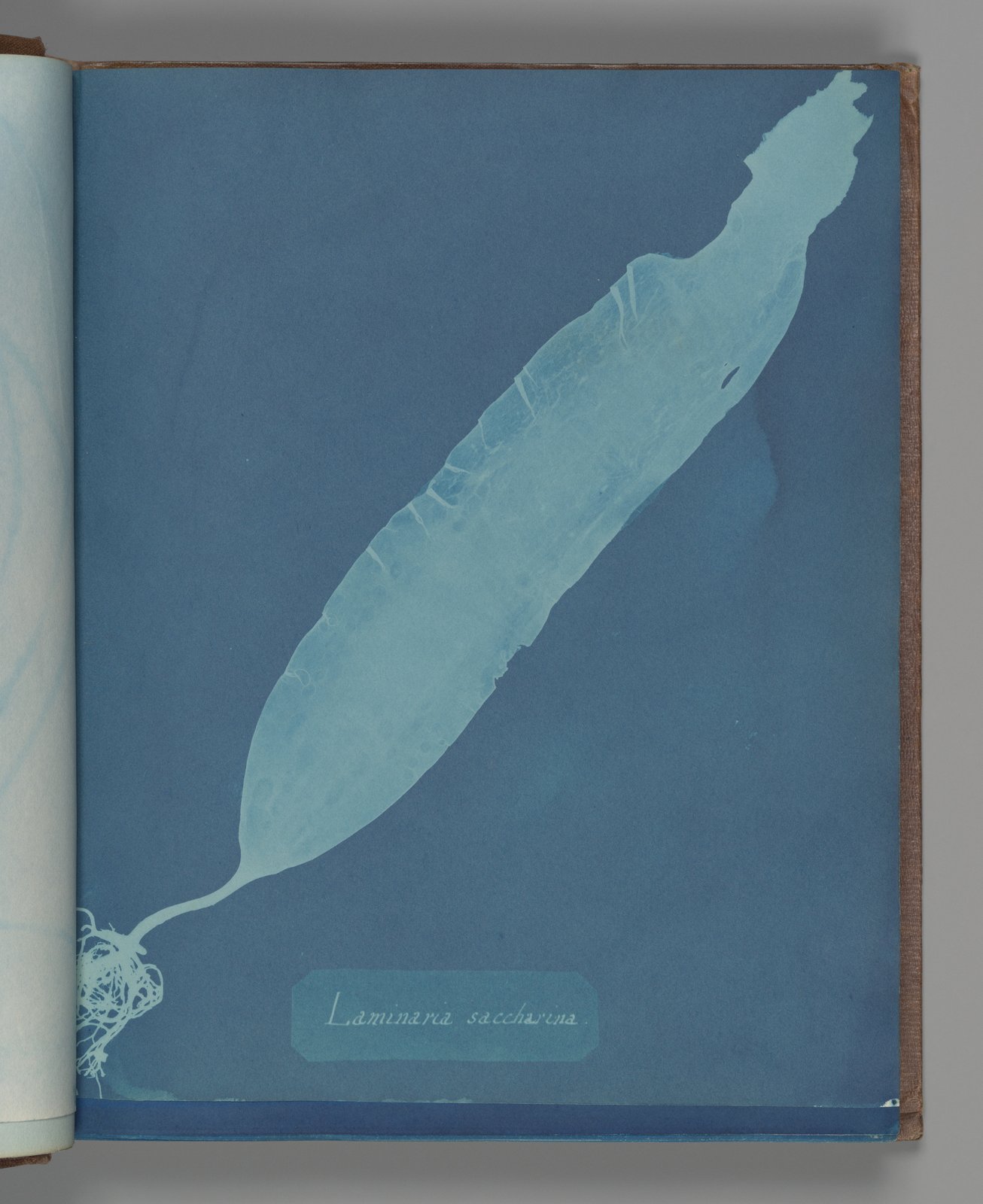
The specimen sets the composition. Atkins arranged each specimen to fill the sheet. Branching red algae such as Rhodomenia Polycarpa spread across the page in clusters, while a single kelp blade in Laminaria saccharina runs on a diagonal from corner to corner. The rectangle stays constant; the shape inside it changes plate to plate, which keeps a long sequence lively.
Small labels, one hand. Most plates carry a short handwritten Latin name near the bottom edge, printed white like the specimen. The captions are tiny compared with the plant, a clear hierarchy that lets the image lead.
Anne Dixon, ferns and flowering plants
After the algae, Atkins turned to land plants. The Getty’s essay by Carolyn Peter (2019) on Cyanotypes of British and Foreign Ferns, dated 1853, says she most likely made these later albums with her close friend Anne Dixon. Peter records that Dixon stayed at Halstead Place in the summer of 1852 to support Atkins after her father’s death earlier that year, and cites the historian Larry Schaaf’s suggestion that Dixon began assisting and making her own cyanotypes then or the following summer. The essay adds that it is hard to tell who made which plates. The Getty album has 100 plates, and its cover carries the gilt inscription “A. D. to H. D. 1853”; Dixon later gave it to her nephew, the photographer Henry Dixon. Britannica separately mentions a related 1854 album, Cyanotypes of British and Foreign Flowering Plants and Ferns, possibly made with Dixon.
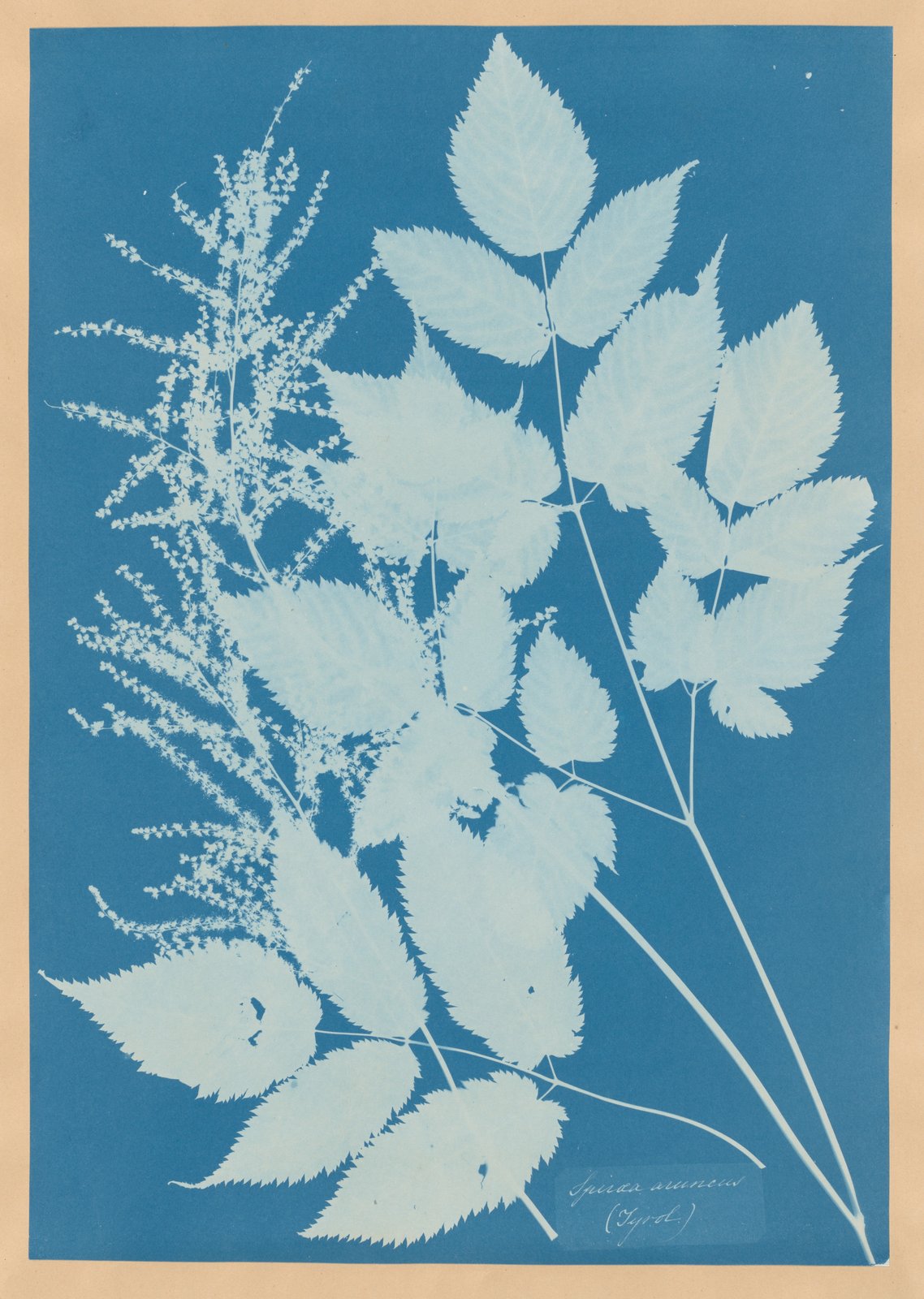
The Met’s Spiraea aruncus (Tyrol), dated 1851–54, shows the change of subject. Feathery flower plumes and serrated leaves overlap, so the white shapes now have depth: where two leaves cross, the double layer prints whiter still.
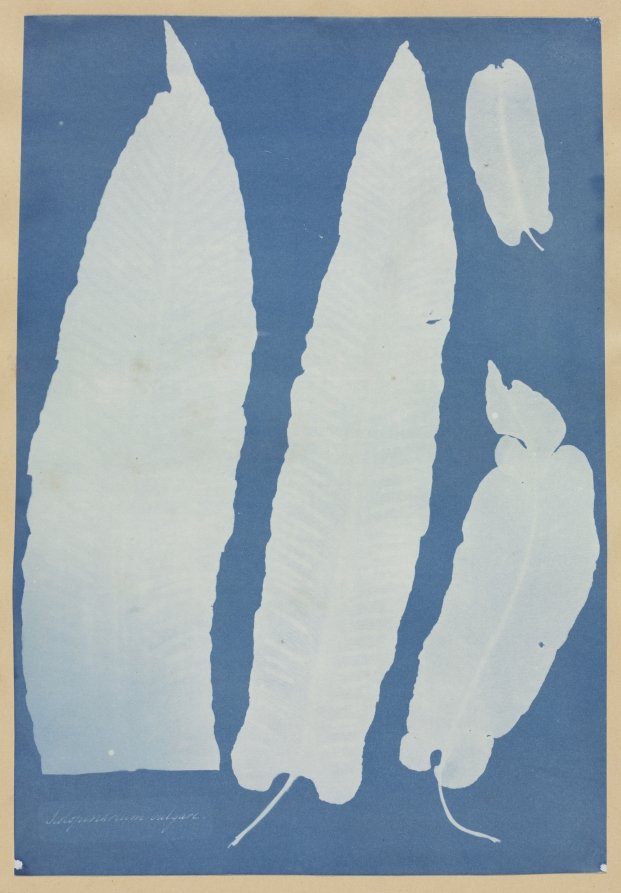
The Cleveland Museum of Art’s Scolopendrium Vulgare (1852–54), a hart’s-tongue fern, is the simplest of all: a few long, tongue-shaped leaves side by side, close to pure flat shapes. For the wider tradition of plant imagery, see our guide to botanical illustration and the botanical theme in the museum collection.
The Anna Atkins palette
Cyanotype gives one colour, Prussian blue, in many strengths. Measured from the Met’s scan of Spiraea aruncus, the deep ground is a strong cyan-blue (#36799b) and the pale plant shapes sit near a cool grey-green (#baccc9). The title page scan reads a little softer, around #4b7d9a. These figures describe photographs of aged sheets, not the original chemistry, and the blue of a cyanotype shifts with light exposure and storage, so treat them as a starting point. You can build out a set of tints in our colour palette generator.
How designers can borrow Anna Atkins’s ideas
Commit to one colour. A single blue with white gives instant identity. For packaging, editorial series or a brand system, a monochrome ground with reversed-out shapes is cheap to print and easy to recognise across many items.
Let the object be the image. Photograms work because the subject is the mark. Scanned leaves, flat-lay product shots on a solid ground, or cut-paper silhouettes all borrow the same honesty. Keep the shapes at or near true size where you can.
Use hand lettering sparingly. Atkins kept her script for the title and small labels. A single handwritten line, reversed out of the background colour, can carry personality without fighting the image.
Design the whole set, not one page. Her contents, errata and dedication share the look of the plates. Treat covers, captions and index pages as part of one system.
Try the process. Cyanotype paper and kits are widely sold for classrooms, and the method is a quick way to make textures for posters or textile prints. Later artists followed the same idea of the plant as pure form; compare the close-up plant photographs of Karl Blossfeldt.
Frequently asked questions
What is Anna Atkins known for?
She is known for Photographs of British Algae: Cyanotype Impressions, issued in parts from 1843 and completed by about 1853, a book of cyanotype photograms of seaweeds. The Cleveland Museum of Art describes it as the first book illustrated with photographs.
What is a cyanotype?
A cyanotype is a photographic print made with iron salts. Britannica explains that paper coated with ferric ammonium citrate and potassium ferricyanide turns deep blue where light reaches it after washing in water, which is why Atkins’s plants appear white on blue.
Did Anna Atkins work with Anne Dixon?
Yes, most likely on the later albums. The Getty’s essay says Atkins probably made her fern and flowering-plant albums with her close friend Anne Dixon, though it is hard to say who made individual plates.
Can I use Anna Atkins’s cyanotypes in my work?
The Metropolitan Museum of Art flags the plates shown here as public domain, and the Cleveland Museum of Art releases Scolopendrium Vulgare under CC0, which is why they appear in this guide. Check each museum’s own terms for any other copy.


