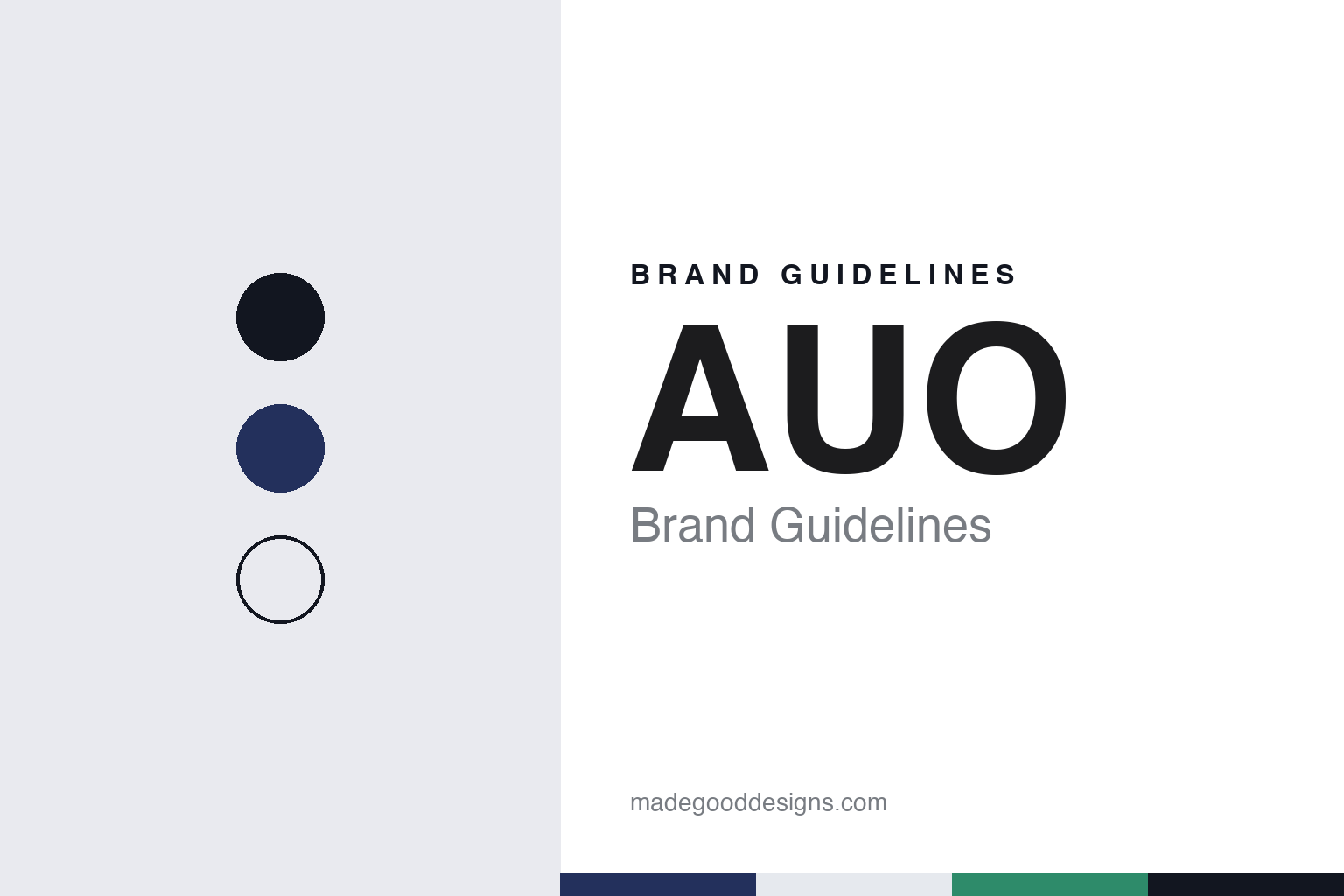
AUO Brand Guidelines
The Taiwanese panel maker formed from Acer Display and Unipac.
Aa
Two constants: an AUO indigo, glass grey and green palette and a Technical sans register. Abstract homage — not an AUO product or mark; no panel, logo or nameplate is reproduced.
Two mergers
From Acer Display Technology to AU Optronics.
AUO began as part of the Acer group. Both English and Chinese Wikipedia date its predecessor, Acer Display Technology — in Chinese 達碁科技 — to August 1996, and the company’s own website gives 1996 as its founding year. The business was listed on the Taiwan Stock Exchange in September 2000.
The name came with a merger. In September 2001 Acer Display Technology combined with Unipac Optoelectronics, in Chinese 聯友光電, and the merged company took the name AU Optronics, 友達光電 in Chinese, according to both Wikipedia editions. Chinese Wikipedia adds that it listed shares in New York under the ticker AUO in May 2002, and that it applied in September 2019 to delist those American depositary shares.
A second merger followed in October 2006, when AU Optronics took over Quanta Display, 廣輝電子. Chinese Wikipedia says the two mergers gave the company production lines across generations for large, medium and small panels; it lists plants in Taoyuan, Taichung and Kaohsiung in Taiwan, and in Suzhou, Xiamen and Kunshan in China.
The company now trades as AUO Corporation, the name in the footer of its website. A press release it issued on 2 April 2024 carries a Hsinchu dateline, and the company describes itself as “based in Taiwan” with operations across Asia, the United States and Europe.
Colour
From panels to cockpits.
Panels remain the core. English Wikipedia lists a run of moves beyond them: AUO entered the solar business in December 2008; set up module-plant joint ventures with Changhong in Sichuan in June 2009 and with TCL in China in April 2010; bought AFPD, the Singapore subsidiary of Toshiba Mobile Display, in July 2010; and formed an OLED alliance with Idemitsu in Japan in February 2012. Chinese Wikipedia adds that the company opened a research centre, the AUO Technology Center, at the Hsinchu Science Park in 2002. In December 2020 its 9.4-inch high-resolution flexible Micro LED display received an innovative product award from the Hsinchu Science Park, the same source says, and in May 2021 the company set up AUO Display Plus for industrial and commercial displays.
The company’s next big move was into cars. On 2 October 2023 AUO agreed to buy Behr-Hella Thermocontrol, the German maker of automotive control panels and climate-control systems, and on 2 April 2024 it announced that it held the whole company, according to the AUO release reproduced on the German firm’s website. In that release AUO said it was “transitioning from a display supplier to a comprehensive solutions provider in smart mobility,” and that it would combine the German company’s human-machine interfaces with its own automotive displays and Micro LED work.
The company’s own description is broad. Its website says it pursues a “Biaxial Transformation Strategy” — “Go Premium” for display technology and “Go Vertical” for applications — built on three pillars: Display, Mobility Solutions and Vertical Solutions. Under display it names Micro LED and Mini LED backlights; under vertical solutions it groups retail, healthcare, education and enterprise, energy and materials businesses, among them ComQi, Space4M, JohnRyan and Avocor. It gives its workforce as 41,000 people.
It also presents itself through sustainability. The company says it joined the RE100 renewable-energy initiative in 2022 as the first enterprise in the global display manufacturing industry to do so, and that it was selected for the World Economic Forum’s Global Lighthouse Network; we give both as AUO’s own statements. Its website describes the company culture as a “Gung Ho” belief in enthusiastic teamwork.
Typography
Display makers in public.
Display-panel makers sell to other companies, so most people meet their work under someone else’s name: the screen in a phone, a television, a laptop or a car dashboard. Their own identities are built for customers, investors and engineers, and they come into view most clearly at trade shows such as the Society for Information Display’s Display Week in the United States and CES in Las Vegas, where makers book large stands to show what their panels can do.
The visual language of those stands is the product itself. Huge curved screens, rollable televisions that rise out of a base and transparent panels set in shop windows or furniture sit beside foldable phones photographed mid-fold and car cockpits wrapped in a single sweep of glass. Close-up photography does the rest: macro shots of red, green and blue sub-pixels, flexible films bent between two fingers and wafer-thin edges seen side-on.
Behind the show floor sits the factory. Company films and reports often show clean fab halls, workers in full-body suits and large sheets of glass substrate carried by robot arms, with plants described by “generation,” a measure of the glass size each line handles. Industry awards add another layer of presentation: Display Week’s Display of the Year awards and CES Innovation Awards appear in the makers’ own timelines.
Their histories run through joint ventures, factory sales and regulatory cases as much as through product launches. This guide sets out what can be checked about each one — who founded it, who owns it and where its panels are made — and marks clearly what rests only on the company’s own word.
Aa
A technical sans — a three-letter name that began as a ticker. (Specimen set in Inter Tight, a sans STAND-IN; NOT the AUO logo.)
AUO
A cartel case and a change of course.
AUO was one of the companies in the LCD panel cartel cases. On 8 December 2010 the European Commission fined six panel makers, among them AU Optronics, for a cartel that it said ran from October 2001 to February 2006. The Commission said the companies met around 60 times, mainly in hotels in Taiwan, in what they called “the Crystal meetings,” and agreed prices and exchanged planning information; AU Optronics’ fine was reduced by 20 percent for cooperating with the investigation.
In the United States the case went to trial. A jury in the Northern District of California found AU Optronics, its American subsidiary and two former executives guilty of a price-fixing conspiracy under the Sherman Act, and English Wikipedia says the company was sentenced in September 2012. In an opinion filed on 10 July 2014, the US Court of Appeals for the Ninth Circuit affirmed all the convictions and AU Optronics’ sentence; the court described the conspiracy as running from October 2001 to January 2006, a month shorter than the European dates.
Its recent statements describe a wider company. The website speaks of mobility and vertical markets alongside panels, and the 2024 release presents the purchase of a German car-electronics maker as part of a shift from display supplier to smart-mobility solutions provider.
For a design guide, AUO shows how a company formed by mergers can settle on a short three-letter name and widen its business around it. Compare Innolux, another Taiwanese panel maker named in the same European decision, and HannStar, another Taiwanese panel maker named in that case. For this guide we use an indigo, a glass grey and a green with a sans, an unofficial interpretation; no product or logo is reproduced.
Explore & save
Keep AUO’s identity on hand — save it to a board in the Made Good inspiration library.
AUO identity set
Pin the AUO indigo, glass grey and green palette and the Technical sans register to your own board.