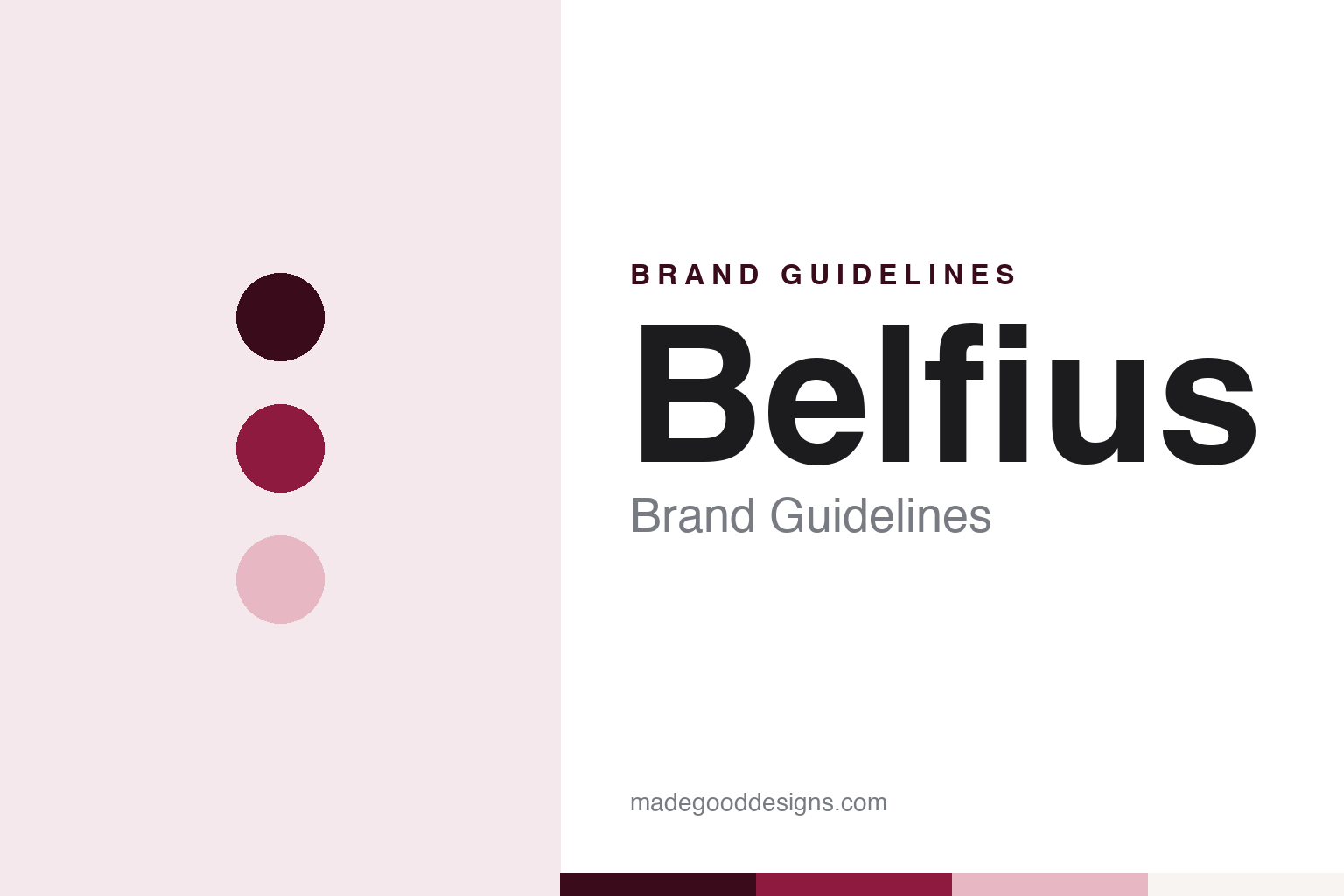
Belfius Brand Guidelines
Gemeentekrediet, Dexia and a 2012 name.
Aa
Two constants: a raspberry and claret palette and an open humanist sans register. Abstract homage — not a Belfius asset; no logo, card or campaign design is reproduced.
A bank for the municipalities
Lending to towns, then to savers.
Belfius began as a bank for Belgium’s towns and villages. The Gemeentekrediet van België, or Crédit Communal de Belgique in French, was founded in 1860 to finance local authority investment, English Wikipedia says; municipalities that wanted to borrow had to buy shares in the bank. The sources used for this guide do not say how the Gemeentekrediet operated during the occupation of 1940–1944.
After the war it turned towards the public. In 1947 it began building a network of retail branches to take savings from households, and from 1960 those branches were run by independent agents, which let them offer a wider range of products. The bank also began collecting art after the Second World War: VRT NWS reported in 2018 that the Gemeentekrediet and Paribas Bank België started buying valuable works to keep national heritage from leaving the country.
International growth started in 1990, with a private bank in Luxembourg and a stake in the Banque Internationale à Luxembourg, raised to a majority in 1992. A second line of the family tree runs through the labour movement’s cooperative, founded in 1924, which became BACOB bank and later Artesia Banking Corporation.
Colour
Dexia, a state purchase and a new name.
In 1996 the Gemeentekrediet merged with Crédit Local de France to form Dexia, a Franco-Belgian group focused on lending to the public sector, listed in Brussels and Paris from 1999. The group grew abroad: it took control of the Italian public-sector lender Crediop in the late 1990s, bought Financial Security Assurance in the United States in 2000 and the Turkish bank DenizBank in 2006, English Wikipedia says. In 2001 Dexia bought Artesia, and its Belgian banking arm, Dexia Bank Belgium, absorbed the BACOB branches from 2002.
The group ran into trouble in 2011. After heavy withdrawals in early October, the Belgian and French governments decided to split it, and on 10 October 2011 the Belgian state’s purchase of Dexia Bank Belgium was announced. On 1 March 2012 the bank was renamed Belfius, and on 19 March Dexia’s shares left the BEL 20 index. Dutch and English Wikipedia both explain the name as a blend of “Bel” for Belgium, “fi” for finance and the English word “us.”
Belfius remains in public hands. 7sur7, carrying a Belga report on 21 September 2026, said the bank is wholly owned by the Belgian state through its federal holding company, and that the government had agreed a plan to sell at most a fifth of its capital; Belfius announced changes to its capital and dividend policy that it said depend on that sale being confirmed and signed. A partial privatisation had first been decided in 2017, Dutch Wikipedia says, either through a stock-market listing or a sale to a strategic investor, but did not go ahead; the government approved the sale of a fifth of the shares in December 2025 and decided in June 2026 that it would not take the form of a stock-market listing. The sale had not been completed at the time of writing.
The bank has kept buying as well. English Wikipedia says Belfius took a stake of about a third in the asset manager Candriam, which Dexia had created in the 1990s, in May 2025, and bought the French insurer Leocare in June 2026. Its main activities, Dutch Wikipedia says, are lending to the public sector, financial services for individuals and businesses, and insurance.
Typography
Design and documentation.
Banks in the Netherlands, Belgium and Luxembourg tend to present themselves with restraint. The usual starting point is a clear sans-serif wordmark, often paired with a simple symbol, set in one or two strong colours. Green, orange, red and blue recur across the region, and many of the names are short: initials, contractions of older merger names, or a single coined word that is easy to say in more than one language.
The messages behind those marks often go back to how the banks are owned and what they say they stand for. Cooperative banks put their members and local roots up front, savings banks and state-owned banks point to their public role, and a growing number of banks lead with sustainability, publishing impact reports alongside their annual reports. Several of today’s names were formed by mergers, and their identities have had to carry two or more histories at once.
Language shapes the design work too. Dutch, French and English often sit side by side, and in Luxembourg Luxembourgish and German join them, so type has to stay readable across longer words, accents and switching between languages on the same page. Photography is usually kept to a minimum, with plain layouts, generous white space and simple icons doing most of the work on websites and in apps.
The pages people visit most are practical ones: everyday banking, savings, mortgages, business accounts and the mobile app. Behind them sit the formal documents, from annual and impact reports to investor pages, where the same colours and type carry a more sober tone. For a designer, the region shows how a bank can stay recognisable through colour and a short name while keeping its interface quiet and functional.
Aa
An open, friendly sans for a bank that speaks of optimism. (Specimen set in Manrope, a sans STAND-IN; NOT the Belfius logo or house typeface.)
Belfius
Optimism as a purpose.
Belfius now frames its brand around one line. On 30 March 2026 it presented Strategy 2030, which it describes as a unified bank-insurer with “four brands under one purpose,” and that purpose is “Unlocking potential with optimism.” A brand campaign, Be Unstoppable, carries the idea to the public; in a press release of 29 April 2026 the company said the campaign speaks to entrepreneurs and households with a plan, and that “1 in 3 Belgians relies on Belfius.” Dutch Wikipedia says its insurance arm has included the DVV brand since 2023.
Culture and sport are part of the picture. VRT NWS described the Belfius art collection in 2018 as the largest collection of Belgian art in the country, with more than 4,300 works drawn from the Gemeentekrediet, Paribas Bank België and BACOB, including works by Rubens, Jordaens and Paul Delvaux, arranged in three parts: Flemish masters of the 16th and 17th centuries, modern art from 1860 to 1960, and contemporary art since 1960. Once shown at Passage 44 in Brussels, it had moved to the top floors of the Belfius Tower nearby. In football, Dutch Wikipedia says, Belfius was Club Brugge’s main sponsor until the 2013–14 season, and the club’s training complex at Westkapelle, near Knokke-Heist, opened as Belfius Basecamp on 17 June 2019.
For a design guide, Belfius shows how a bank can take a new name after a crisis and build a purpose-led identity around it. Compare KBC, another Brussels bank-insurer, and BNP Paribas Fortis. For this guide we use a raspberry red, a deep claret and a soft blush with a sans, an unofficial interpretation; no product or logo is reproduced.
Explore & save
Keep Belfius’s identity on hand — save it to a board in the Made Good inspiration library.
Belfius identity set
Save the Belfius raspberry and claret palette and the open humanist sans register to your own board.