Bharat Petroleum Brand Guidelines
An Indian refiner built on the business of Burmah-Shell.
Aa
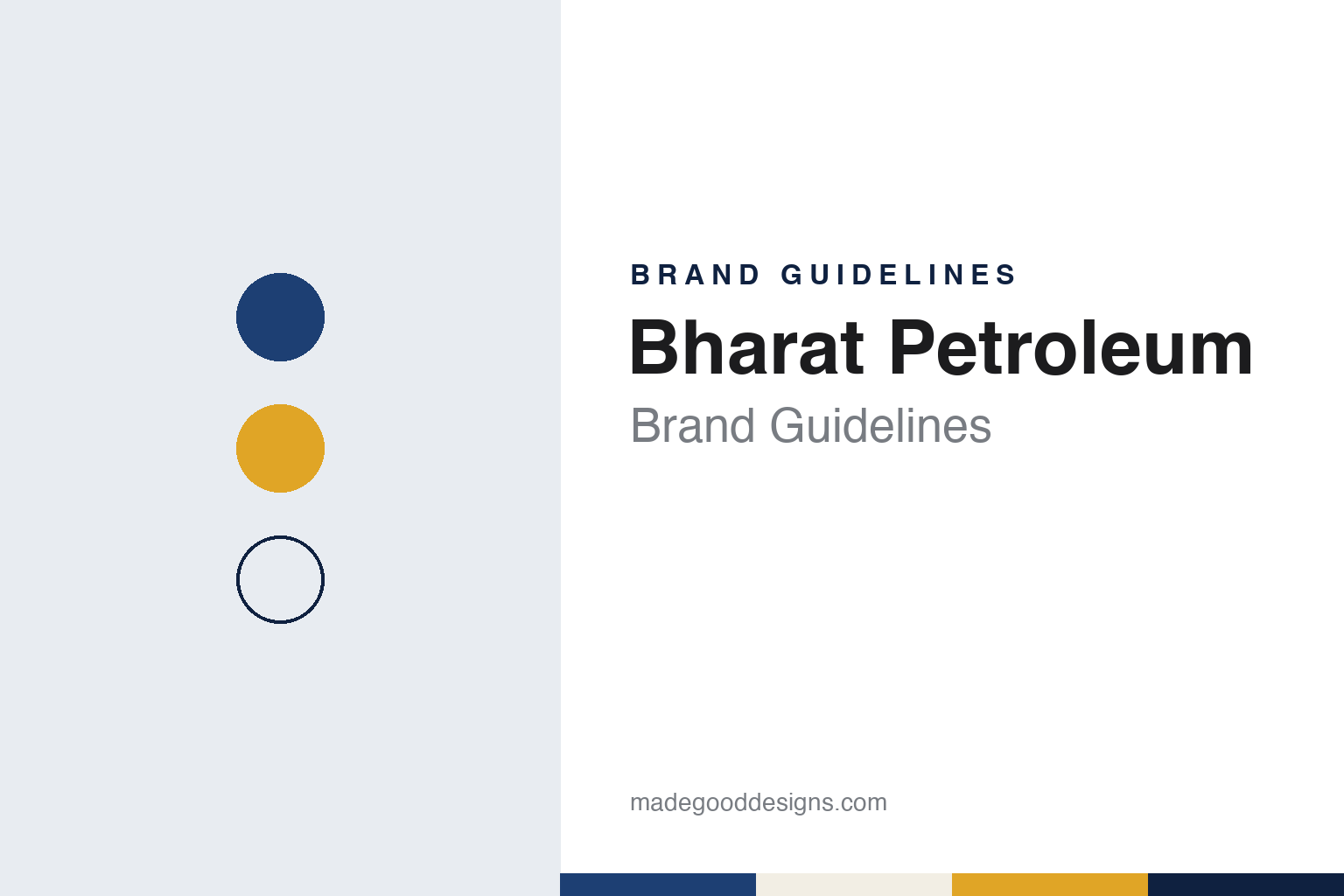
Two constants: a blue, gold and cream palette and a plain grotesque sans register. Abstract homage — not a Bharat Petroleum product or mark; no logo, cylinder or station sign is reproduced.
Burmah-Shell
A Glasgow oil company, Shell and kerosene tins.
Bharat Petroleum grew out of a British business. The Burmah Oil Company was founded in Glasgow in 1886, English Wikipedia says, to develop oil fields in Burma and the Indian subcontinent, and in most of India it marketed its products through a joint venture with Shell. Bharat Petroleum’s own history dates that venture to 1928, when Asiatic Petroleum (India), a marketing company formed by Royal Dutch, Shell and the Rothschilds, joined Burmah Oil to form the Burmah-Shell Oil Storage and Distributing Company of India.
The company tells the Burmah-Shell story as one of distribution. It says Burmah-Shell began by importing and marketing kerosene, carried in four-gallon and one-gallon tins across India, and promoted kerosene stoves and lamps so that villages would buy the fuel. It says Burmah-Shell built India’s first drive-through fuel station in 1928, introduced LPG as a cooking fuel in Indian homes in the mid-1950s, and moved aviation fuel by bullock cart before airport hydrant systems arrived; these are the company’s own claims.
The Indian business changed hands in 1976. On 24 January 1976, the company says, Bharat Refineries Limited, wholly owned by the public sector, took over Burmah-Shell’s interests in India, including its refinery and its national marketing organisation; a newspaper advertisement that day carried the new company’s first greetings to the nation. Bharat Refineries was later renamed Bharat Petroleum Corporation Limited. Burmah Oil itself went on to buy Castrol in 1966 and, as Burmah-Castrol, was bought by BP Amoco in 2000, English Wikipedia says.
Colour
A logo chosen in 1977.
Bharat Petroleum dates its logo precisely. The company says it selected a new logo on 18 November 1977. It notes that the mark is commonly seen as “golden drops of oil,” but traces its idea to the ancient Chinese symbol of yin and yang, the paired forces of light and dark, and to the diagram that shows them turning in a continuous cycle; that reading is the company’s own.
The consumer brands sit under that mark. On the forecourt, the company says, it runs more than 25,000 fuel stations under its Pure for Sure promise, with premium petrol sold as Speed and Speed 100, convenience stores under the In & Out name, the SmartDrive app and loyalty schemes called PetroBonus and SmartFleet. Indian Chemical News reported on 1 September 2026 that the network reached 25,323 outlets in the 2025–26 financial year and that BPCL’s fast chargers for electric vehicles passed 4,500 outlets.
Cooking gas has its own name. Bharatgas, the LPG brand, uses the motto “Cook Food Serve Love,” the company says. Lubricants are sold as MAK Lubricants, which the company says come from four blending plants and are supported by an R&D centre in Mumbai; Indian Chemical News reported MAK sales of 428 thousand tonnes in 2025–26.
The same report gives a sense of how far the brand now reaches beyond fuel. It said BPCL held a 27.3 per cent share among India’s public-sector oil marketing companies, that its BeCafe outlets numbered 212, and that Bharatgas had launched Bharatgas Lite ZIP, a lighter 10-kilogram composite LPG cylinder. Its aviation business, the report added, sold a record 2.2 million tonnes of fuel in the year.
Typography
Refineries, forecourts and fuel cards.
Refiners and fuel marketers sit between the oil field and the driver, and their identities have to work at very different scales. The same name may appear on a refinery gate, the side of a tanker truck, a forecourt canopy, a pump display, a lubricant bottle and a page of an investor presentation, so marks tend to be simple shapes and short words that survive distance, weather and night lighting.
Much of the public image is still built on the forecourt. Station brands carry the colour and the logo, while the company behind them may run several names at once: Phillips 66, for example, says it sells fuel in the United States under the Phillips 66, Conoco and 76 brands and in Britain under JET. Payment cards, loyalty schemes and apps extend the forecourt to the phone; Phillips 66 promotes one app, Fuel Forward, across its three US brands.
Lubricants give refiners a second, shelf-sized identity. Bottles and drums are often sold under their own names rather than the corporate one, such as Indian Oil’s Servo or Phillips 66’s Kendall, and they sit beside competitors in shops and workshops, where a pack has to be recognised quickly.
The newest part of the story is told in announcements and reports. Companies present renewable diesel, sustainable aviation fuel and electric-vehicle charging through press releases, sustainability pages and investor material; Phillips 66 describes converting a California refinery to renewable fuels, and Indian Oil has added charging points at its fuel stations. Safety pages, refinery photographs lit at night and annual reports complete a register that is usually more technical than the forecourt. The guides in this group set out what can be checked about each company: its origins, owners, plants and brands.
Aa
A plain grotesque sans for a public-sector fuel brand. (Specimen set in Libre Franklin, a sans STAND-IN; NOT the Bharat Petroleum logo.)
Bharat Petroleum
Three refineries and a sale that was called off.
Bharat Petroleum refines oil at three sites: Mumbai, Kochi and Bina. The Kochi refinery in Kerala started in 1966 as Cochin Refineries Limited, a joint venture with the American company Phillips Petroleum, and was later renamed Kochi Refineries before becoming a unit of BPCL, the company says. The Bina refinery in Madhya Pradesh came through Bharat Oman Refineries: on 31 March 2021 BPCL bought the 36.62 per cent stake held by its partner OQ, formerly Oman Oil, taking full ownership, the Oil & Gas Journal reported.
The state’s plan to sell the company did not go ahead. In a stock exchange filing reported by DT Next on 10 June 2022, BPCL said the government had, by a letter dated 3 June 2022, called off the tender to sell its entire stake of about 53 per cent, after two of the three bidders withdrew; the company stopped all work on the sale, including its data room.
Plans now run in the other direction. At BPCL’s 73rd annual general meeting, Indian Chemical News reported on 1 September 2026, chairman Sanjay Khanna described expansion plans to take Kochi from 15.5 to 17 million tonnes a year and Bina from 7.8 to more than 11 million tonnes, a proposed refinery and petrochemical complex at Ramayapatnam in Andhra Pradesh at the pre-project stage, and a unit at Mumbai being developed to co-process renewable feedstock into sustainable aviation fuel. These are plans, not finished projects.
For a design guide, Bharat Petroleum shows how a company that took over a foreign marketer’s business can give it a new public face through one mark and a few consumer names. Compare Indian Oil and Hindustan Petroleum, two more of India’s public-sector fuel marketers. For this guide we use a harbour blue, a gold and a cream with a sans, an unofficial interpretation; no product or logo is reproduced.
Explore & save
Keep Bharat Petroleum’s identity on hand — save it to a board in the Made Good inspiration library.
Bharat Petroleum identity set
Pin the Bharat Petroleum blue, gold and cream palette and the plain grotesque sans register to your own board.