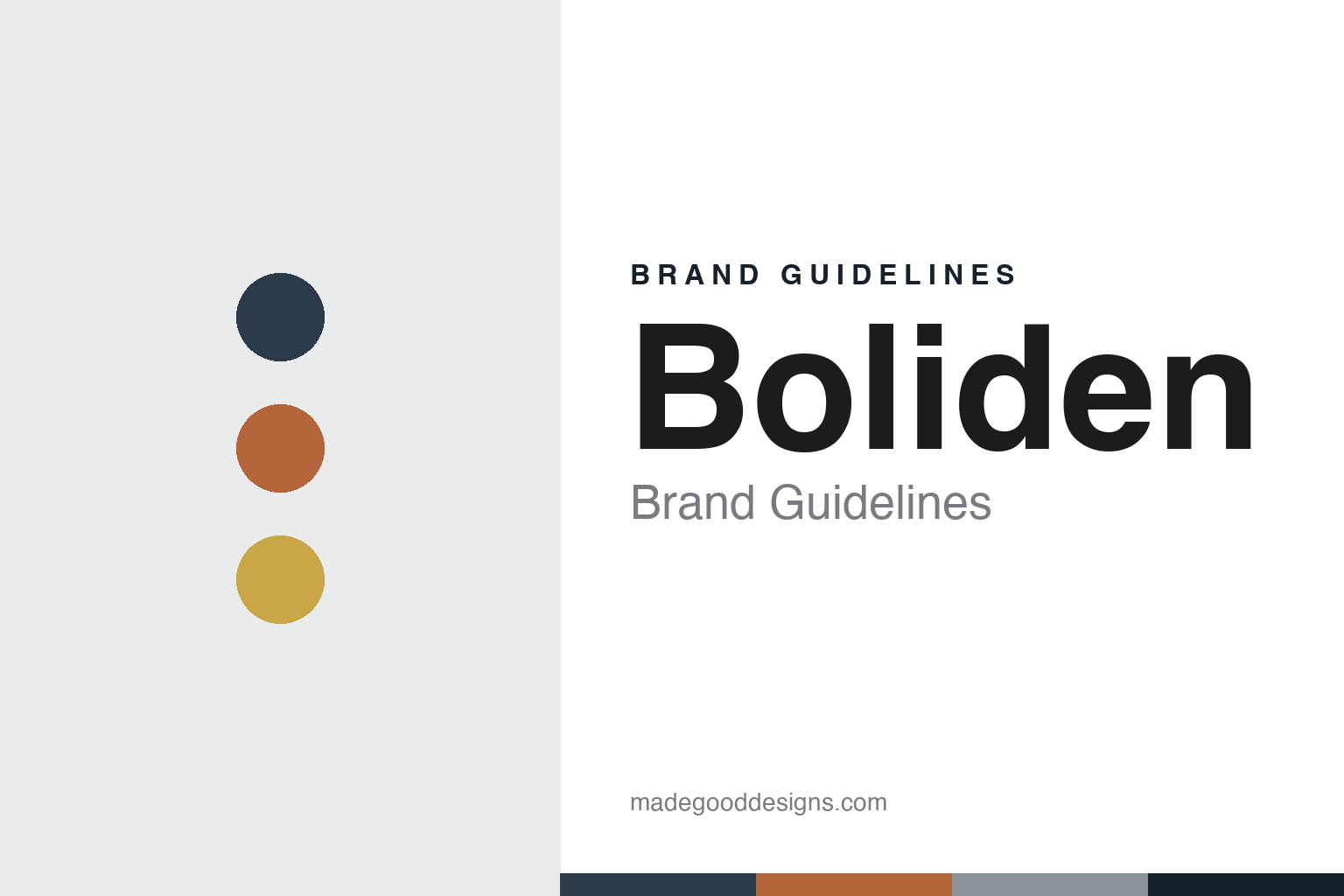
Boliden Brand Guidelines
A 1924 gold find, a coastal smelter and a century of metals.
Aa
Two constants: a slate, copper and gold palette and an industrial sans register. Abstract homage — not a Boliden product or mark; no logo, plant or site image is reproduced.
Fågelmyran, 1924
A drill core, a map misprint and a smelter on the coast.
Boliden takes its name from a mine, and the mine took its name from a mistake. Swedish Wikipedia says a misprint on the General Staff map turned Bjurliden, the farmstead where the deposit lay, into Boliden, and the name passed to the mine, the company and the town. The find itself came on 10 December 1924 at Fågelmyran, a little over 30 kilometres north-west of Skellefteå in Västerbotten. The company’s own history describes the moment the drilling stopped and the core came up rich in gold; it calls the deposit the start of what became, for some decades, Europe’s largest and richest gold mine. The ore also held copper and large amounts of silver.
The prospecting had begun earlier. English Wikipedia says Centralgruppens Emissionsbolag, majority-owned by Skandinaviska Banken, had been searching around Skellefteå since 1918. In May 1925, Boliden says, the bank took over the business and formed two companies, Västerbottens Gruvaktiebolag and Skellefteå Gruvaktiebolag. In 1931 they merged into Bolidens Gruvaktiebolag, the basis of today’s group. The driving force, Swedish Wikipedia says, was the mining engineer Oscar Falkman, who led the company until 1941. Boliden was part of Ivar Kreuger’s business group until 1932; English Wikipedia says the bank then took the shares back and held the company until it was listed on the stock exchange in 1952, and that a law restricting foreign ownership of Swedish mining companies, nicknamed “Lex Boliden” by the press, followed in the same period.
The ore was hard to treat. Boliden says it was rich in arsenic, and at the end of the 1920s only two smelters in the world, one in Germany and one in the United States, could handle it, and only in small amounts. In 1927 the company decided to build its own. It chose the coast near Skelleftehamn, with a port and a railway, joined the islands of Hamnskär and Rönnskär to each other and to the mainland, and started the smelter in 1930. Swedish Wikipedia says Skelleftehamn grew up as a company town around it. The first Boliden ore had been mined in the spring of 1926, and the original mine closed in 1967.
Colour
Mines, smelters and scrap.
The 1930s and 1940s took Boliden beyond gold. English Wikipedia says the company invested in copper, lead and some nickel in response to wartime demand, opening the Laver copper mine in 1936, Kristineberg in 1940 and the Laisvall lead mine in 1943, which ran until 2001. With oil and rubber scarce, Boliden says, it opened a 96-kilometre aerial ropeway in 1943 to carry concentrate from Kristineberg to Boliden; Swedish Wikipedia calls it the longest in the world at the time and says it ran for 44 years. In 1957 Boliden bought Zinkgruvor AB and with it Garpenberg in central Sweden, a mine the company dates back to 375 BC, and in 1968 it opened the Aitik open pit near Gällivare, which it describes as one of Europe’s largest copper mines.
Recycling became part of the identity early. Boliden says it launched the Kaldo furnace in the mid-1970s, opened its first lead Kaldo plant at Rönnskär, began buying electronic scrap for the furnace in 1981, and acquired the Danish lead recycler Paul Bergsöe & Son, now based in Landskrona. Swedish Wikipedia says a 2012 expansion made electronic-scrap recycling at Rönnskär one of the largest operations of its kind. Boliden reports that Rönnskär produced 266,000 tonnes of copper cathodes in 2025, along with zinc clinker, lead, gold, silver and sulphuric acid.
The smelter side grew in 2003, when Boliden took over the Harjavalta, Kokkola and Odda smelters and the Tara zinc mine in Ireland from Finland’s Outokumpu. Boliden’s history records that site’s past too: in 1944 Outokumpu moved its Imatra smelting plant west to Harjavalta, away from the war, work the company says was done by Russian prisoners of war; in 1949 metallurgists there developed the method now called flash smelting. Later steps added the Kevitsa copper and nickel mine in Finland in 2016, and in 2025 the Somincor (Neves-Corvo) mine in Portugal and Zinkgruvan in Sweden, both bought from Lundin Mining. Since 2021 Boliden has sold metals under a “Green Transition Metals” label, among them Low-Carbon Copper and Recycled Zinc. In 2022 it opened an underground repository for long-term waste at Rönnskär, and in 2023 the smelter’s tank house was destroyed by fire; Swedish Wikipedia says a new electrolysis plant is being built to replace it.
Typography
Category and register.
Platinum-group, nickel and zinc miners sell to refiners, carmakers, battery makers and investors rather than to shoppers, and their visual identities tend to reflect that. Corporate sites in this group often lean on deep blues, steel and slate greys and copper or bronze accents, tones that echo metal, rock and industrial plant without pointing to any single product. Wordmarks are usually short: a clipped group name, an acronym or a founding name kept through decades of mergers.
Photography does much of the work. Shaft heads, headgear against the sky, concentrators, smelters and refineries are commonly shown at scale, often from a distance and with people small in the frame, so that the size of an operation reads at a glance. Underground images, core trays and molten metal appear as texture beside portraits of employees and community members.
Information is organised by place and by metal. Many producers give each mine its own page, with location, depth, life of mine and headcount, and add explainers on what each metal is used for: platinum and palladium in autocatalysts, platinum in fuel cells, nickel and other metals in batteries, zinc in galvanised steel. Production updates, mineral resource and reserve statements, and annual integrated reports sit close to the surface of the site, because investors and analysts are a core audience.
Sustainability and community pages sit alongside the operations. Sections on tailings storage facilities, water, climate, employee housing, host communities and responsible sourcing are standard, and labour relations, strikes and land agreements form part of many of these companies’ public histories. The result is a register that is sober, data-heavy and place-specific, in which colour and typography stay restrained so that maps, tables and site photographs can carry the identity.
Aa
An industrial sans for a company named after a mine. (Specimen set in Archivo, a sans STAND-IN; NOT the Boliden logo.)
Boliden
Owners, a Spanish dam and the Arica case.
Ownership changed several times. The polymer maker Trelleborg began buying Boliden shares in 1986 and soon owned it outright, Boliden says. In 1996 Trelleborg decided to divest the group; the new Boliden Limited set up its head office in Toronto the following year and bought the Canadian miner Westmin, a period the company itself calls the greatest crisis in its history. On 25 April 1998 the tailings dam at the Los Frailes mine near Aznalcóllar, west of Seville, owned by the subsidiary Boliden Apirsa, failed and released about 4.5 million cubic metres of tailings into the river system near Doñana. Swedish Wikipedia says the criminal case against Apirsa was dropped in 2000, a decision confirmed in 2001, with the court finding design and construction faults in the dam; claims by Spanish authorities continued in civil courts for years afterwards. In 2001 the head office moved back to Sweden, and the company has since been Boliden AB, based in Stockholm.
A second case goes back to the mid-1980s, when Boliden exported smelter sludge from Rönnskär to the Chilean company Promel in Arica for processing. The TT news agency reported in 2018 that Promel never processed the material and later went bankrupt, and the sludge stayed on the edge of the town. A group representing 796 Chilean citizens sued Boliden in Sweden. Boliden won in the Skellefteå district court, TT reported in April 2018, and on 27 March 2019 the Court of Appeal for Upper Norrland upheld that result, ruling that the claims were time-barred under Swedish law’s ten-year limit.
Boliden marked its centenary in 2024. On 27 August 2026 it agreed to buy Votorantim’s majority stake in Nexa Resources in exchange for new Boliden shares; the deal needs shareholder approval at an extraordinary general meeting called for 23 November 2026 and had not been completed at the time of writing. For a design guide, Boliden shows how a name born on a misprinted map can carry a mine, a town and a listed group for a hundred years. Compare Lundin Mining, which sold it Zinkgruvan and Somincor, and the zinc smelter Nyrstar. For this guide we use slate, copper, steel grey and gold with a sans, an unofficial interpretation; no product or logo is reproduced.
Explore & save
Keep Boliden’s identity on hand — save it to a board in the Made Good inspiration library.
Boliden identity set
Pin the Boliden slate, copper and gold palette and the industrial sans register to your own board.


