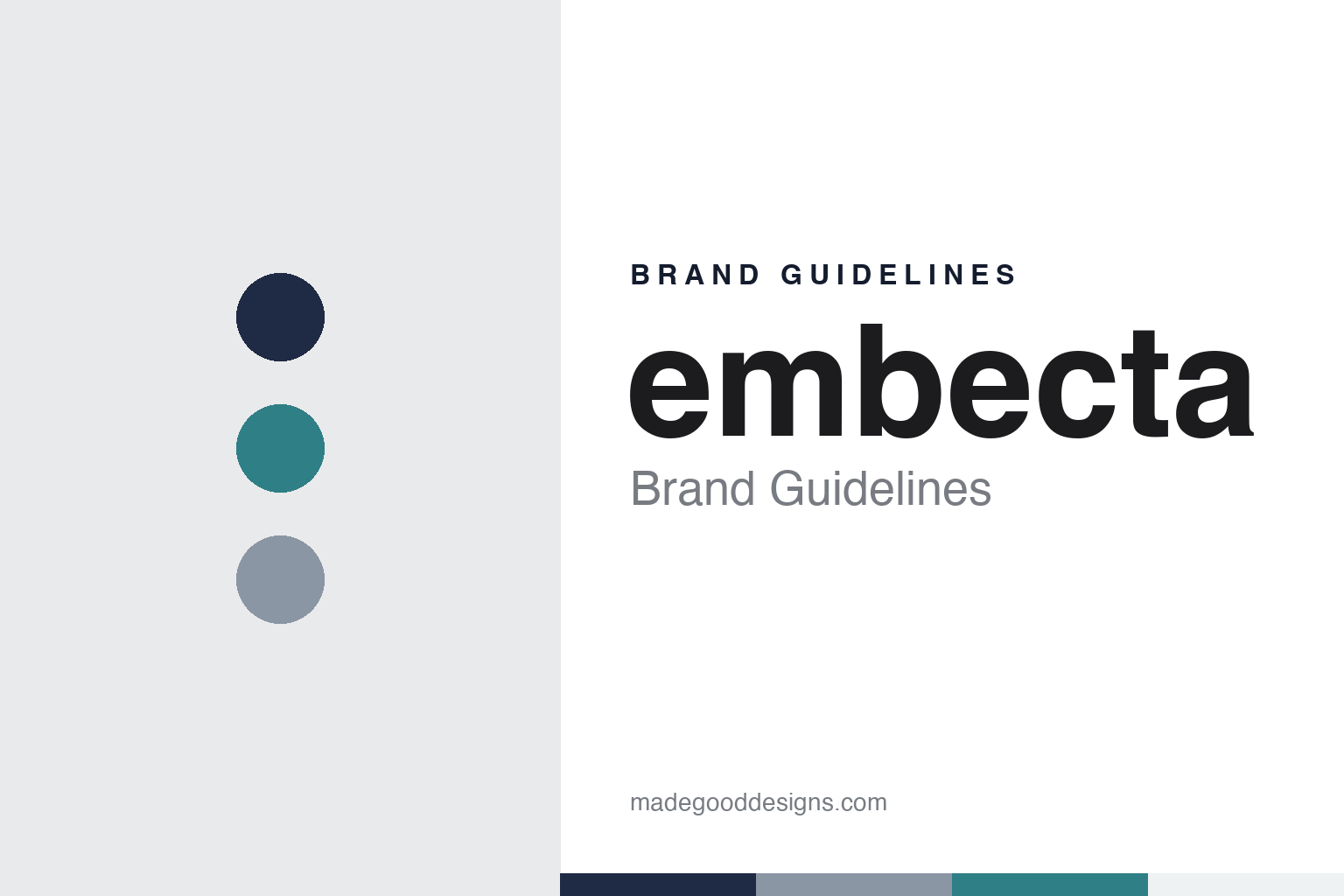
embecta Brand Guidelines
BD’s diabetes-care business, spun off under a lower-case name.
Aa
Two constants: a navy, steel and teal palette and a rounded lower-case sans register. Abstract homage — not an embecta product or mark; no device, logo or packaging is reproduced.
Out of BD
A new name for an old business.
embecta is the diabetes-care company that BD (Becton, Dickinson and Company) spun off on 1 April 2022. BD announced that day that it had completed the separation of Embecta Corp., which holds BD’s former Diabetes Care business. BD shareholders received one embecta share for every five BD shares they held, BD kept no ownership stake, and the new company’s stock began trading on the Nasdaq under the symbol EMBC. MedCity News reported the same day that BD had first announced the plan in May 2021 and that its board approved the spinoff in February 2022.
The company writes its name in lower case, and its website gives the trademark as “embecta.” Its headquarters are in Parsippany, New Jersey, MedCity News reported. At the spinoff it was led by Devdatt Kurdikar, previously worldwide president of BD Diabetes Care.
The business is far older than the name. MedCity News noted that diabetes products had been key to BD’s corporate identity for more than a century, and that BD itself was founded in 1897 by Maxwell Becton and Fairleigh Dickinson, at first selling glass syringes. In a launch statement republished by Pharmacy Times in April 2022, embecta said its history in diabetes care dates back to 1924 and the development of what it called the world’s first specialised insulin syringe. Its website today speaks of “nearly 100 years” in diabetes care and of “the first insulin delivery device.” On launch day the new company’s leadership rang the Nasdaq closing bell, and the statement described embecta as one of the largest pure-play diabetes care companies in the world, with a vision of helping people “live a life unlimited by diabetes.”
The split was meant to leave each side with a clearer focus. BD said the spinoff formed part of its “BD 2025” strategy and would let both companies concentrate on their core businesses; on embecta’s side, the packaging pages of its website explain that BD continues to sell other medical devices outside diabetes care, while BD’s pen needles and insulin syringes are now part of embecta.
Colour
Pen needles, syringes and a pump that stopped.
embecta makes pen needles and insulin syringes. Its current US range lists the Nano 2nd Gen and Nano 4mm pen needles, Ultra-Fine pen needles and Ultra-Fine insulin syringes, and the company says embecta, Nano and Ultra-Fine are its trademarks. At the spinoff it described itself as the leading producer of diabetes injection devices and the global market leader in pen needles, making about 8 billion injection devices a year for an estimated 30 million people; those are the company’s own figures, and MedCity News cited similar numbers from a BD investor presentation.
On manufacturing, the company said in 2022 that it had about 800,000 square feet of manufacturing space across the United States, Ireland and China. Its website now speaks of three manufacturing facilities around the globe, sales in more than 100 countries and more than 2,000 employees.
embecta also tried to move into insulin pumps. MedTech Dive reported in November 2024 that the company had received FDA clearance in September 2024 for an open-loop insulin patch pump with a 300-unit reservoir, but was cancelling the programme as part of a cost-cutting restructuring. Chief executive Dev Kurdikar told investors the company had not intended a full market launch of the cleared version, and that a closed-loop version would need “several more years of significant investment.” The company said it would focus on its core business and give priority to paying down debt, and that it expected to complete the restructuring in the first half of 2025.
Typography
How diabetes device makers present themselves.
Diabetes device makers sell small things that people wear, carry or use many times a day: continuous glucose monitors worn on the upper arm or the belly, insulin pumps and tubeless patch pumps, blood-glucose meters with their test strips, and the pen needles and syringes used for injections. Their brand worlds are built around those objects, and increasingly around the data the objects produce.
A typical presentation pairs a close-up of a sensor or pump on skin with a phone screen showing a glucose graph and trend arrows. Apps and watch faces have become as central as the hardware: sensor makers describe readings sent wirelessly to phones, shared with family members and passed to insulin pumps, and that connection between devices is often the story the brand tells.
Photography in the category tends to be bright and active, with runners, swimmers, parents and children, while meter-and-strip brands lean on clean packshots of the meter, the strip pot and the lancing device. Regulation shapes the words as much as the pictures: product names come with indications, approval dates and age ranges, and marketing copy stays within what regulators such as the U.S. Food and Drug Administration have cleared.
The industry meets at medical congresses such as the American Diabetes Association’s Scientific Sessions, the annual meeting of the European Association for the Study of Diabetes (EASD) and the ATTD conference on advanced technologies and treatments for diabetes, where new devices and study results are presented to clinicians. This guide sets out what can be checked about each maker — who founded it, who owns it, where it says its products are made and what regulators have said — and marks clearly what rests only on the company’s own word.
Aa
A rounded lower-case sans, in the spirit of a lower-case wordmark. (Specimen set in Nunito Sans, a sans STAND-IN; NOT the embecta logo.)
embecta
Colour-coded boxes and a wider remit.
The clearest view of embecta’s identity is its packaging. After the spinoff, BD-branded pen needles and syringes moved into new embecta boxes, and the company’s website sets out the changes: the pen-needle name was updated to Nano 2nd Gen and the syringe name to Ultra-Fine, every box carries the embecta logo and a realistic image of the product, box colour is matched to needle length, and syringe boxes call out barrel capacity. The company tells users these are “the same products with the same manufacturing and quality” in new packaging. Its site uses the line “Advance every day together.”
In 2026 the company reached beyond diabetes. Manufacturing Chemist reported on 15 May 2026 that embecta had completed its acquisition of Owen Mumford Holdings Limited, a UK maker of medical devices and drug-delivery technology founded in 1952, in a deal first announced on 19 March 2026. The magazine said the purchase brought Owen Mumford’s Aidaptus auto-injector platform and was part of embecta’s repositioning as a broad-based medical supplies company, and it put embecta’s staff at about 2,500. It said Owen Mumford’s skills in device design, moulding and assembly would be combined with embecta’s commercial reach, distribution network and large-scale manufacturing, and that the combined company was aiming at drug-delivery partners in markets including obesity, diabetes, autoimmune disease and anaphylaxis. Owen Mumford’s own website lists ranges including Unifine pen needles, Unistik and the Autopen. embecta’s website now describes “two strong legacies” and “one united team.”
For a design guide, embecta shows how a spun-off business can build a new name around long-established products, with a lower-case wordmark and boxes coded by colour. Compare BD, the company it came from, and Insulet, a maker of patch pumps. For this guide we use navy, steel grey and a soft teal with a rounded sans, an unofficial interpretation; no product or logo is reproduced.
Explore & save
Keep embecta’s identity on hand — save it to a board in the Made Good inspiration library.
embecta identity set
Pin the embecta navy, steel and teal palette and the rounded lower-case sans register to your own board.