Emma Stebbins made sculpture that explains itself through objects. An angel holds a lily. A worker rests his hand on his tools. An apprentice reads a sheet of paper with his foot on a broken column. Each figure is quiet, upright and plainly dressed, and the meaning sits in one or two props that anyone can read. That is the same job a designer does with an icon, a pictogram or a hero image: one figure, one gesture, one clear symbol.
Two of her marbles are flagged public domain by the Art Institute of Chicago and appear below; her public monuments are described in text. For more cleared sculpture and prints, browse the MGD museum inspiration collection.
Who was Emma Stebbins?
The Metropolitan Museum of Art and the Art Institute of Chicago both give her dates as 1815–1882, and the Art Institute records that she was born in New York. She began as a painter. Green-Wood Cemetery’s biography and Encyclopedia.com both describe her election as an associate of the National Academy of Design in the early 1840s on the strength of her paintings and portraits; Green-Wood adds that she had trained with the portraitist Henry Inman. Sources give 1842 or 1843 for that election.
She went to Rome in 1857, according to Encyclopedia.com and the nineteenth-century sculptors’ biography compiled on the Sculptors of the 19th Century site. Both say she turned to sculpture there, and both name the American sculptor Benjamin Paul Akers as a teacher; Encyclopedia.com adds that the British sculptor John Gibson encouraged her. The Art Institute places her within a community of women sculptors working in Rome in the late 1850s, a circle that also included Harriet Hosmer.
In Rome she met the American actor Charlotte Cushman, who became her companion; Encyclopedia.com and the Smithsonian Libraries both describe the partnership. After Cushman’s death Stebbins edited Charlotte Cushman: Her Letters and Memories of Her Life, which Encyclopedia.com dates to 1878.
Key works and dates
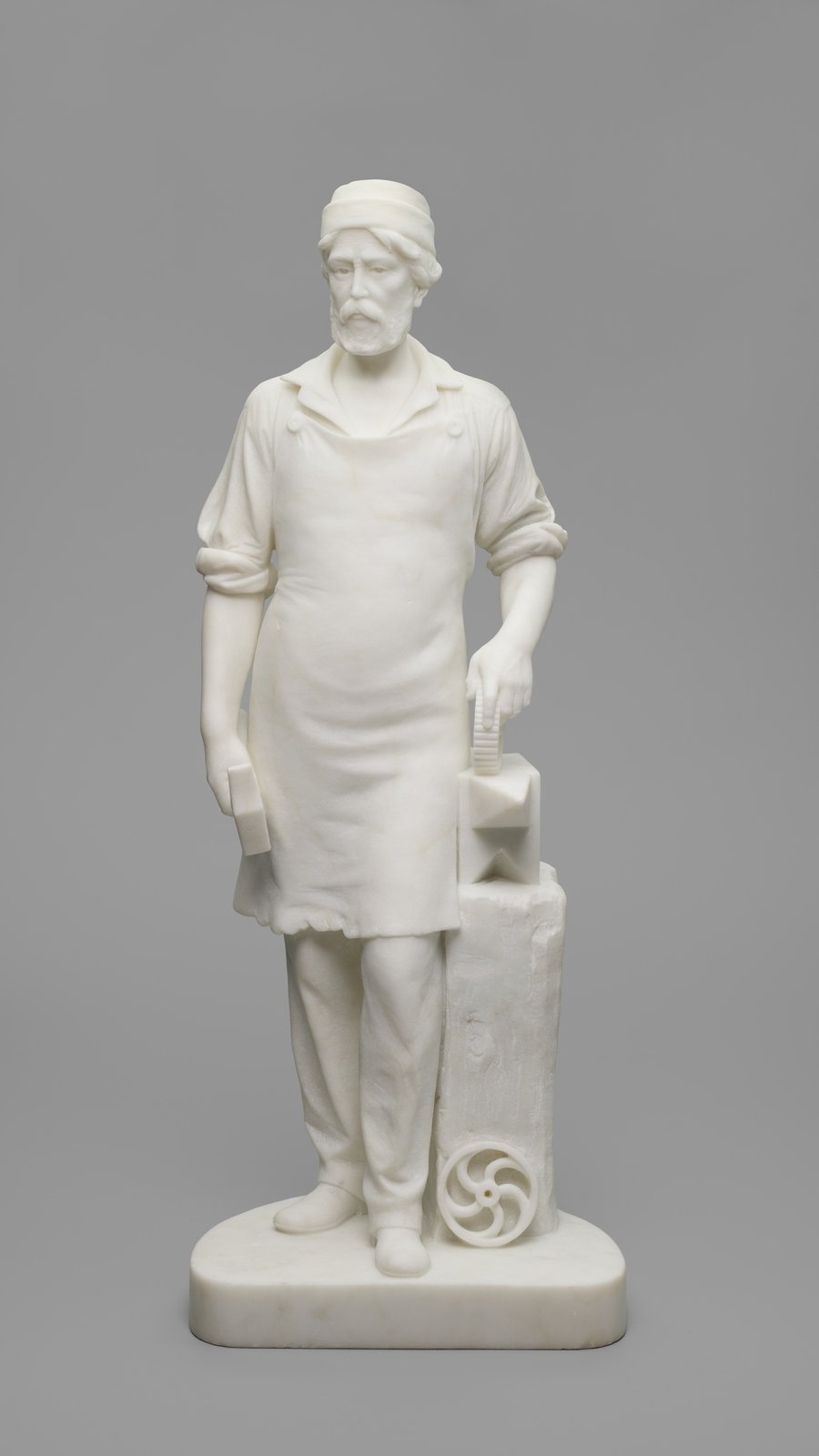
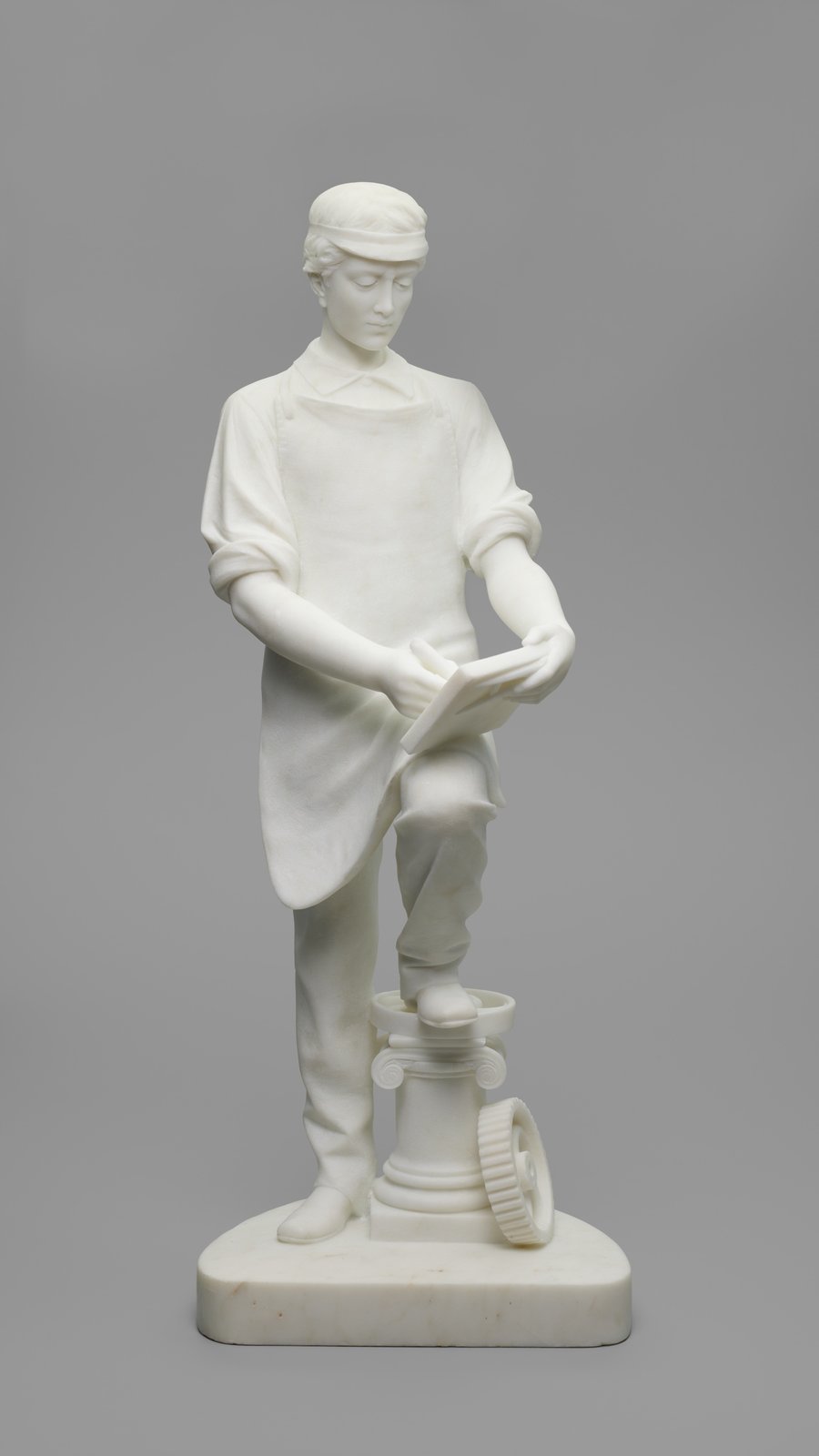
c. 1859, Machinist and Machinist’s Apprentice. Two marble statuettes, each about 75 centimetres high, made in Rome and now in the Art Institute of Chicago. Both are signed “EMMA STEBBINS ROME” on the base. The museum’s provenance record notes that they were sold together in 1998 as a pair of allegorical figures of industry.
1865, Horace Mann. A bronze statue of the education reformer outside the Massachusetts State House in Boston, dedicated in 1865, commissioned by Mann’s friends and supporters after his death.
c. 1867, Christopher Columbus. NYC Parks dates the statue to 1867 with a query; other accounts give 1869. It was intended for Central Park and now stands in Columbus Park in downtown Brooklyn, near the New York State Supreme Court building.
1873, Angel of the Waters. The bronze figure on Bethesda Fountain in Central Park. NYC Parks says she worked on the design in Rome from 1861 until 1868 and records the dedication on 31 May 1873.
What to look at: the Machinist pair
The two Chicago marbles are a useful lesson in how to make an everyday subject look serious. Ordinary working men in caps and long aprons are carved in white marble, the material of gods and heroes. The Art Institute describes the subject as a modern one treated with classical forms, and you can see the method at once: upright stance, weight on one leg, simplified folds, faces turned slightly down in concentration.
The older Machinist rests one hand on a tall block, and a spoked wheel leans against its base. The young Machinist’s Apprentice studies a sheet held in both hands, one foot raised on a short column with a scroll capital, and a toothed gear sits beside it. Column and gear side by side say “classical learning meets modern industry” without a single word.
The pair also works as a system. Same height, same base shape, same apron, same cap, but one figure is older and bearded and looks outward, the other is young and reads. That is a family of icons: shared rules, one variable changed.
Measured from the Art Institute’s scans of these two marbles, the palette is a soft two-step contrast: a pale warm stone (#ccc9c3) for the lit marble against a mid neutral grey ground (#949393). These describe the museum photographs, not the stone itself. You can sample them in our image colour picker.
Emma Stebbins and the Angel of the Waters
Her Central Park angel is a single figure with wings spread, standing on a rock-like mass above a basin. In one hand she holds a lily; with the other she reaches down over the water in blessing. Below, four small cherubs stand for Temperance, Purity, Health and Peace. The idea comes from the Gospel of John’s story of an angel who stirred the healing waters of the pool of Bethesda in Jerusalem.
Local histories, including those of the Friends of the Old Croton Aqueduct and the Gotham Center for New York City History, link the subject to the Croton Aqueduct, which brought clean water to the city. The fountain is, in effect, a monument to a water supply, told through a religious image of healing water.
Several accounts record that delivery of the bronze figures was delayed, first by the Franco-Prussian War and then by difficulties in New York. Central Park historian Sara Cedar Miller has written that her brother Henry Stebbins, who chaired the park’s board of commissioners, helped her obtain the commission. The Central Park Conservancy scheduled the fountain to be switched off from early August 2026 for a restoration expected to last about a year.
For designers, the composition is the lesson. The figure is a strong vertical with wings that widen its silhouette at the top, like a capital letter T with a soft outline. The lily is a tiny, high-contrast accent that tells you who she is. The downward hand points the eye to the water, which is the real subject. Silhouette, accent, pointer: three moves that also organise a good poster.
Technique: from clay to marble and bronze
Stebbins worked in both of the main nineteenth-century sculpture materials. The Chicago statuettes are carved marble, and the Art Institute places their making in Rome. Her large public commissions, the Horace Mann and the Angel of the Waters, are bronze. The Met’s marble portrait bust of John Neal Tilton, dated about 1865, shows her working at a smaller, private scale in the same years.
The Art Institute notes that, like other women of her generation, she had been denied life-drawing classes in the United States and learned to model the figure from the art she studied in Europe and from the circle of artists around her. Her figures stay clothed and simply posed, with the emphasis on silhouette, drapery and meaningful objects.
For more on the classical style that shaped her, read our guide to neoclassical art.
Signature and lettering: name plus place
Both Chicago marbles are signed on the base, chiselled “EMMA STEBBINS ROME”. The signature does two jobs: it names the maker and places the work in the city that every American collector of the time associated with classical sculpture. Harriet Hosmer did the same in Latin with “fecit Romae”.
The lesson for a studio mark or product label is simple. A name and a place in one line of clean capitals reads as confident and honest, and a place name can add meaning a logo alone cannot.
How designers can borrow Emma Stebbins’s ideas
Let one prop tell the story. A lily, a gear, a sheet of paper: choose a single object your audience already understands and make it the accent.
Treat ordinary subjects with dignity. The Machinist pair puts workers into the visual language of heroes. Shoot or draw everyday users with the same calm, upright framing you would give a founder.
Design families, not one-offs. Keep base, scale and costume constant and vary one feature, and a set of figures reads as a system.
Use a pointing gesture. The angel’s downward hand leads the eye to the water. In a layout, a gaze or gesture can lead to the headline or the call to action.
For other women sculptors who worked in Rome in the same years, see our guides to Harriet Hosmer and Edmonia Lewis.
Frequently asked questions
What is Emma Stebbins known for?
For the bronze Angel of the Waters on Bethesda Fountain in Central Park, dedicated in 1873, as well as the Horace Mann statue in Boston (1865), the Christopher Columbus now in Brooklyn and the marble Machinist pair of about 1859.
Where did Emma Stebbins train as a sculptor?
In Rome, from 1857, where she studied with the American sculptor Benjamin Paul Akers and was encouraged by John Gibson.
Where can I see Emma Stebbins’s work?
The Angel of the Waters is in Central Park, the Horace Mann outside the Massachusetts State House and the Columbus in Brooklyn. The Art Institute of Chicago holds the Machinist pair and the Met holds a marble portrait bust.
Can I use these Emma Stebbins images?
The two images here are flagged public domain by the Art Institute of Chicago. Check each museum’s record before reusing any other photograph of her work.