Fingrid Brand Guidelines
Finland’s main grid, gathered into one company in 1996.
Aa
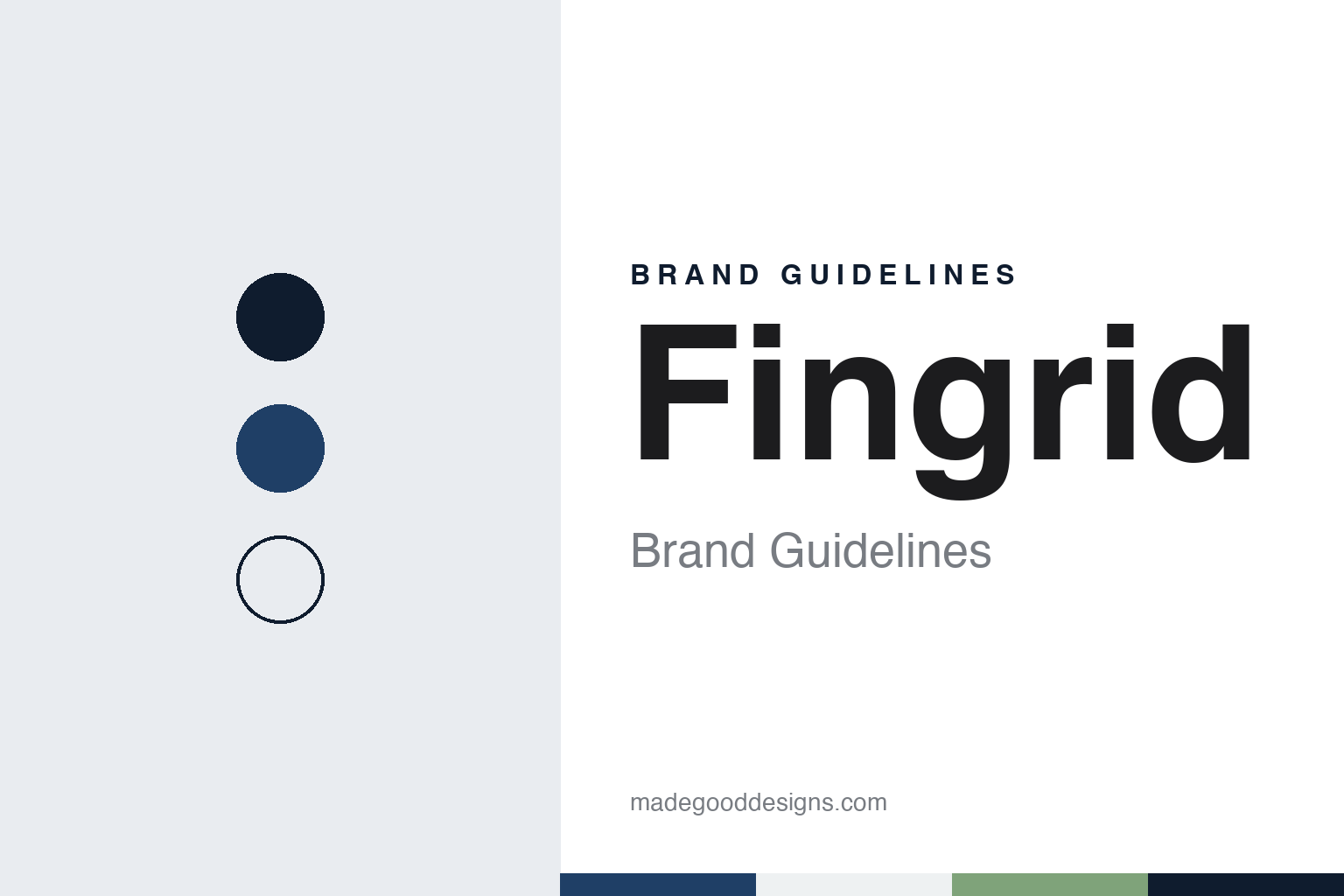
Two constants: a northern blue, birch white and lichen green palette and a plain engineering sans register. Abstract homage — not a Fingrid asset or mark; no logo, pylon or signage is reproduced.
Suomen Kantaverkko
A national grid company formed in 1996.
Fingrid is Finland’s national electricity transmission grid operator, with its head office in Helsinki. It was established on 29 November 1996 as Suomen Kantaverkko Oy and began operating on 1 September 1997, according to English and Finnish Wikipedia. The company is now Fingrid Oyj.
The new company brought Finland’s main grid under one owner. Finnish Wikipedia says an agreement between Imatran Voima Oy, Pohjolan Voima Oy and the Finnish state concentrated the grid business in a single company, which bought the 400 kV, 220 kV and principal 110 kV networks owned by IVO Voimansiirto Oy and Teollisuuden Voimansiirto Oy; the encyclopedia describes the transaction as the largest business deal in Finnish economic history up to that time. The insurers Pohjola, Sampo and the Tapiola group later became shareholders.
Two forces lay behind the founding, Finnish Wikipedia says. One was Finland’s membership of the European Union and the directive opening electricity markets, which required grid management to be separated from generation and sales. The other, according to Antti Tuuri’s biography of the industrialist Tauno Matomäki, was the paper and pulp industry’s dissatisfaction with the transmission charges it had been paying. The same separation principle shaped the shareholder list later: in 2011 the power companies Fortum Power and Heat and Pohjolan Voima sold their stakes, 25% each, because EU internal-market rules required generation and transmission ownership to be kept apart, English Wikipedia says.
Ownership today is mixed. Finnish Wikipedia says public bodies hold 53.2% of the shares and 70.9% of the votes, through the Finnish state directly and the National Emergency Supply Agency, with the remaining shares held by financial and insurance institutions, among them the pension insurer Ilmarinen. Although Fingrid is a public limited company, its shares are not publicly traded.
Colour
Lines across the north and under the sea.
Finnish Wikipedia says roughly 75% of all electricity used in Finland passes through Fingrid’s grid, which comprises more than 14,000 kilometres of 400, 220 and 110 kV lines and over a hundred substations. Fingrid does not trade electricity; it transmits it from generators to distribution and industrial companies, plans and supervises the use of the grid, and is responsible for keeping consumption and production in balance. A subsidiary, Fingrid Datahub Oy, runs the information-exchange system for the retail electricity market.
Cross-border links define much of its work. With Sweden’s Svenska kraftnät it built Fenno-Skan 2, an 800 MW direct-current submarine link completed in 2011. EstLink 2 to Estonia, a 650 MW direct-current link about 165 kilometres long, most of it cable on the bed of the Gulf of Finland, entered commercial use in February 2014, Finnish Wikipedia says. That cable was damaged on Christmas Day 2024, along with several other undersea cables, Yle reported; Fingrid said in April 2025 that about a kilometre of it would be renewed, and the link returned to service on 20 June 2025, Keskisuomalainen reported, citing the STT news agency. English Wikipedia notes that transmission from the Russian network was interrupted by the Russian side on 13 May 2022.
The largest recent project runs north. The Aurora Line, a 400 kV, 380-kilometre overhead connection from Pyhänselkä in Muhos to Messaure in northern Sweden, built with Svenska kraftnät, was taken into use ahead of schedule in November 2025, the public broadcaster Yle reported on 13 November 2025. Fingrid’s deputy chief executive Timo Kiiveri had said in April 2025 that it would add 35% more transmission capacity between the two countries; Yle called it the most significant investment in the Finnish grid this decade and noted that it had received European Union CEF funding.
Inside Finland the build-out continues. On 14 October 2026 Yle reported that the Council of State had granted Fingrid an expropriation permit for the Veteli–Alajärvi section of the Lakeuslinja, a 400 + 110 kV line from Kalajoki to Alajärvi that continues to Hausjärvi, 420 kilometres in all; three sections still awaited permits. On 1 October 2026 Yle reported Fingrid’s plan for a new transformer at the Vuoksi substation in Imatra, which a Fingrid account manager said would make room for about 400 MW of new consumption in the early 2030s.
Typography
How grid operators present themselves.
Electricity transmission operators sell nothing a customer can hold, so their identities lean on the network itself. Most present a short corporate name set in a clean sans-serif wordmark, often with a small symbol or a single letter given weight, and keep the type plain enough to sit on a substation gate, a hard hat or a regulatory filing without change. Blue, green and yellow are the familiar colours of the category, read as sky, landscape and current.
Photography does much of the work. Pylons are shown in fields, dunes and mountain valleys, substations are framed against open sky, and cable ships, converter platforms and offshore islands stand in for the reach of a grid that crosses borders. People appear mostly as engineers and line crews in protective clothing, photographed at work rather than posed.
The websites follow a shared pattern. A grid map and an interconnector page show where lines run and which countries they link, and a network development plan sets out future routes and upgrades as the operator dates and describes them. Many publish real-time system data, with dashboards for load, generation, cross-border flows and balancing prices, and open consultation pages where residents and landowners can comment on planned lines.
The last regular section is recruitment. Careers pages address electrical engineers, technicians, data specialists and graduates, and present grid building as long-term public work. For a designer, the category is a study in restraint: a calm wordmark, a limited palette and a library of landscape, map and data imagery carry an identity that has to be trusted more than it has to be noticed.
Aa
A plain engineering sans. (Specimen set in Work Sans, a sans STAND-IN; NOT the Fingrid logo.)
Permits, maps and people
A grid company’s public face.
Much of Fingrid’s public communication is about planning, permits and land. Finnish Wikipedia says the company published a grid development plan in 2025 that reaches to 2035, built on Finland’s long-term climate and energy strategy. New power lines need a permit from the Council of State, preceded by consultation with authorities and landowners; compensation for line corridors is set under the expropriation act by an impartial expropriation committee, not by Fingrid itself. In Yle’s October 2026 report the company criticised processing times, saying the expropriation procedure took half a year in 2019 and now takes about two years on average, and that faster permitting would be the most significant single way to shorten grid construction.
The company is spread across the country. Besides the Helsinki head office, Finnish Wikipedia lists sites in Hämeenlinna, Rovaniemi, Oulu, Vaasa, Jyväskylä and Varkaus. Fingrid is also among the Nordic and Baltic system operators that share ownership of the Nord Pool power exchange, according to Norwegian Wikipedia’s article on Statnett.
Leadership changed at the start of 2024: Jukka Ruusunen led the company until the end of 2023, and Asta Sihvonen-Punkka, previously executive vice president, took over as president and chief executive on 1 January 2024, English Wikipedia says.
For a design guide, Fingrid shows how a grid operator’s public face is built from maps, permits and cross-border links rather than consumer products. Compare Statnett, Norway’s grid operator, and Energinet, its Danish counterpart. For this guide we use a northern blue, a birch white and a lichen green with a sans, an unofficial interpretation; no product or logo is reproduced.
Explore & save
Keep Fingrid’s identity on hand — save it to a board in the Made Good inspiration library.
Fingrid identity set
Save the Fingrid northern blue, birch white and lichen green palette and the plain engineering sans register to your own board.