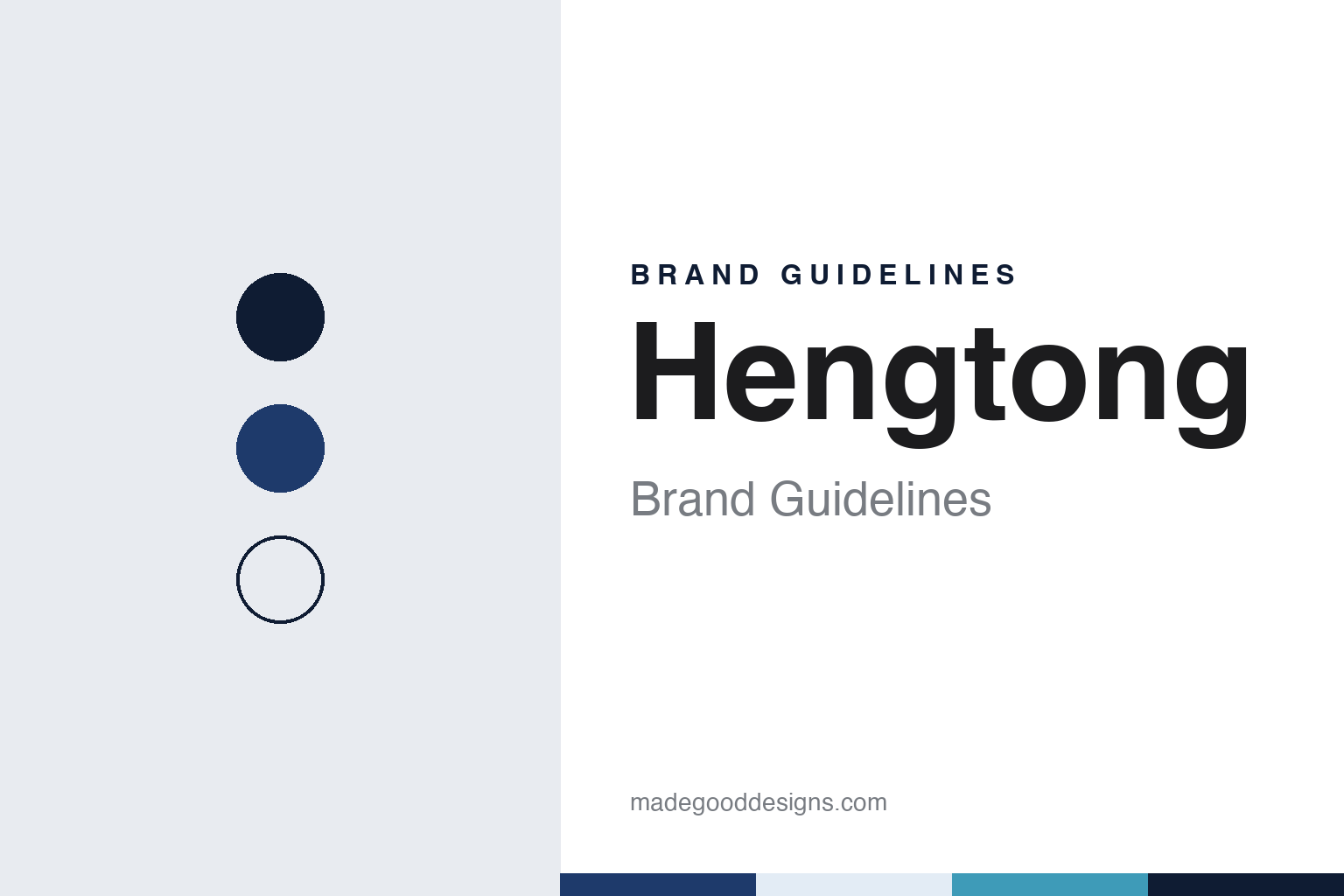
Hengtong Brand Guidelines
Suzhou’s 1991 cable group, from optical fibre to the sea floor.
Aa
Two constants: a Hengtong navy and lake cyan palette and an Engineered sans register. Abstract homage — not a Hengtong product or mark; no cable, logo or nameplate is reproduced.
Hengtong Group
A cable group from Wujiang.
Hengtong is a Chinese cable group based in Wujiang District, Suzhou, in Jiangsu province. Both English Wikipedia and the company give its founding year as 1991, and Wikipedia names Cui Genliang as its founder. The group marked its thirtieth anniversary with a ceremony in December 2021, according to the development history on its Chinese website.
Its main listed company is Hengtong Optic-Electric, which the group says was founded in 1993 and which English Wikipedia says was listed on the Shanghai Stock Exchange in 2003. The group describes Hengtong Optic-Electric’s work as integrated telecom and energy networks: optical communication, copper communication, power transmission, marine engineering and new materials.
Hengtong has grown into a wide holding structure. Its English website says it has more than 70 wholly owned and holding companies, five of them listed, with manufacturing in China and abroad and sales offices in more than 40 countries and regions. Its Chinese website describes four industrial groups, more than 20,000 staff and three large industrial parks in China, one each for optical communication, marine industry and optoelectronics.
English Wikipedia notes that Hengtong was one of the first businesses in its province to set up a Communist Party branch inside the company, and quotes the group’s mission, “serve the people and devote to society,” as a reference to a speech by Mao Zedong. The group’s Chinese website gives party-building work its own section.
Colour
Fibre, preforms and the sea.
Hengtong’s communications business covers the whole chain from glass to network. Its English website lists the steps as preform, optical fibre, optical cable, optical devices and optical networks, alongside what it calls quantum private communication and network services. On the energy side, the company says, it makes power cable up to ultra-high voltage and submarine power cable.
Partnerships shaped the fibre business. In 2010, according to English Wikipedia, Hengtong formed Jiangsu OFS Hengtong Optical Technology, a joint venture with OFS, the American fibre maker owned by Japan’s Furukawa Electric, to make optical fibre preforms — the glass rods from which fibre is drawn. In 2012 it announced a joint venture with the Brazilian cable maker Brascopper to build a fibre-optic cable plant in Mato Grosso do Sul, Wikipedia adds.
The biggest step was undersea. Huawei Marine Networks was set up in Tianjin in 2008 as a joint venture between the British firm Global Marine Systems, with 49%, and Huawei, with 51%. In November 2019 Lightwave, republished by SubTel Forum, reported that Global Marine’s parent HC2 had agreed to sell its stake to Hengtong Optic-Electric, and that Hengtong had also agreed with Huawei to buy Huawei’s 51%. Hengtong’s own history records a signing ceremony for the Huawei Marine purchase on 22 October 2019. On 6 June 2020 Submarine Networks reported that the sale of a further 30% had closed, leaving Huawei Marine Networks owned 81% by Hengtong and 19% by HC2 under a two-year put option. English Wikipedia links the purchase to US sanctions on Huawei.
The seller framed the deal as an exit. HC2 said the sale was part of a strategy to leave the submarine network market, and its chairman said the joint venture had completed more than 98 projects around the world since it began, Lightwave reported.
Hengtong also built on land for the sea. On 9 November 2019, its history says, it launched the Hengtong International Marine Industrial Park with the government of Changshu, a city within Suzhou.
Typography
Light under the sea.
Optical fibre and submarine cable are hard things to picture. The working product is a strand of glass thinner than a hair, or a cable that spends its life on the seabed, so the companies that make them borrow images from the process instead. The most familiar is the fibre itself: glowing strands fanned out against a dark ground, light running along their length and spilling from the cut ends.
Factory pictures come next. Fibre makers show preform towers, the tall draw towers where a glass rod is heated and pulled into fibre, and long rows of spools. Submarine cable makers show their ships: cable ships alongside a quay, giant circular tanks of coiled cable in the hold, and ploughs or remotely operated vehicles lowered over the stern. World maps traced with submarine routes, each line ending at a landing point on a coast, carry the same story on a website or a trade-show wall.
People appear mostly at work. Technicians splice fibre inside clean tents on a deck or a beach, engineers check repeaters on a test bench, and crews guide cable ashore at a landing site. The trade also has its own stages, such as the OFC conference for optical communications and the SubOptic conference for the submarine cable industry, where the same strands, cross-sections and route maps return on booths and slides.
This guide looks past those shared images to what can be checked about each company: who founded it, who owns it now, where it makes its fibre or cable, which systems it is known for, and which events in its history, from mergers to changes of owner, shaped the name it trades under. Where a claim rests only on a company’s own word, we say so.
Aa
An engineered sans for a cable maker. (Specimen set in IBM Plex Sans, a sans STAND-IN; NOT the Hengtong logo.)
Hengtong
A group with brands on several continents.
Hengtong works through several names abroad. Its English website lists among its brands Aberdare Cables in South Africa, Cables de Comunicaciones Zaragoza in Spain, Alcobre in Portugal and PT Voksel Electric in Indonesia, a Jakarta cable maker founded in 1971 that is listed on the Indonesian exchange. Hengtong’s page on Voksel says it became a foreign-investment company in 1989 through a joint venture with Japan’s Showa Electric Wire & Cable, now SWCC, and that it makes power, telecommunication and optical fibre cables. It also lists a fibre company in Jena, Germany, and a Hengtong Optic-Electric company in Egypt’s Suez economic zone.
English Wikipedia cites outside rankings: market research firm Integer placed Hengtong seventh in its 2017 list of the top 100 global wire and cable producers, and in 2025 World Brand Lab placed it 386th in its list of the world’s 500 most influential brands. The company itself says it ranks among the top three in global optical fibre communication and in high-voltage submarine cable, a claim it makes on its own websites.
Its Chinese website records recent milestones. In January 2025, it says, Hengtong Optic-Electric was among the first plants named a national “excellent-level” smart factory, and on 25 July 2025 the group held a ceremony to start production at its Hengtong optoelectronic technology industrial park.
For a design guide, Hengtong shows how a privately founded Chinese cable maker presents fibre, power cable and submarine systems under one group name. Compare ZTT and YOFC, two other Chinese optical fibre and cable makers. For this guide we use harbour navy, deep ink and a lake cyan with an engineered sans, an unofficial interpretation; no product or logo is reproduced.
Explore & save
Keep Hengtong’s identity on hand — save it to a board in the Made Good inspiration library.
Hengtong identity set
Pin the Hengtong navy and lake cyan palette and the Engineered sans register to your own board.