HUB International Brand Guidelines
Eleven Canadian brokers, four regional hubs and one Chicago name.
Aa
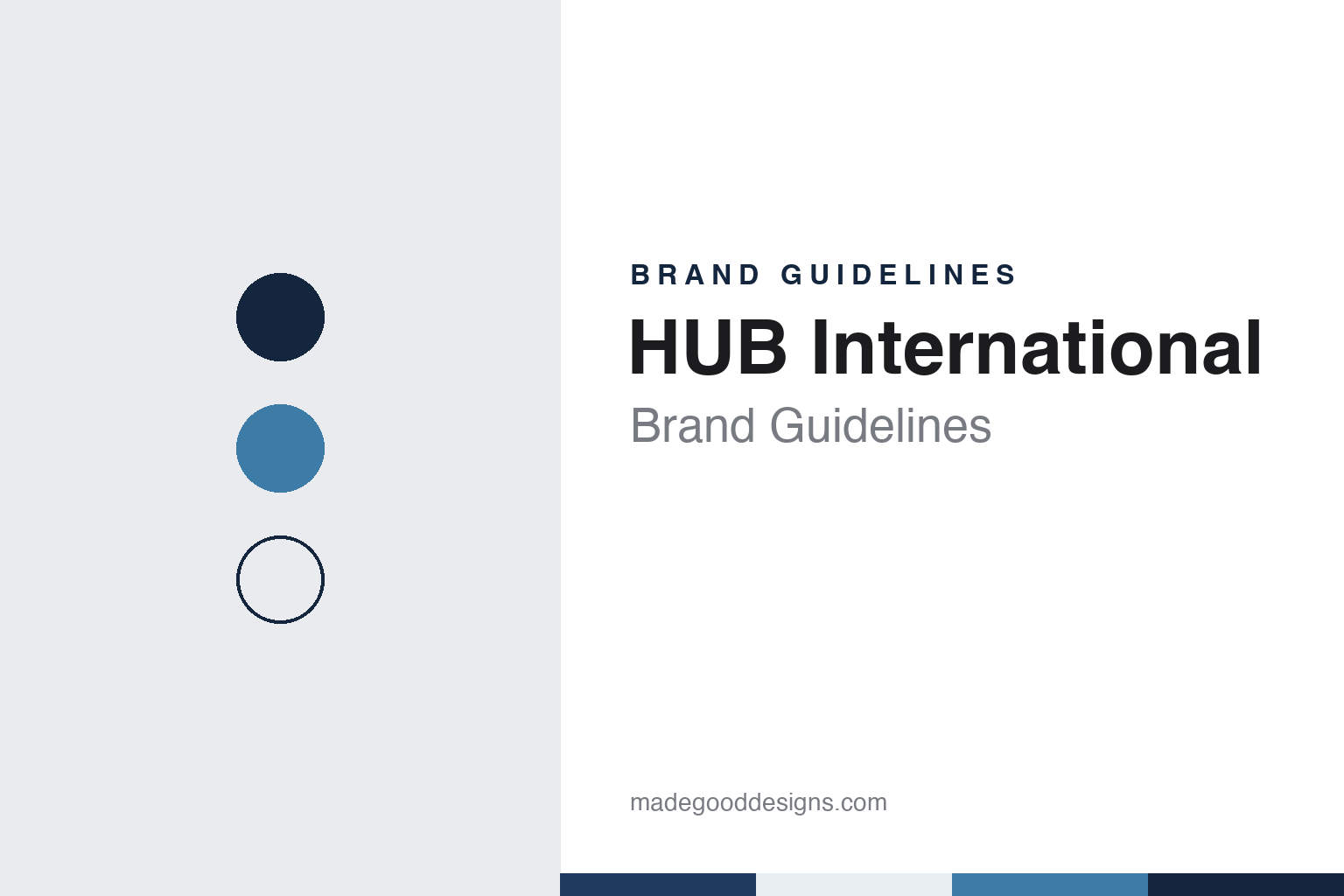
Two constants: a navy, lake blue and mist palette and a plain-spoken sans register. Abstract homage — not a HUB International mark; no logo or signage is reproduced.
The Hub Group
A Leamington brokerage and ten partners.
HUB International did not begin in Chicago. Its history, as told in the International Directory of Company Histories, starts in Leamington, Ontario, where Richard A. Gulliver, in insurance since 1977, took over the small brokerage his father had set up. By the late 1990s he had built it into a larger Toronto brokerage called The Hub Group (Ontario).
The idea of a consolidator came with outside money. According to the same history, V. Prem Watsa, head of the Toronto insurance holding company Fairfax Financial, wanted to back a publicly traded brokerage that would buy up smaller independent firms, and agreed to take a large minority stake. In November 1998 Gulliver’s firm merged with ten other Canadian brokerages to form The Hub Group Limited. The partners came from across the country, among them Barton Insurance Brokers of Chilliwack, British Columbia, Martin Assurance & Gestion de Risques of Montreal and Mitchell McConnell Insurance of Saint John, New Brunswick. Insurance Journal gave the same starting point in 2007: the company “got its start in 1998 when 11 Canadian brokers merged.”
The name describes the structure. The Directory says that after a first year of buying more than forty Canadian brokerages, the group was organised within four operating hubs; in 2007 Insurance Journal described the company as built around large regional “hubs” with satellite offices across the United States and Canada. The shares were listed on the Toronto Stock Exchange in February 1999, and Gulliver served as the first president and chief executive.
The move south came quickly. In October 1999 the group bought Mack and Parker, a Chicago brokerage that became its entry into the United States and its Midwest hub; Mack and Parker’s president, Martin P. Hughes, became chairman and chief executive that December. In September 2000 the company took the name Hub International Limited, and in early 2001 it moved its headquarters to Chicago, the Directory says. Purchases in Boston, New York and Michigan followed.
Colour
Listed twice, then private since 2007.
For less than a decade HUB was a public company on two exchanges. Insurance Journal reported in 2007 that a 2002 offering in the United States had added a New York Stock Exchange listing to the Toronto one, and that the company had kept buying brokerages every year since its formation.
In February 2007 HUB agreed to be acquired by funds advised by Apax Partners together with Morgan Stanley Principal Investments, Insurance Journal reported. The deal was completed in June 2007, and as a result the company was delisted from both the New York and Toronto exchanges, the same publication noted in 2013.
The second change of control came in August 2013, when HUB agreed to be acquired by funds advised by the San Francisco private equity firm Hellman & Friedman, which would hold a majority, with senior management keeping a significant stake, Insurance Journal reported. At the time HUB had more than 6,500 employees in the United States, Canada and Brazil. Later reports confirm the firm’s investment dates from 2013.
Minority investors have since joined. Toronto’s Altas Partners first took a minority stake in 2018 and Leonard Green & Partners in 2023, Insurance Journal reported in May 2025, when HUB announced a further minority investment led by accounts advised by T. Rowe Price, Alpha Wave Global and Singapore’s Temasek. Wealth Management confirmed in September 2026 that those three had taken their stake and that Hellman & Friedman remained the majority owner. Leadership passed from Hughes to Marc Cohen, named chairman and chief executive in the 2025 report and president and chief executive in 2026.
A return to the public markets is in preparation. Wealth Management reported in September 2026 that HUB had filed papers for a proposed initial public offering in late June 2026; as of that report the offering was pending. By then, Insurance Business and Wealth Management reported, the firm had completed more than 600 acquisitions since 2016 and had more than 21,000 people in more than 700 offices across North America, covering commercial insurance, employee benefits, retirement and private wealth.
Typography
Brokers, consolidators and their names.
An insurance broker has no product to photograph. It sells advice and access: it places cover with insurers on a client’s behalf, and it is paid for judgement and relationships rather than for anything a customer can hold. So brokers present themselves largely through people and expertise. Their websites lean on portraits of client advisers and specialist teams, and on named leaders who speak for the firm in the trade press.
Expertise is shown through publishing. Brokers issue risk-management reports, market outlooks and webinars on subjects such as cyber exposure, property values or employee benefits, and many organise their sites around industry practices, from construction and aviation to healthcare and sport, and around capabilities such as casualty, financial lines or private client. Howden’s US website, for example, is laid out by industries and capabilities in this way.
Scale is shown through maps and counts. Office networks spread across countries are a common feature, and so are round numbers of locations and people: Brown & Brown’s website gives a count of more than 700 locations and about 23,000 people. In a sector that has grown through consolidation, acquisitions announcements are a regular part of a broker’s news page, and the dates of agreement and completion are often months apart.
The rest of the presentation is about belonging. Brokers sponsor sport, the arts and community causes, run charitable foundations, and give recruiting pages much of the weight, because the people are the offer. This guide sets out what can be checked about each firm — who founded it, who owns it now and from when — and marks clearly what rests only on the company’s own word.
Aa
A plain-spoken sans for a name written in capitals. (Specimen set in Libre Franklin, a sans STAND-IN; NOT the HUB International logo.)
HUB International
One name over six hundred acquisitions.
The company writes its name in capitals, HUB. In September 2026 it unveiled a new brand identity, its first since 2016, Insurance Business and Wealth Management reported. The work included a new tagline, a refreshed logo, a redesigned website and updated employee values.
The new brand signature is “For every ambition,” and HUB describes its value proposition as “moving you forward with clarity and confidence,” Coverager reported. Wealth Management said the project was led by chief marketing officer Ellina Shinnick and drew on interviews with clients, prospects, employees, carriers, banking partners and newly acquired firms. HUB said its rebuilt website is meant to get clients to the right specialist faster and is designed for the way people, and increasingly AI-powered search tools, find and evaluate a broker. According to Insurance Business, the company said the rebrand does not change how clients work with their advisers or how the firm is structured; what changes is that clients who arrived through an acquired agency now deal with one named firm.
The name itself has stayed constant through every change of owner since 2000. The company was The Hub Group when eleven brokers merged, took the name Hub International Limited in September 2000, and kept it through the Apax, Hellman & Friedman and later minority investments; the 2026 refresh changed the logo and the words around it, not the name.
For a design guide, HUB International shows how a consolidator can turn a description of its own structure into a brand, then refresh it as the network grows. Compare Gallagher, another Chicago broker, and Acrisure, a fellow private-capital consolidator. For this guide we use a navy, a lake blue and a pale mist with a sans, an unofficial interpretation; no product or logo is reproduced.
Explore & save
Keep HUB International’s identity on hand — save it to a board in the Made Good inspiration library.
HUB International identity set
Pin the HUB International navy, lake blue and mist palette and the plain-spoken sans register to your own board.