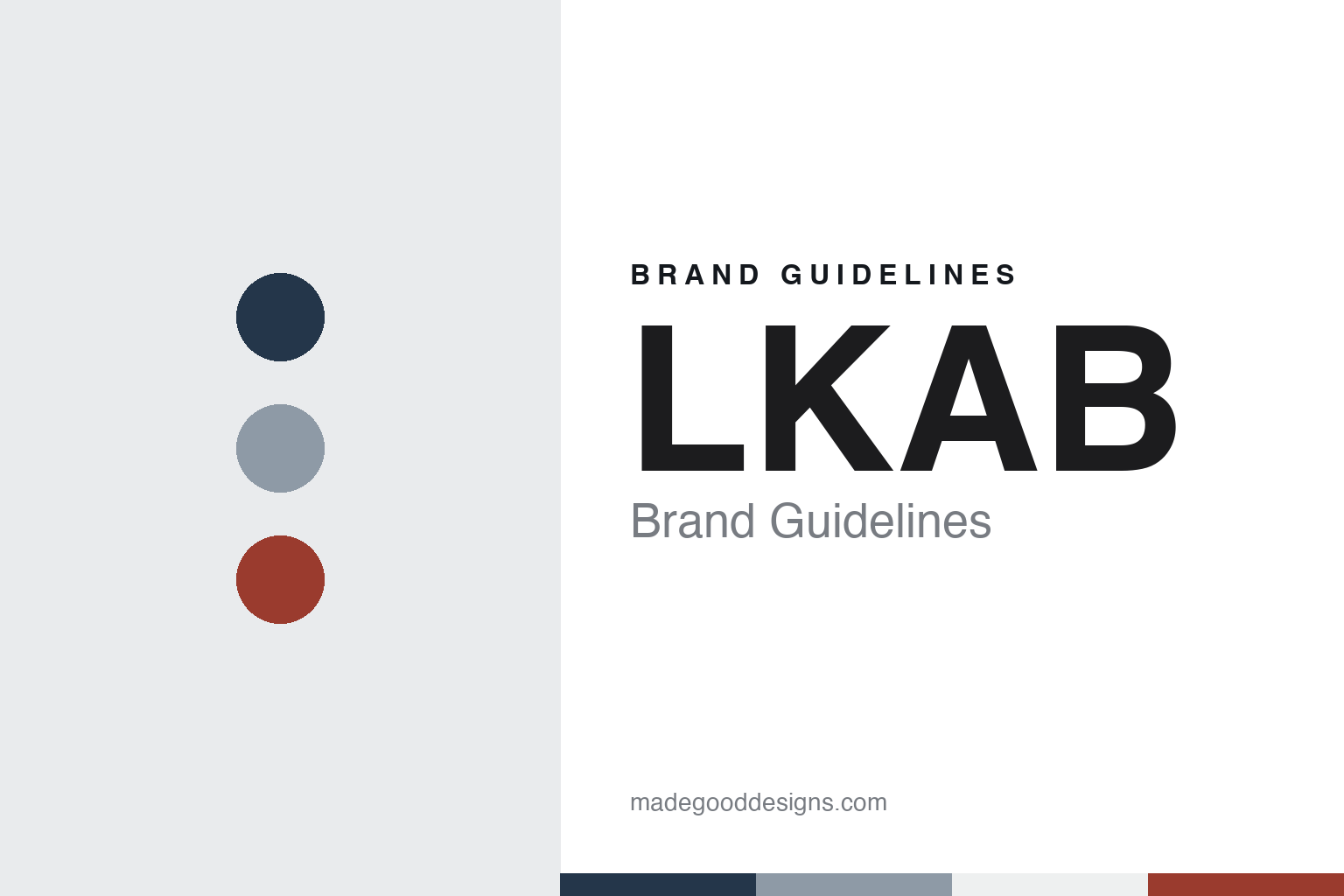
LKAB Brand Guidelines
Sweden’s state iron ore miner, deep under the Arctic ore fields.
Aa
Two constants: a polar blue, pellet grey and wooden red palette and a Nordic grotesque register. Abstract homage — not an LKAB product or mark; no logo, photograph or document is reproduced.
Luossavaara-Kiirunavaara
Two mountains, a railway and a model company town.
LKAB takes its name from two mountains: Luossavaara and Kiirunavaara, the ore hills of what became Kiruna. The company tells its prehistory through a legend: in 1642 a farmer, Lasun Lassi, found a strange black stone while hunting squirrels near Masugnsbyn, and it turned out to be iron ore. Iron from the far north was hard to use, though, until the Thomas process of the 1870s made phosphorus-rich ore suitable for steel, Swedish Wikipedia says, and until rail arrived; LKAB says the first ore train from Malmberget reached Luleå on 12 March 1888.
The company itself dates from 1890. Swedish Wikipedia says its articles were adopted that October and its first general meeting was held in Stockholm in December, with the major Robert Schough, who held nearly half the shares, as chairman; LKAB gives 18 December 1890 and names the banker K. A. Wallenberg as one of Schough’s partners. Within three years the founders sold, and AB Gellivare Malmfält took control in 1893. In 1898 the Swedish and Norwegian parliaments decided to extend the ore railway to Narvik; LKAB says its whole operation was linked by rail from Luleå to Narvik by 1902.
The geologist Hjalmar Lundbohm was hired as site manager in 1898. LKAB calls him its first managing director and the founder of Kiruna, built as a model company town; Swedish Wikipedia says the settlement took the name Kiruna on 27 April 1900. In 1904 the private Grängesberg company, Trafikaktiebolaget Grängesberg-Oxelösund, bought control, and after a political fight over foreign and private ownership the Riksdag decided in 1907 that the state would take half of LKAB, with an option on the rest after fifty years, Swedish Wikipedia says.
During the Second World War LKAB exported a large share of its production to Germany, Swedish Wikipedia says. English Wikipedia says that before the war Sweden supplied Germany with about nine million tonnes of ore a year, seven million of it from Kiruna and Gällivare, shipped through Luleå and Narvik, and that both sides in the war saw the ore fields as strategically important.
The state took over in steps. In 1957 it bought out Grängesberg, which kept 4 percent; in 1976 it became sole owner. The head office moved to Stockholm and then, in the 1970s, to Luleå, where it remains.
Colour
Underground mines, pellets and an ore railway to two coasts.
LKAB’s signature is depth. It decided in 1952 to take Kiruna underground, joining Malmberget, which was already there, and Swedish Wikipedia says underground mining at Kiruna began in 1962. The company now calls Kiirunavaara and Malmberget the world’s two largest underground iron ore mines.
Most of what it sells is processed. Swedish Wikipedia says LKAB refines its ore into pellets and fines and supplies steelmakers including SSAB in Luleå, and that in 2013 pellets made up 82 percent of its deliveries. LKAB says 1965 brought a new harbour in Luleå, the Svappavaara mine and new pelletising plants at Svappavaara and Kiruna. The ore travels on the Malmbanan railway either west to the ice-free port of Narvik in Norway or east to Luleå on the Gulf of Bothnia.
The company’s history has hard stretches. In 1969 and 1970 a wildcat strike involving more than 4,500 miners at Kiruna, Luleå, Malmberget and Svappavaara stopped work for about two months; LKAB says it ended with monthly salaries replacing piece rates. The company also describes an all-time low in the early 1980s and a reconstruction that cost many jobs, followed by a turn to quality products and research with Luleå University of Technology; Swedish Wikipedia credits it with developing olivine pellets in the 1980s.
LKAB is more than ore. Its explosives maker, LKAB Kimit, was founded in 1975; other subsidiaries cover industrial minerals, water-powered drilling under the Wassara name, steel construction, rock works and property in Kiruna and Gällivare. The company says it is wholly owned by the Swedish state, organised in two divisions, Iron Ore and Special Products, and employs about 5,200 people in countries including Sweden, Norway, the UK, the Netherlands, Germany and the USA.
Typography
How iron ore miners present themselves.
Iron ore miners sell a raw material that few people ever see, so their public image is built from the places where it comes out of the ground. The standard picture is aerial: a red-earth open pit cut into benches, haul roads spiralling down its walls, trucks reduced to specks. Underground miners show the opposite view — tunnels, drill rigs and lit caverns far below the surface — but the aim is the same, to make scale legible.
The second set of images is about movement. Iron ore is heavy and cheap to dig but costly to carry, so miners photograph the chain that gets it to customers: ore trains kilometres long crossing dry country or snow, pellet plants and stockpiles, and export jetties where bulk carriers load at the end of a long line. Rail and port pages often get as much space as the mines themselves.
Much of what these companies publish is explanation. Websites and reports carry geology and grade explainers, describe ore types such as lump, fines and pellets, and set out reserves and production as the companies report them. Alongside sit pages on rehabilitation of mined land, water use and tailings, and on newer projects to cut emissions in steelmaking.
The last layer is accountability. Miners publish community and Indigenous-partnership reports, accounts of resettlement where mines reach towns, sustainability reports and, for listed or state-owned groups, detailed annual reports. For a designer, the identity of an iron ore company lives as much in these documents, maps and diagrams as in any logo.
Aa
A plain Nordic grotesque for a state miner. (Specimen set in Work Sans, a sans STAND-IN; NOT the LKAB logo.)
LKAB
A moving town, a moved church and a hydrogen bet.
Mining at depth has moved a town. LKAB says it has been working on the urban transformation of Kiruna and Gällivare since 2004, because the mines deform the ground beneath them. In August 2025 The Guardian reported that Kiruna Kyrka, a wooden Lutheran church inaugurated in 1912 and designed by Gustaf Wickman in a form that recalls a Sámi lávvu, was being rolled about five kilometres to a new site over two days. The paper said the church was one of 23 cultural buildings being relocated, that LKAB had offered residents either compensation or rebuilt homes, and that the town’s full relocation was not expected to be finished until 2035. It also reported criticism from the Sámi reindeer-herding community, who said the expansion fragments grazing land.
The same tension appears in the courts. On 15 June 2026 the Swedish Land and Environment Court granted LKAB an environmental permit for continued and expanded operations at Malmberget, including a protected-area permit for the Torne and Kalix river system, a plant for apatite concentrate and a direct reduction plant for sponge iron. The court set 93 conditions, named the residential environment, reindeer herding and the Lina river among the central issues, and said the company should consult the Sámi villages.
That sponge iron plant is part of HYBRIT, a joint venture of LKAB, the steelmaker SSAB and the power company Vattenfall, started in 2016, which aims to reduce iron ore with hydrogen instead of coal. Swedish Wikipedia says a pilot plant opened in Luleå in August 2020 and that in August 2021 SSAB produced steel using hydrogen-reduced iron from it. In June 2026 the trade site GMK Center reported that the investment decision on the larger project was still pending. In January 2023 LKAB also announced a large deposit of rare earth elements in northern Sweden, which it said was the largest known in Europe, English Wikipedia says.
For a design guide, LKAB shows a state company whose identity is bound to a landscape: two named mountains, an ore railway and a town it is rebuilding. Compare SSAB, its partner in HYBRIT and Luleå neighbour, and Vale, another pellet producer. For this guide we use a polar blue, pellet grey, snow white and a wooden red with a sans, an unofficial interpretation; no product or logo is reproduced.
Explore & save
Keep LKAB’s identity on hand — save it to a board in the Made Good inspiration library.
LKAB identity set
Pin the LKAB polar blue, pellet grey and wooden red palette and the Nordic grotesque register to your own board.