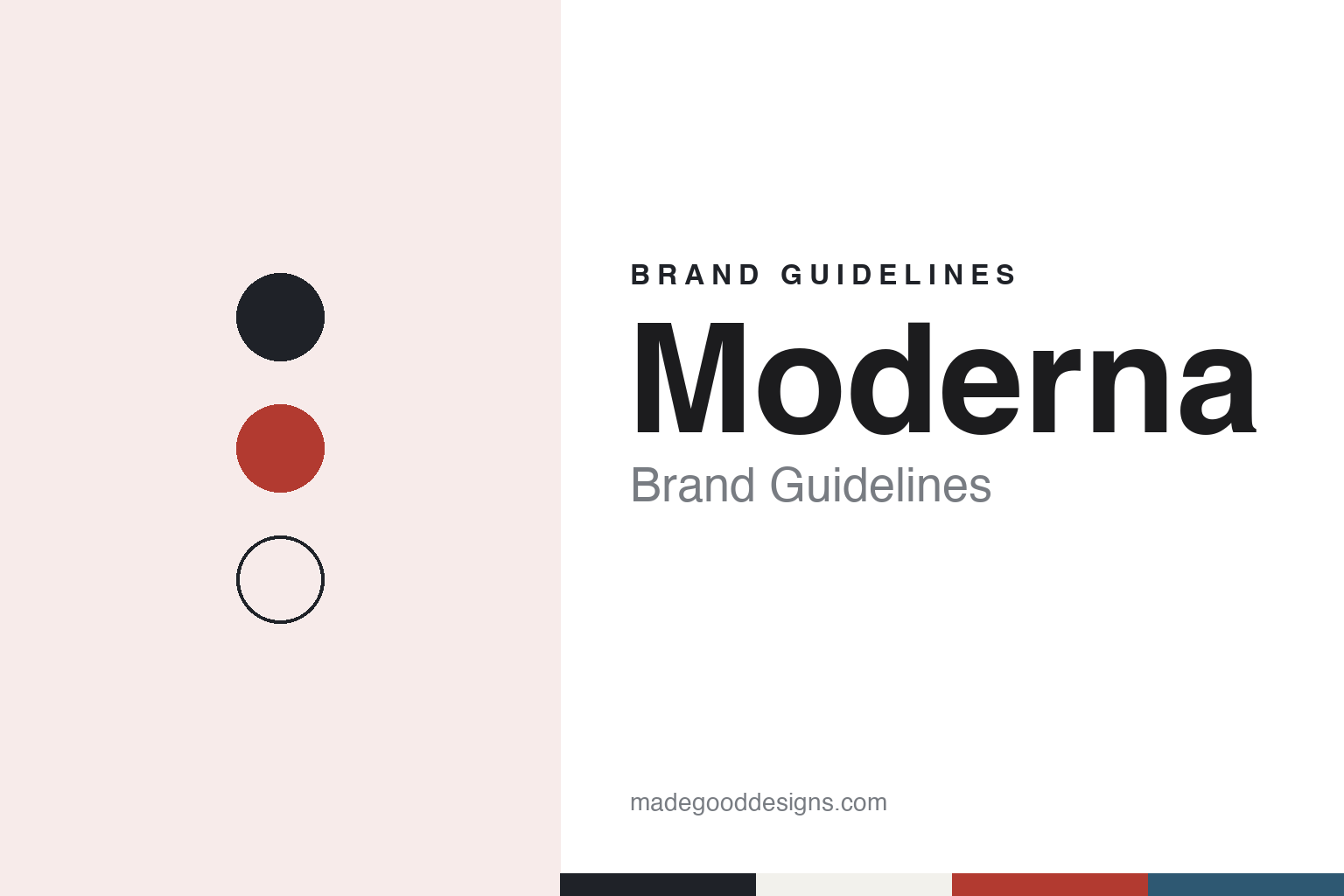
Moderna Brand Guidelines
A Cambridge company named for modified RNA.
Aa
Two constants: a charcoal, coral and cold-blue palette and a clinical sans register. Abstract homage — not a Moderna product or mark; no vial, logo or pack is reproduced.
ModeRNA
A name built from “modified” and “RNA.”
Moderna began in 2010 in Cambridge, Massachusetts, under the name ModeRNA Therapeutics. English Wikipedia names its founders as Derrick Rossi, Timothy A. Springer, Kenneth R. Chien, Robert S. Langer and Noubar Afeyan. The company’s own timeline says it was incorporated in 2010 and began operations in 2011, when Stéphane Bancel joined as its founding chief executive.
The name is a piece of brand writing in itself. The company says it combines the words “modified” and “RNA,” and notes that the result happens to contain the word “modern”; Wikipedia gives the same three-part origin. The early spelling, ModeRNA, set the letters RNA in capitals; the company has since used the single word Moderna.
The science behind the name is messenger RNA, or mRNA: a molecule that carries instructions for making proteins. Wikipedia describes Moderna as a company focused on RNA therapeutics, chiefly mRNA vaccines. When the company went public, the IPO research firm Renaissance Capital, writing on 6 December 2018, described it as “an early-stage biotech developing therapies based on its modified mRNA platform” — the platform idea that the company still puts at the centre of its story.
The early years were spent building that platform. The company’s timeline says new headquarters and laboratories opened in Cambridge in 2014, that it gave the first human dose of an mRNA flu vaccine candidate in 2015, and that it signed a lease in 2016 for a clinical manufacturing site in Norwood, Massachusetts, which opened in 2018. Wikipedia adds partnerships with AstraZeneca in 2013, Merck in 2015 and Vertex Pharmaceuticals in 2016.
Moderna also set up separate ventures around the platform, Wikipedia says: Onkaido Therapeutics in January 2014, for mRNA-based cancer treatments; Valera in January 2015, for viral, bacterial and parasitic diseases, where staff worked on a Zika vaccine candidate; and Elpidera in May 2015, for rare-disease work begun with Alexion Pharmaceuticals. Grants came from DARPA and, from January 2016, the Bill & Melinda Gates Foundation.
Colour
From a Nasdaq ticker to named vaccines.
Moderna’s shares began trading on Nasdaq on 7 December 2018 under the ticker MRNA, Wikipedia says. The symbol does double duty: it reads as the abbreviation for messenger RNA and as a shortening of the company name. Renaissance Capital headlined the offering as the largest biotech IPO ever.
The products came with the pandemic. Wikipedia says the US Food and Drug Administration allowed clinical trials of the company’s COVID-19 vaccine candidate in March 2020 and issued an emergency use authorization in December 2020. The company’s timeline records full FDA approval of Spikevax in 2022; the approval of mRESVIA, a respiratory syncytial virus vaccine, in the United States, Europe, Canada and Qatar in 2024; the US approval of mNEXSPIKE, a second COVID-19 vaccine, in 2025; and, it says, the European approval in 2026 of mCOMBRIAX, a combined flu and COVID-19 vaccine. Wikipedia dates the FDA approval of mRESVIA to May 2024, for adults aged 60 and older.
On its own pages the company styles its newer product names with a lower-case “m” followed by capitals, as in mRESVIA, mNEXSPIKE and mCOMBRIAX, while Spikevax is set in ordinary title case.
The company has also widened its footprint. Wikipedia says that in April 2022 it announced a vaccine plant in Montreal, part of a ten-year partnership with the Government of Canada, Quebec and McGill University, and that in 2023 it bought OriCiro Genomics, a Japanese maker of genetic engineering tools, in its first acquisition. The company was part of the Nasdaq-100 index from July 2020 to December 2024, Wikipedia adds. Work with Merck on a cancer vaccine candidate, now called intismeran autogene, received breakthrough designation from the FDA in early 2023, Wikipedia says.
Typography
How vaccine makers present themselves.
Vaccine makers sell to health ministries, procurement agencies, hospitals and clinicians long before any patient sees a pack, and their visual language reflects that audience. The imagery tends to stay close to the work itself: gloved hands holding a vial up to the light, rows of filled vials on a stainless line, and researchers in lab coats at a bench or a microscope. The point of these pictures is to show process and care rather than spectacle.
Production is a second recurring subject. Company photographs often show clean production suites, with staff in full gowns, hoods and masks behind glass, and long views of filling lines, bioreactors and freezers. For mRNA companies in particular, the plant itself has become part of the story, and new sites tend to be photographed and announced as milestones in their own right.
A third strand is global health. Vaccine makers frequently show clinics, community health workers and the cold chain: insulated boxes, refrigerated trucks and storage rooms that keep doses within a temperature range on the way to where they are used. Maps, partner logos and the names of public bodies often sit alongside these images, because much of the business runs through governments, international agencies and non-profit funders.
The trade has its own meeting places. Conferences such as the World Vaccine Congress and ESCMID Global, the congress of the European Society of Clinical Microbiology and Infectious Diseases, bring companies, researchers and buyers together. In a field where so many pictures show similar vials, gowns and laboratories, a name, a typeface and a single accent colour often do much of the work of telling one company from another.
Aa
A clinical sans — the register of a science-led company. (Specimen set in Inter Tight, a sans STAND-IN; NOT the Moderna logo.)
Moderna
A platform company with patents in court.
Wikipedia lists a series of patent disputes. Arbutus Biopharma sued Moderna in 2022 over lipid nanoparticle technology; in April 2023 a court affirmed a decision to cancel an Arbutus patent, and in April 2024 a court order interpreted the patents in the way Arbutus had urged. In February 2023 Moderna agreed to settle a dispute with the National Institutes of Health, Dartmouth College and Scripps Research over rights to a chemical technique. In November 2024 GSK filed a patent suit against Moderna in federal court in Delaware, and cases between Moderna and Pfizer and BioNTech in several countries are described as ongoing.
The company today remains Moderna, Inc., based in Cambridge. Its website says that since its founding in 2010 it has worked to build what it calls “the industry’s leading mRNA technology platform,” and that its aim is to make mRNA medicines a reality; we give those as the company’s own words. Wikipedia says it has dozens of treatment and vaccine candidates in development, including candidates for influenza, cytomegalovirus and several cancers.
For a design guide, Moderna shows how a company can carry its technology in its name, its ticker and its product names at once. Compare BioNTech, the Mainz mRNA company, and Merck, Moderna’s partner on cancer vaccine work. For this guide we use charcoal, a coral red and a cold blue with a sans, an unofficial interpretation; no product or logo is reproduced.
Explore & save
Keep Moderna’s identity on hand — save it to a board in the Made Good inspiration library.
Moderna identity set
Pin the Moderna charcoal, coral and cold-blue palette and the clinical sans register to your own board.