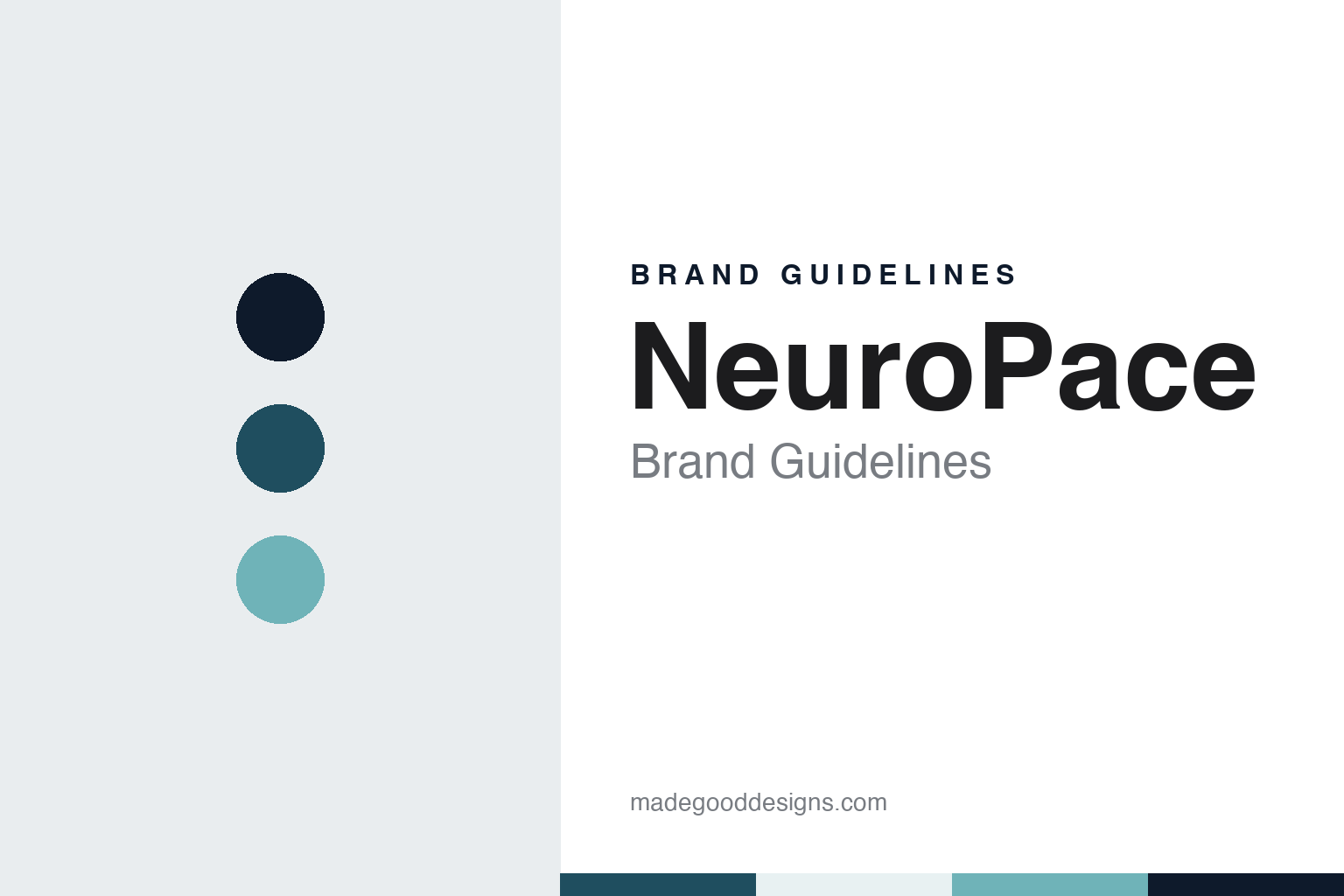
NeuroPace Brand Guidelines
One implant, one idea: a stimulator that responds.
Aa
Two constants: a NeuroPace navy and teal palette and a Display sans register. Abstract homage — not a NeuroPace product or mark; no implant, logo or device image is reproduced.
Sixteen years to approval
A Mountain View company built on one implant.
NeuroPace is a medical-device company based in Mountain View, California, and its history is the history of one product family: the RNS System, a neurostimulator implanted in the skull that senses electrical activity in the brain and responds to it. Company profiles published by IPOScoop and by Stock Analysis give 1997 as the year NeuroPace was incorporated, and both place its headquarters in Mountain View.
In a December 2011 post on his blog The World of Implantable Devices, the engineer David Prutchi listed NeuroPace among the medical-device companies founded by David R. Fischell, a serial entrepreneur with a doctorate in applied physics from Cornell University who had worked at Bell Laboratories before turning to medical devices full-time. Prutchi described NeuroPace at that point as a privately held company in Mountain View.
For its first sixteen years NeuroPace was a development company. The U.S. Food and Drug Administration’s premarket-approval database records that NeuroPace filed its application for the RNS System on 2 July 2010 and that the agency approved it on 14 November 2013, under the generic name “implanted brain stimulator for epilepsy.” The approval order covers adults aged 18 or over with partial-onset seizures traced to no more than two foci who had not been helped by two or more anti-epileptic medications, and the database lists a long series of later supplements to that approval.
Investors carried the company through that long development. Neurotech Reports noted in March 2021 that a financing round in 2020 had been led by Accelmed Partners, with OrbiMed Advisors and KCK Group among the returning investors. In April 2021 NeuroPace listed its shares on the Nasdaq under the ticker NPCE; Stock Analysis gives 22 April 2021 as its first trading day and showed the shares still trading in November 2026. Its chief executive is Joel Becker, according to the company’s December 2025 press release; in 2021 Neurotech Reports quoted Mike Favet in that role.
Colour
Sensing first, then stimulating.
Prutchi’s 2011 post gives the plainest account of the hardware. It expands RNS as “Responsive Neurostimulator.” The neurostimulator is implanted in the cranium and connected to one or two leads — depth leads placed into the brain or cortical strip leads laid on its surface — positioned near the place where a patient’s seizures begin. Rather than stimulating on a fixed schedule, the device is designed to detect abnormal electrical activity and respond with stimulation. In 2011 clinicians set it up with a programmer, a laptop with proprietary software and a telemetry wand, which also let them view and upload the electrocorticogram, the record of brain activity stored on the implant. Stock Analysis now lists a physician tablet for programming, a Patient Remote Monitor, a patient data management system that collects what the implant records, and the nSight platform, which it describes as giving clinicians personalized patient reports and programming suggestions.
That responsive idea is the brand. Neurotech Reports, in its March 2021 issue, called the RNS System “the only FDA-approved brain-responsive neurostimulator” for focal-onset refractory epilepsy, and set NeuroPace beside Medtronic and LivaNova as the three publicly traded makers of implanted devices for epilepsy. The company today describes its platform as delivering “personalized, real-time treatment at the seizure source”; that is its own wording.
NeuroPace has been working to widen the system’s use. Neurotech Reports wrote that in February 2021 the company had received an FDA Breakthrough Device designation for the potential use of the RNS System in idiopathic generalized epilepsy, a form of the condition the magazine described as having a strong genetic basis, and that its listing filing named further possible areas of research, among them depression and memory disorders. The company ran a trial in idiopathic generalized epilepsy called NAUTILUS. On 8 December 2025 it announced what it called positive 18-month results, describing NAUTILUS as the first randomized controlled trial of neuromodulation in drug-resistant idiopathic generalized epilepsy; those results and that description are the company’s own announcement.
Typography
Design and documentation.
Neuromodulation companies sell devices that most people will never see. Spinal cord stimulators, sacral nerve stimulators, hypoglossal nerve implants and brain-computer interfaces sit under the skin or inside the skull, so the companies that make them have to show something else: the scale of the device, the place it sits in the body, and the people it is meant for.
A few images recur across the category. Implants are often photographed held between fingertips or beside a coin or a key fob, to make their size legible. X-ray-style renders show thin leads running along a spine or curving toward a nerve, with the generator drawn as a small rounded shape. Patient pages tend to use calm portraits at home, on walks or with family, rather than hospital scenes.
Brain-computer interface start-ups lean in another direction: glowing renders of the brain, electrode arrays magnified many times over, and photographs of lab benches, engineers and surgical teams. Their audience includes investors and researchers as much as doctors, and the imagery often reads as a promise about the future rather than a product shot.
The category also has its own meeting places. Trade congresses such as the North American Neuromodulation Society (NANS) meeting, the International Neuromodulation Society (INS) congress and the Society for Neuroscience annual meeting are where companies show booths, posters and new hardware to clinicians and scientists. This guide sets out what can be checked about each company — founding, ownership, products and approvals as dated sources state them — and marks clearly what rests only on the company’s own word.
Aa
A clean display sans — one word, a capital P in the middle. (Specimen set in Manrope, a sans STAND-IN; NOT the NeuroPace logo.)
NeuroPace
One word, a capital P.
The company writes its name as one word with a capital P in the middle — NeuroPace — and its product name, the RNS System, carries the same idea of response. Its public material speaks in two registers. Patient pages talk about drug-resistant epilepsy, eligibility and living with the implant, with a step-by-step quiz that asks whether a patient might be a candidate. Its corporate pages are brief: they place the company in Mountain View and list five values — patient focus, science, innovation, integrity and leadership — each with a one-line motto, such as “We transform lives” and “We do what’s right.”
Its regulatory record is public: the FDA’s premarket-approval database lists the original 2013 approval together with each later supplement to it. Readers looking for the company should use neuropace.com, its own site.
For a design guide, NeuroPace shows how a company built on a single implant can make one idea — sensing and responding — the centre of its name, its product and its pages. Compare Medtronic, which Neurotech Reports named in 2021 as another publicly traded maker of implanted epilepsy devices, and Synchron, a neurotechnology company whose implant also records the brain’s electrical activity. For this guide we use a cortex navy and a signal teal with a sans, an unofficial interpretation; no product or logo is reproduced.
Explore & save
Keep NeuroPace’s identity on hand — save it to a board in the Made Good inspiration library.
NeuroPace identity set
Pin the NeuroPace navy and teal palette and the Display sans register to your own board.