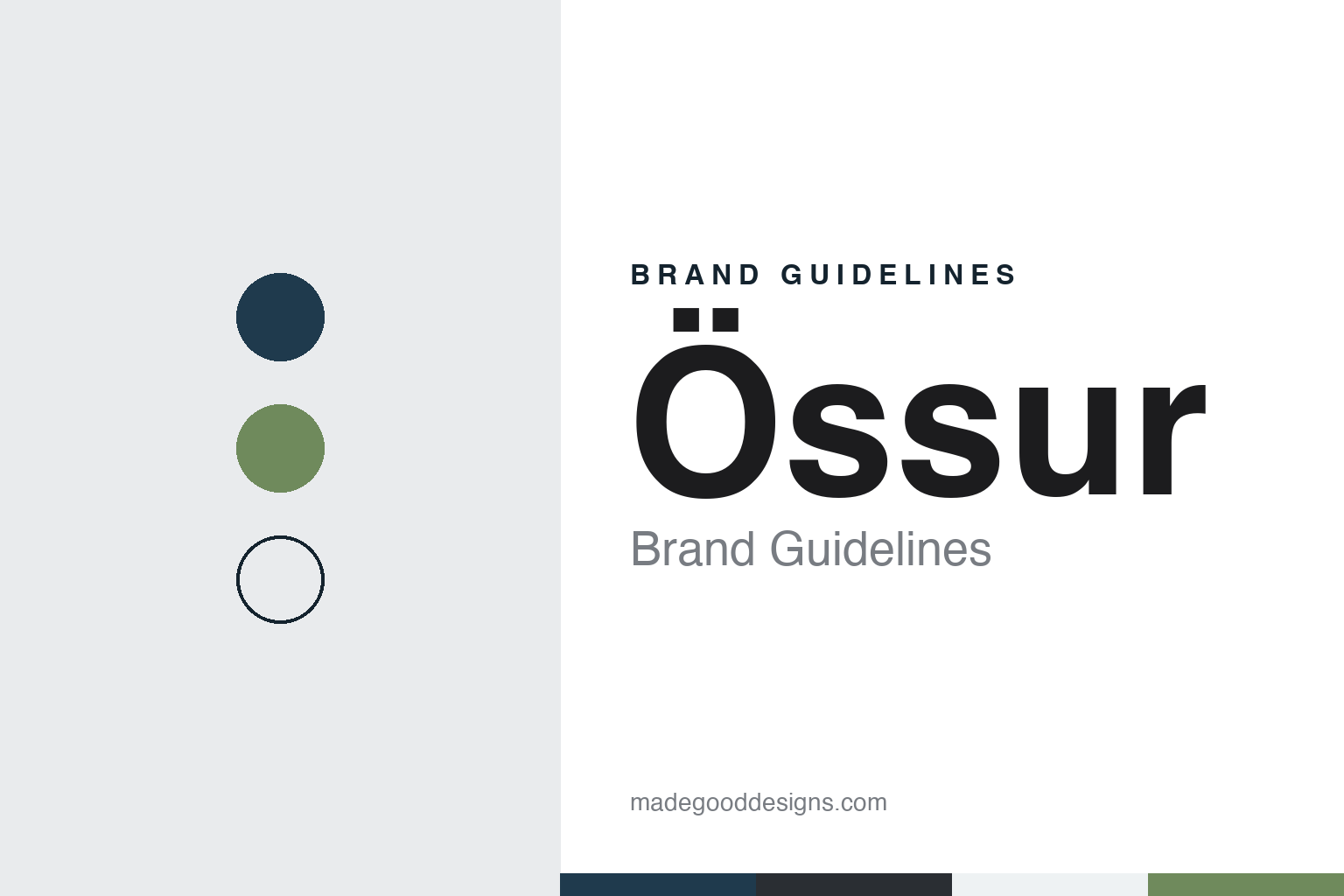
Össur Brand Guidelines
A prosthetist’s first name on liners, feet and knees.
Aa
Two constants: a fjord blue, basalt and glacier white palette and a Nordic sans register. Abstract homage — not an Össur product or mark; no prosthesis, brace, logo or wordmark is reproduced.
A Prosthetist’s Name
From an Icelandic workshop to a listed group.
Össur began in Iceland in 1971. English Wikipedia says it was founded by Össur Kristinsson, a prosthetist, and that his family owned the company until 1999, when it was listed on the Iceland Stock Exchange. The company says it is named after him, and credits him with developing a silicone interface for prosthetic sockets that became the Iceross liner. For its first years it served only the Icelandic market; English Wikipedia dates its first exports to 1986.
The listing started a long run of purchases. English Wikipedia counts more than twenty acquisitions since 2000. Among them are Flex-Foot, Inc. in 2000, whose name now covers Össur’s carbon-fibre feet; Royce Medical in 2005; the French compression-wear company Gibaud in 2006, which took Össur into stockings, bandages and stump socks; Touch Bionics in 2016; and College Park Industries in 2019, which the group now describes as a designer and manufacturer of lower-limb prosthetics. In January 2024 an announcement on Nasdaq Copenhagen said Össur had agreed to buy all the shares of Fior & Gentz, a German maker of knee and ankle joints for custom orthoses, founded in 1997.
The shares moved market as the company grew. Össur has been listed on Nasdaq Copenhagen since 2009, according to both English Wikipedia and the company, and in 2019 it marked twenty years as a public company. In 2024 the listed parent took a new name, Embla Medical, English Wikipedia says, while Össur stayed as the name on the products. Embla Medical explains the choice on its website: in Nordic mythology Embla was the first woman, made from the wood of an elm, and the company presents her as a symbol of new life, breath and movement.
Today the group describes itself as home to Össur, Fior & Gentz and College Park, and to a network of clinics run under the ForMotion name, which its 2025 annual report says was being rolled out globally. Its head office is in Iceland, and English Wikipedia places Össur’s headquarters in Reykjavík, with offices in the Americas, Europe and Asia and distributors in other markets.
Colour
Liners, carbon-fibre feet and microprocessor knees.
Össur works in two broad fields: prosthetics, and what it calls bracing and supports. English Wikipedia lists prosthetic limbs and joints, liners, sockets, locks and sleeves on one side, and braces for arms, legs and torso, along with cervical collars, on the other. Among the product names the company itself lists are Iceross, Flex-Foot, Total Knee and Unloader.
The Flex-Foot line is made from carbon fibre, a material English Wikipedia notes is used in aerospace for its combination of strength and flexibility. The Flex-Foot Cheetah running blade is a derivative of that line, the encyclopedia says; it was developed by the engineer Van Phillips and has been worn by athletes including Alan Oliveira and Markus Rehm. The Total Knee is described there as a prosthetic knee with a locking moment in full extension, and the Mauch Knee as one with a hydraulic system.
Electronics followed. The company groups its microprocessor products under the heading of bionics, and English Wikipedia names three of them: the Rheo Knee, a microprocessor-controlled knee; the Power Knee, a motor-powered knee; and the Proprio Foot, a motor-powered foot module. In November 2006 the BBC’s online magazine described the Proprio Foot as one of “a new range of bionic artificial limbs” designed by Össur, using sensors and a built-in microprocessor to imitate some of the actions of a human foot. English Wikipedia also records a research collaboration with the Alfred Mann Foundation on implanted sensors for controlling a prosthesis, extended under a new agreement in 2019.
Recognition has come from outside the medical trade. In 2006 the World Economic Forum named Össur a “technology pioneer,” English Wikipedia says, and the company repeats the title on its own pages. Össur also sponsors a group of para-athletes as Team Össur; English Wikipedia names Sarah Reinertsen, Markus Rehm and Jody Cundy among them.
Typography
How the category presents itself.
Prosthetics and orthotics companies sell to two audiences at once. Their customers are mostly clinicians, the prosthetists and orthotists who measure, cast and fit, and the clinics and health systems that pay; the people who wear the limbs and braces are the ones the pictures are built around. Blatchford’s website, for one, splits into sections for healthcare professionals, with technical documentation, training and clinical papers, and for patients and caregivers.
The imagery follows from that. Product shots often show carbon-fibre feet, knee joints and silicone liners isolated on white, like engineering components, which in part they are. Next to them come people in everyday settings: walking a dog, climbing stairs, at work or at home. Clinic photographs show a clinician kneeling beside a patient to check the alignment of a socket. The language around the pictures is about mobility and independence, often in a short slogan that the company uses as a statement of purpose.
Sport supplies the most dramatic images. Running blades made from carbon fibre have become a visual shorthand for the whole field, and makers put para-athletes in front of the camera; Össur, for one, sponsors a group of them as Team Össur, English Wikipedia says, naming Markus Rehm and Jody Cundy among them. Those pictures sit beside the quieter work of everyday limbs, which make up most of what the trade fits.
The industry also has its own meeting places. OTWorld in Leipzig, a world congress and trade fair held every two years, brought prosthetists, orthotists, manufacturers and researchers together in May 2026 and has announced its next edition for May 2028, with a para-sport activity area among its features. For a designer, the category is a study in balance: precision engineering, clinical trust and personal stories, held together, in several cases, by a founder’s own name.
Aa
A clean Nordic sans for a company named after its founder. (Specimen set in Manrope, a sans STAND-IN; NOT the Össur logo or wordmark.)
Össur
A founder’s name under a mythological parent.
The company’s websites show how the identity is split. The Americas pages say Össur Americas is based in Orange County, California, serving the United States, Canada and South America, and runs an education and custom-fabrication facility in Orlando, Florida. The global pages describe the company’s work as the development, production and sale of non-invasive orthopaedics, with a staff of around three thousand in 25 countries; English Wikipedia gave a figure of more than 3,500 people for 2019.
Both Össur and its parent use the phrase “Life Without Limitations,” marked as a registered trade mark, as a statement of purpose, and Embla Medical says it has produced more than 2,200 patents since 1971. The name Össur keeps its Icelandic Ö in the company’s own writing, while its web addresses spell it “ossur.” Above it sits Embla Medical, a name taken from mythology rather than from a person; below it sit sub-brands such as Iceross, the founder’s liner, and Flex-Foot, which arrived with the acquisition of 2000.
The group has kept acquired names in use rather than folding them all into one. Fior & Gentz and College Park appear under their own names in the 2025 annual report, beside Össur and the ForMotion clinics. That gives the group a layered structure: a parent name for investors, a founder’s name for the main product range, and separate names for specialist makers and for clinics.
For a design guide, Össur shows how a founder’s first name can carry a product family while a listed parent takes a different, mythological name. Compare Blatchford, the British limb maker founded in 1890, and Permobil, the Swedish power-wheelchair maker. For this guide we use a deep fjord blue, a basalt grey and a glacier white with a moss-green accent and a sans, an unofficial interpretation; no product or logo is reproduced.
Explore & save
Keep Össur’s identity on hand — save it to a board in the Made Good inspiration library.
Össur identity set
Pin the Össur fjord blue, basalt and glacier white palette and the Nordic sans register to your own board.