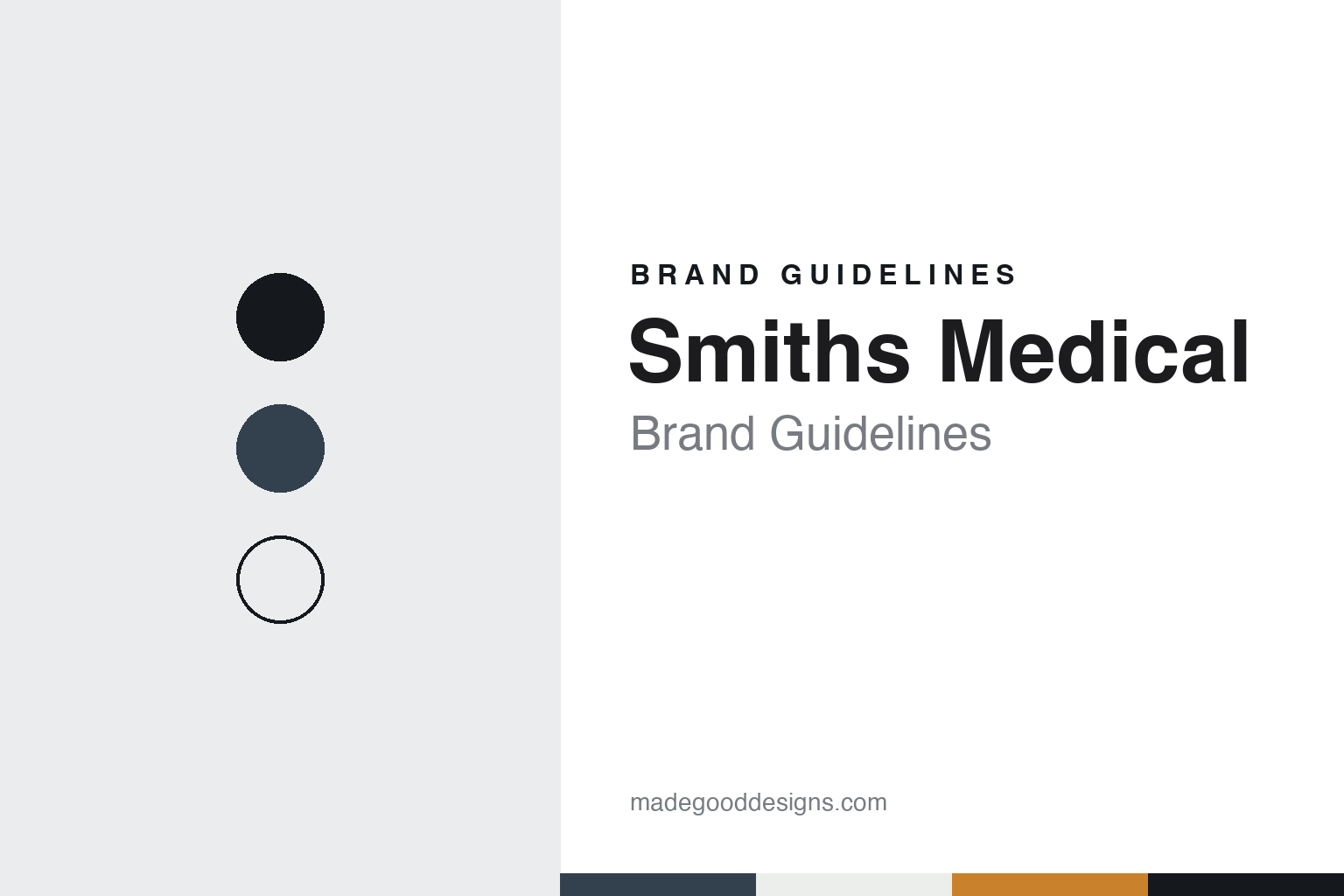
Smiths Medical Brand Guidelines
A British tubing firm turned infusion division, sold to ICU Medical in 2022.
Aa
Two constants: a Smiths Medical slate, amber and tubing grey palette and an Industrial serif register. Abstract homage — not a Smiths Medical product or mark; no device, logo or label is reproduced.
Portland Plastics
A tubing maker bought by an instrument firm.
Smiths Medical was the medical arm of Smiths Group, the London engineering company that began, English Wikipedia says, as a jewellery and watch business opened by Samuel Smith in 1851. Smiths became known for clocks, watches and the instruments fitted to British cars and motorcycles. Its move into medicine came through plastics: in the late 1950s it took control of Portland Plastics, a maker of plastic and nylon tubing. Grace’s Guide to British Industrial History dates that purchase to 1957, while English Wikipedia gives 1958 and calls the firm the foundation of the Smiths Medical Systems division.
In 1967 Portland Plastics took the name Portex, based in Hythe, Kent, according to Grace’s Guide. Portex made tubes for anaesthesia and airways, and Grace’s Guide records several Queen’s Awards in the 1970s, including one for the Profile cuff used on endotracheal and tracheostomy tubes. The parent, by then called Smiths Industries, was reorganised in 1984 into three divisions — Industrial, Medical Systems, and Aerospace and Defence — English Wikipedia says, and the medical side kept buying.
Grace’s Guide lists a long run of purchases. The first came in 1979, when the business bought Concorde Laboratories, a maker of blood-sampling products. In 1988 the business bought Avon Medicals, with dialysis and blood transfusion products; in 1989 Peter von Berg, a maker of pressure transducers and catheters; and in 1994 Deltec, an American maker of medication delivery pumps and vascular access devices; Wikipedia also dates the Deltec purchase to 1994. In 1995 came Level 1, an American temperature-management company, and in 1997 Graseby Medical, whose products included hospital medication pumps. In 1998 it bought BCI, whose monitors tracked respiration, oxygen saturation and blood pressure, and in 2001 it added Bivona, a maker of silicone airway products.
Colour
Smiths Medical International.
The parent company became Smiths Group plc in November 2000, English Wikipedia says, and by 2003 medical was one of its three divisions, according to Grace’s Guide. Portex had traded as Sims Portex from 1996 before returning to the Portex name in 2001; in 2004 it was renamed Smiths Medical International, and in 2005 the business bought Medex, an American maker of critical care products, Grace’s Guide records. Not every move was a purchase: in 2002, Grace’s Guide adds, the business sold its Simcare urology range to Mentor Medical, and it had bought H.G. Wallace in two steps, in 1992 and 1993.
By the time of its sale the business was run from the United States. The Orange County Business Journal described Smiths Medical in January 2022 as a Minneapolis-based subsidiary of Smiths Group, employing some 7,500 people at manufacturing operations in the United States, the United Kingdom, Mexico and Italy. Its products, ICU Medical said, were syringe and ambulatory infusion devices, vascular access and “vital care” products. Grace’s Guide summarises its 2020 range as infusion systems, vascular access products and airway management products.
Several of its product names outlived the company. The CADD ambulatory pumps and Medfusion syringe pumps are named in a 2025 FDA warning letter as made at the former Smiths Medical site in Minneapolis, and ICU Medical’s website today lists the Portex name on airway products and Level 1 on fluid warmers, alongside Bivona tracheostomy tubes.
Typography
Bedside and ward.
Hospital device makers sell to clinicians, purchasing teams and hospital engineers rather than to shoppers, and their brands are built for that audience. Their catalogues and websites tend to show the equipment where it is used: infusion pumps on poles beside a bed, dialysis machines lined up in a treatment room, monitors and consoles in intensive care.
Much of the product is small and disposable, so the pictures often come close. Gloved hands hold a catheter, a cannula or an infusion set; blood tubing is coiled for a dialysis session; a dialyzer or a single-use endoscope is photographed on plain white so that every connector and label can be read. Product names usually lean on model numbers and technical terms rather than on lifestyle words.
People appear too, usually in uniform: nurses and doctors at the bedside, technicians at a workbench, trainers at a company teaching centre. Several makers in this group run their own training facilities for clinicians, and they present them as part of what they sell alongside the devices.
The trade meets at congresses and fairs. Medica in Düsseldorf gathers hospital suppliers from around the world each autumn; ASN Kidney Week, the American Society of Nephrology’s annual meeting, draws dialysis makers; and Digestive Disease Week brings together gastroenterologists and endoscopy suppliers. Stands, booth graphics and congress brochures are where many of these brands are seen at their largest, and this guide sets out what can be checked about each company: who founded it, who owns it, and where it says its products are made.
Aa
A sturdy serif for a British-born medical division. (Specimen set in Source Serif 4, a serif STAND-IN; NOT the Smiths Medical logo.)
Smiths Medical
Sold to ICU Medical in January 2022.
Smiths Medical is no longer an independent business. Smiths Group had already agreed to sell the division to a buyer named Trulli Bidco when, on 8 September 2021, it and ICU Medical of San Clemente, California, announced a deal the two companies described as superior. Under it Smiths would hold about ten per cent of ICU Medical and name a director to its board. ICU said on 6 January 2022 that it had completed the purchase, earlier than the first-half timetable it had given; the Orange County Business Journal reported that the two sides had first talked in 2018, and that Smiths’ chief executive had called the sale the group’s largest portfolio move in over a decade.
Smiths Group itself has since become, in English Wikipedia’s description, a business mainly in industrial technologies, after selling its interconnect and detection divisions in 2026. ICU Medical now makes and sells the former Smiths Medical lines, as its website and the FDA show. On 4 April 2025 the US Food and Drug Administration sent ICU Medical a warning letter after inspecting the former Smiths Medical site in Minneapolis in July and August 2024; it said the Medfusion Model 4000 syringe pump and the CADD-Solis VIP ambulatory pump had been changed without the premarket submissions the agency requires. MedTech Dive reported that the changes were fixes made after a Class I recall over fluid delivery, false alarms and interrupted therapy, and that the letter followed a series of recalls since the 2022 purchase.
For a design guide, Smiths Medical shows how a corporate division name can sit above older product brands — Portex, CADD and Medfusion — that outlast it. Compare ICU Medical, which bought the business, and B. Braun, the Melsungen maker of the Braunüle cannula. For this guide we use a slate blue, a warm amber and a pale tubing grey with a serif, an unofficial interpretation; no product or logo is reproduced.
Explore & save
Keep Smiths Medical’s identity on hand — save it to a board in the Made Good inspiration library.
Smiths Medical identity set
Pin the Smiths Medical slate, amber and tubing grey palette and the Industrial serif register to your own board.