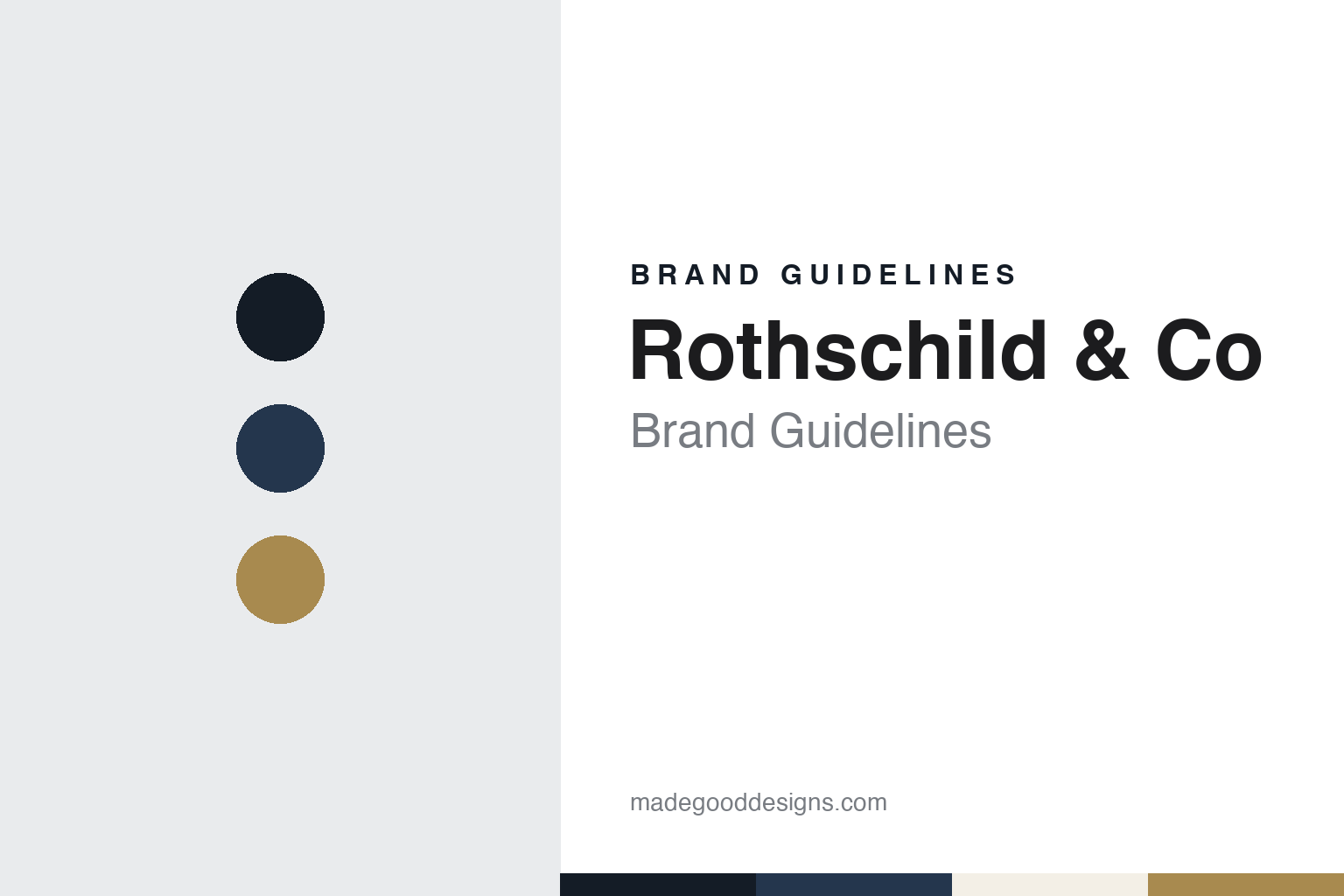
Rothschild & Co Brand Guidelines
The family bank from Frankfurt that kept one London address for two centuries.
Aa
Two constants: a Rothschild & Co ink, vellum and brass palette and a restrained serif register. Abstract homage — not a Rothschild & Co asset or mark; no logo, crest or document is reproduced.
Frankfurt and five cities
A family business, a partnership agreement and five sons.
Rothschild & Co dates its records to 1769, when, the company says, Mayer Amschel Rothschild was building a family business in Frankfurt; it places the start of that business in the 1760s and the family’s roots in the city in the 15th century. In 1810 he drew up the family’s first partnership agreement, which the company calls the foundation document of its modern business. His five sons took the business to Frankfurt, London, Paris, Vienna and Naples in the early 19th century, a spread that The Business Times, carrying an AFP report, also described in September 2023.
The London house was N M Rothschild & Sons. English Wikipedia says Nathan Mayer Rothschild, the third son, first settled in Manchester, in finance and the textile trade, before founding the London firm in 1811 at New Court, St Swithin’s Lane, where Rothschild & Co’s London headquarters still stand. In the early 19th century the bank handled subsidies the British government paid to its allies during the Napoleonic Wars, and in 1875 it financed the British government’s purchase of a controlling interest in the Suez Canal. English Wikipedia also records that the London bank provided the government borrowing used under the Slavery Abolition Act 1833 to pay compensation to slave owners, a debt only fully redeemed in 2015.
The Paris house began when James, born Jacob, settled in the city in 1812 and formally created de Rothschild Frères in 1817, English Wikipedia says. The family motto, Concordia, Integritas, Industria, was chosen in 1822, according to the company. The French and English houses later joined other investors in the Rio Tinto copper mines in 1873 and lent to and invested in the De Beers diamond mines in 1887.
Colour
War, nationalisation and a railway company’s name.
After the First World War the Rothschild banks moved steadily towards advisory work and raising finance for companies, including the London Underground, English Wikipedia says. In Austria, the Rothschilds’ interests passed under Nazi control in 1938, ending more than a century of the family’s banking in Central Europe, and after the Fall of France in 1940 the Paris bank was seized by the German occupiers and restored to the family at the end of the war, according to English Wikipedia. The company says members of the French family in exile in New York in the 1940s created the basis of its modern US business.
The company that carries the name today has a separate origin. Paris Orléans was founded in 1838 as the Compagnie du chemin de fer de Paris à Orléans, a railway, and was nationalised in 1938 into the new state railway, SNCF. After the Second World War the French family turned what remained into a holding company for its banking and other investments. The government of François Mitterrand nationalised Banque Rothschild, in 1981 according to English Wikipedia and in 1982 according to the company, and the bank lost its rue Laffitte offices, its Paris home since 1812. David and Éric de Rothschild rebuilt the French business under the Paris Orléans name and regained the use of the family name in the mid-1980s: 1985 by the company’s account, 1986 by English Wikipedia’s.
The French and British houses merged in 2003 under David de Rothschild, the company says, and French Wikipedia dates the consolidation of the English and French branches within Paris Orléans to April 2012. In 2011 the trading name changed from N M Rothschild & Sons to Rothschild & Co, English Wikipedia says, and in 2015 Paris Orléans itself took the Rothschild & Co name. The Swiss-based Edmond de Rothschild Group, a separate business, contested that use of the name; the two sides settled in 2018, French Wikipedia says, on terms under which the name is not used on its own.
Typography
Design and documentation.
Independent investment banks sell advice rather than balance sheets, and their public identities tend to reflect that. An advisory firm’s website usually leads with a name, a list of offices and a record of work. Most of the firms in this guide carry the surname of a founder or founding family, and the house name is typically set in a restrained serif or a plain sans with almost no ornament. The office list itself can run to dozens of cities on several continents.
The record of work is the centrepiece. Advisory firms publish transaction lists, the modern form of the printed “tombstone” notice, naming the client, the counterparty, the firm’s role and the year. Evercore’s transactions pages, for example, mark each mandate as pending or closed. In these guides the deals are named without their sums.
Around that record sit a handful of recurring page types: sector and coverage pages describing the industries and kinds of assignment a firm handles, such as mergers and acquisitions, restructuring, capital markets and private capital; team and leadership pages with partner biographies; and, at firms with research or asset management arms, research reports, outlooks and insights. Media pages often consist largely of announcements of senior hires by sector and city.
Careers pages complete the set: they describe training programmes, internships and the idea of partnership; Evercore, for one, calls talent its primary distinguishing asset. This guide sets out what can be checked about each firm — who founded it, how its ownership changed and how it presents itself today — and keeps each firm’s own claims attributed to it.
Aa
A restrained serif — the register of a centuries-old house. (Specimen set in EB Garamond, a serif STAND-IN; NOT the Rothschild & Co logo.)
Rothschild & Co
Private again, with New Court as its London home.
In February 2023 Concordia, the family holding company and the largest shareholder with nearly 40 per cent of the capital, announced a plan to buy the shares it did not own. The Business Times reported on 13 September 2023, citing the French markets regulator AMF, that the tender had closed on 8 September with Concordia holding just over 95 per cent of the capital, enough to request a mandatory delisting; the company says it left Euronext Paris in 2023. Rothschild & Co now describes three businesses, Global Advisory, Wealth and Asset Management and Five Arrows, its alternative-assets arm created in 2009, and more than 70 offices in 50 countries under seventh-generation family leadership, with Alexandre de Rothschild as executive chairman. Its French wealth business merged with Banque Martin Maurel in 2016 by the company’s dating; English Wikipedia gives 2017. On 15 June 2026 it signed an agreement to buy the Hamburg private bank Marcard, Stein & Co; completion was subject to regulatory approval and had not taken place at the time of writing.
Two Swiss matters are on the record. In June 2015 the group’s Swiss bank, now Rothschild & Co Bank AG, entered a non-prosecution agreement with the Tax Division of the US Department of Justice over US-related accounts and paid a penalty, English Wikipedia says. In July 2018 the Swiss regulator FINMA concluded proceedings linked to the Malaysian fund 1MDB, finding the bank and its trust subsidiary in serious breach of money-laundering due-diligence rules and appointing an audit agent to review the changes the bank had made.
The London address has its own design history. New Court has been rebuilt three times on the same site, English Wikipedia says: an Italian palazzo-style building of 1865 by Thomas Marsh Nelson, a 1962 rebuild, and a fourth building, decided in 2005, by Rem Koolhaas and his Office for Metropolitan Architecture, with a rooftop “sky pavilion” and views of St Stephen Walbrook from the lobby. The twice-daily London gold fixing was held in a room there until 2004.
For a design guide, Rothschild & Co shows how a family name, a motto and one London address can carry a firm through mergers, nationalisation and a return to private ownership. Compare Lazard, another Paris and London advisory house, and Goldman Sachs. For this guide we use a deep ink blue, a soft vellum and an aged brass with a serif, an unofficial interpretation; no product or logo is reproduced.
Explore & save
Keep Rothschild & Co’s identity on hand — save it to a board in the Made Good inspiration library.
Rothschild & Co identity set
Pin the Rothschild & Co ink, vellum and brass palette and the restrained serif register to your own board.