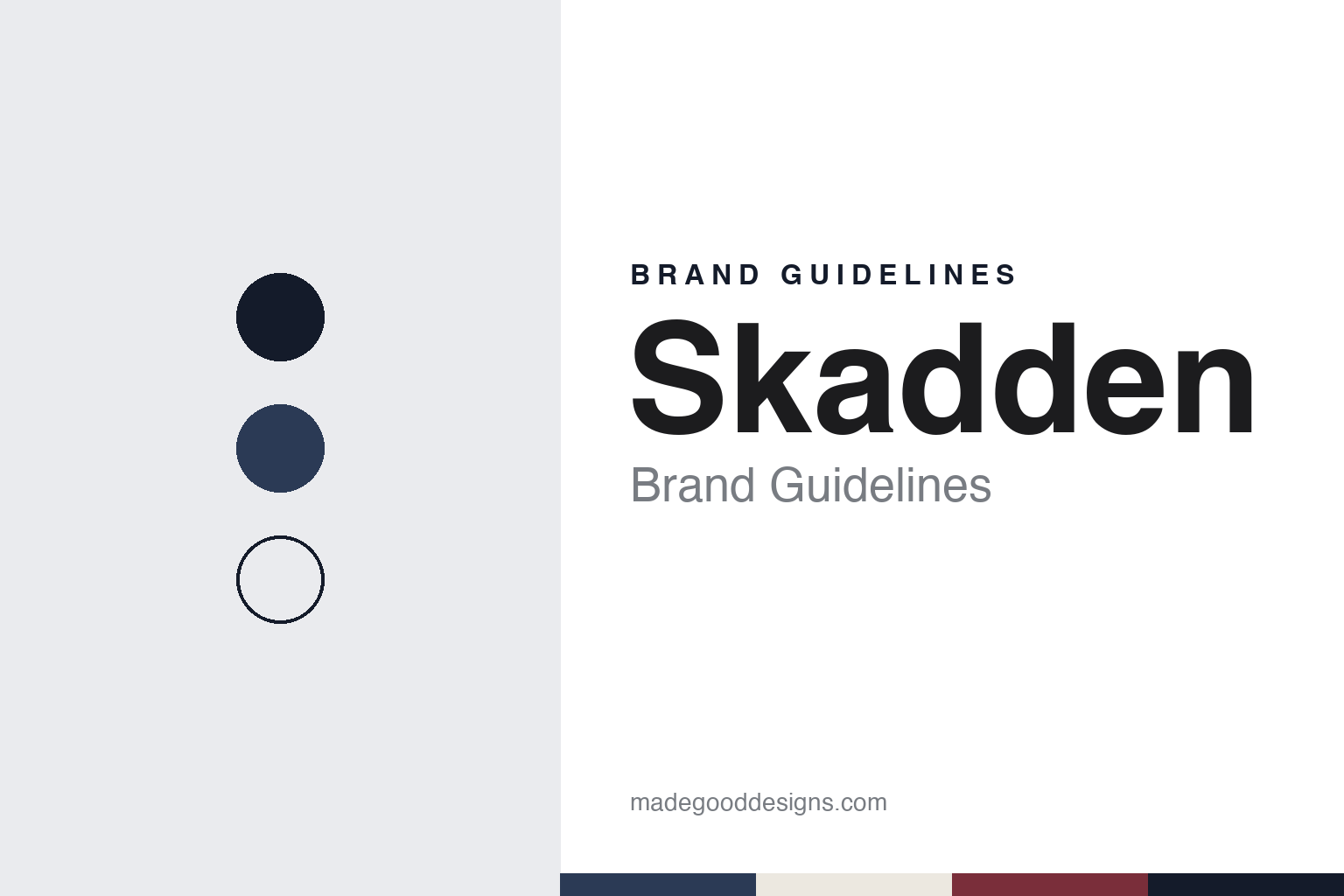
Skadden Brand Guidelines
A 1948 New York partnership that made takeover work its own.
Aa
Two constants: a navy, paper and claret palette and a transitional serif register. Abstract homage — not a Skadden asset; no logo, wordmark or document is reproduced.
Skadden, Arps & Slate
Four lawyers, no clients and a new partnership.
Skadden began in New York in 1948. According to Lincoln Caplan’s 1993 book Skadden: Power, Money, and the Rise of a Legal Empire, as summarised in the International Directory of Company Histories, the firm was founded on 1 April 1948 as Skadden, Arps & Slate, an informal partnership with no formal agreement. The three surnames of its founding partners still open the firm’s name, and news reports commonly shorten it to simply Skadden.
The lawyer most associated with the firm arrived in its first year. Joseph Flom met the founding partners over lunch in 1948, before he had graduated from Harvard Law School, and that year became the firm’s first associate, Harvard Law Today reported in February 2011. “There were four lawyers and no clients,” Flom recalled in a 1991 interview with the Harvard Law School Bulletin. The International Directory of Company Histories says Flom eventually influenced the firm’s growth more than any founding partner, and that his early work centred on shareholders’ derivative actions, the suits that owners of a company can bring against its board and management.
Growth was slow at first. By the mid-1960s, the directory says, the firm had about 20 lawyers and more work than it could handle. Two more names, Meagher and Flom, were added to the masthead, which became Skadden, Arps, Slate, Meagher & Flom — one of the longer names in American law, and the reason the short form stuck. The partnership later took a limited-liability form, which the directory describes as a hybrid between a partnership and a corporation.
Colour
Tender offers, proxy fights and retainers.
Skadden’s reputation rests on mergers and acquisitions. The International Directory of Company Histories says the firm handled its first tender offer in 1964, and that Flom rose in the 1960s as an adviser in proxy battles; Harvard Law Today describes him as widely recognised as a pioneer of the takeover strategies later used by bidders, targets and investment bankers. Caplan, as quoted in the directory, dates the firm’s turning point to a contested takeover in 1974.
The directory explains the opening the firm found. Many established Wall Street firms, it says, would not handle hostile takeovers for fear of upsetting long-standing corporate clients, and Skadden took the work. It also describes a new fee structure: corporate clients paid the firm a retainer so that it would be available to defend them in the event of a hostile bid, which also kept a would-be acquirer from hiring it against them. By the directory’s account, the firm was involved in almost every major American merger and acquisition from the late 1970s through the 1980s.
The firm also drew unusual attention for a law firm. The directory notes that the journalist Steven Brill featured it in Esquire and in the first issue of The American Lawyer, and Caplan’s book-length history appeared in 1993. Its offices spread from New York: Washington in 1976, Chicago in 1984, and a first office outside the United States in 1987, according to the directory, which by the late 1990s listed offices in cities including Beijing, Brussels, Frankfurt, Hong Kong, London, Paris, Tokyo and Toronto.
Inside, the firm changed how it was run. In 1990, the directory says, it reorganised its management to work more like a corporation with a board, and it promoted its first woman partner in 1981. Caplan, as summarised in the directory, also describes a reserve the firm called its “Rainy Day Fund,” intended to cover all of its expenses for six months in an emergency, and a committee that divides profits by weighing the quality of work, hours, practice profitability and contributions to management.
Typography
How large US law firms present themselves.
Large American law firms tend to present themselves with restraint. Many are named after founding or senior partners, and their names are often set as sober wordmarks: a serif with a long institutional pedigree, or a plain grotesque sans, usually in a single colour. Navy, near-black and white are common choices, with an occasional accent kept for links and headings rather than for decoration. Long partnership titles are frequently cut down over the decades to two surnames joined by an ampersand, or to a single surname used in conversation.
Their websites are built around how clients and recruits search. Practice-area and industry pages sit near the top, alongside a directory of lawyer biographies, each with a headshot, admissions, education and representative work. Latham & Watkins, for example, organises its main menu under People, Capabilities, Achievements, Insights and Global Citizenship, and lists every office by city on its About Us page.
Publishing is a large part of the presentation. Firms issue client alerts on new laws and rulings, along with articles, podcasts and webcasts grouped under headings such as insights or thought leadership. Many also publish pro bono reports, figures on community service and reports on diversity and inclusion, and some set out environmental commitments for their offices.
Recruiting pages form a separate register, written for law students and junior lawyers: summer associate programmes, training, office life and alumni networks. Across all of these pages the visual system usually stays quiet, so that the firm’s name, its people and its record of work carry the identity. The guides in this series look at how individual firms use those conventions, and where their histories and names differ.
Aa
A sober transitional serif for a long masthead. (Specimen set in Libre Baskerville, a serif STAND-IN; NOT the Skadden logo or wordmark.)
Skadden
Fellowships, a 2025 agreement and a short name.
Skadden’s public-interest programme carries its short name. In 1988 Flom co-founded the Skadden Fellowships, through which the firm supports at least 25 law school graduates each year to work in public-interest jobs for up to two years, Harvard Law Today reported in 2011. Flom was a founding trustee of the programme, and the fellowships have made the name familiar well beyond corporate law.
In 2025 the firm was drawn into the US government’s dealings with large law firms. On 28 March 2025 the White House announced an agreement under which Skadden committed to pro bono legal work for causes that the President and the firm both support and affirmed merit-based hiring, Business Insider reported; the outlet described such agreements as a way for firms to avoid punitive executive action. The firm said it had engaged proactively with the administration, according to the same report.
As a brand, Skadden works on a single surname. The full firm name runs to five partners, but the identity that appears in headlines, rankings and the fellowship programme is the first word alone, set in the restrained register common to large American law firms.
For a design guide, Skadden shows how a long partnership name can be carried by its first word without losing its weight. Compare Wachtell, Lipton, another New York firm known for mergers work, and Sullivan & Cromwell, a far older Wall Street partnership. For this guide we use a deep navy, warm paper and a claret with a serif, an unofficial interpretation; no product or logo is reproduced.
Explore & save
Keep Skadden’s identity on hand — save it to a board in the Made Good inspiration library.
Skadden identity set
Save the Skadden navy, paper and claret palette and the transitional serif register to your own board.