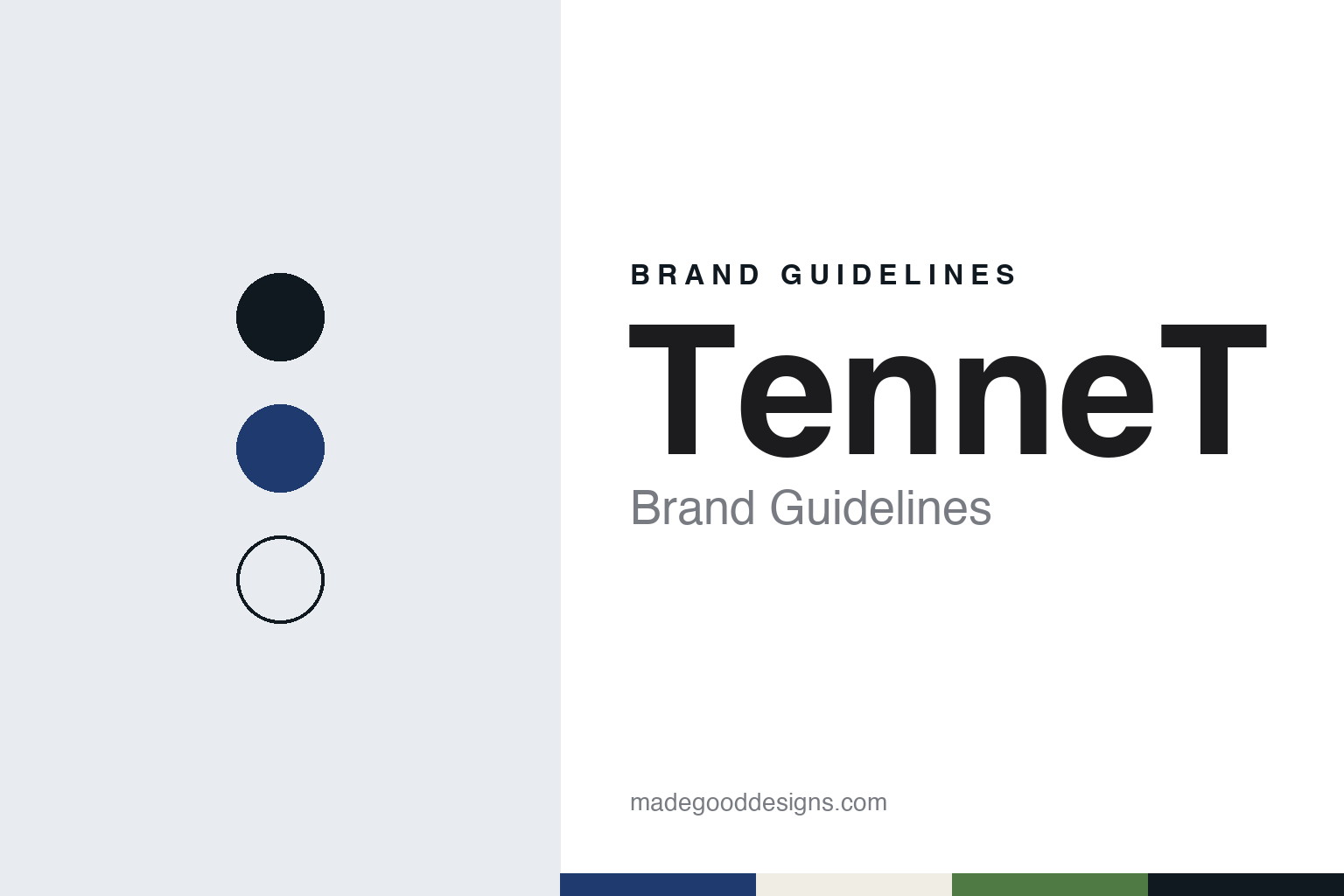
TenneT Brand Guidelines
Arnhem’s 1998 grid operator, from the Randstad ring to the North Sea.
Aa
Two constants: a delta blue, papyrus white and polder green palette and an engineering sans register. Abstract homage — not a TenneT asset or mark; no pylon drawing, logo or map is reproduced.
Arnhem, 1998
A liberalised market and a national grid.
TenneT began in 1998, when the Dutch electricity industry was liberalised. Dutch Wikipedia says the Electricity Act of that year named TenneT Transmission System Operator B.V. the independent manager of the national transmission grid, and traces its grid role back to SEP, the cooperative that Dutch power producers formed in 1949 to link their stations and run the national interconnecting network. English Wikipedia, citing the economist Eric van Damme in The Energy Journal (2005), dates the formation to the 1998 liberalisation, and the International Directory of Company Histories (2006) gives 2001 as the year it was incorporated as a business under the law that reorganised the production sector. Its statutory tasks were to manage the national high-voltage grid and to keep the supply and demand of electricity in balance.
The company is based in Arnhem, and its sole shareholder is the Dutch state, represented by the Ministry of Finance. Dutch Wikipedia says the Dutch operating company, TenneT TSO B.V., has regional offices in Hoogeveen, Gouda and Weert. In its first decade TenneT gathered up the country’s high-voltage networks. In December 2003 it took over Transportnet Zuid-Holland, owner of the 150 kV grid in South Holland. A 2006 law on independent grid management, known as the splitting law, made TenneT responsible for all networks of 110 kV and above, and in 2009 it bought the regional high-voltage grids of Enexis, Delta and Liander, Dutch Wikipedia says. In 2004 it had begun a large expansion of the Dutch network, including a new Randstad 380 kV ring around the western conurbation.
The company also stepped into markets. In 2004 it bought EnergieKeuze, an online exchange for gas and power contracts, and in 2005 it joined the Belgian and French operators Elia and RTE and the APX and Powernext exchanges to form the Belgian power exchange Belpex, English Wikipedia says. The name is written with a capital T at each end, TenneT; German Wikipedia records the house spelling “TenneT TSO” for the German subsidiary and notes that it appears publicly as TenneT Germany.
Colour
Cables under the North Sea, pylons on the polders.
Much of TenneT’s work is out of sight, except where it crosses borders and seas. In 2006 it began building NorNed, a 700 MW undersea direct-current cable, with the Norwegian grid operator Statnett. English Wikipedia says commercial operation was delayed by poor weather and a break in the cable, and that the link entered service on the night of 6 May 2008, running about 580 km between Feda in Norway and Eemshaven in the Netherlands. With Britain’s National Grid it formed a joint venture for BritNed, a 1,000 MW, 260 km link between the Isle of Grain in Kent and Maasvlakte near Rotterdam, which began operating on 1 April 2011. The 700 MW COBRAcable to Denmark, also landing at Eemshaven, is run with Energinet from 2019, and the German arm runs the 1,400 MW NORD.LINK cable to Norway with Statnett from 2020, English Wikipedia says.
At sea TenneT also brings power from offshore wind farms in Dutch and German waters to land through converter platforms, Dutch Wikipedia says. In 2016, English Wikipedia says, TenneT proposed an artificial island of about 6 km² in the Dutch corner of the Dogger Bank to gather several gigawatts of offshore wind, and in 2017 it called for feasibility studies. On land in Germany it is building SuedLink, a direct-current line of almost 700 km from the north of the country to the south; English Wikipedia says that after protests from local residents the plan was changed from overhead lines to underground cables, with completion scheduled for 2028.
The most visible design object is the pylon. The Wintrack is a Dutch high-voltage pylon made of a pair of tubular masts, a so-called bipole, designed by the architecture firm ZJA for TenneT. Dutch Wikipedia says the design is not patented and may be used freely, that it received the Dutch Steel Award 2016, and that the first masts went up in 2011; a second version from around 2017 can be made partly or wholly of concrete. The masts are painted a pale papyrus white with darker fittings, and TenneT says, according to the same article, that the greyish tone lets the mast fade into the Dutch sky. Wintrack masts carry the 380 kV line between Doetinchem and Wesel, which entered service in 2018.
Typography
How grid operators present themselves.
Electricity transmission operators sell nothing a customer can hold, so their identities lean on the network itself. Most present a short corporate name set in a clean sans-serif wordmark, often with a small symbol or a single letter given weight, and keep the type plain enough to sit on a substation gate, a hard hat or a regulatory filing without change. Blue, green and yellow are the familiar colours of the category, read as sky, landscape and current.
Photography does much of the work. Pylons are shown in fields, dunes and mountain valleys, substations are framed against open sky, and cable ships, converter platforms and offshore islands stand in for the reach of a grid that crosses borders. People appear mostly as engineers and line crews in protective clothing, photographed at work rather than posed.
The websites follow a shared pattern. A grid map and an interconnector page show where lines run and which countries they link, and a network development plan sets out future routes and upgrades as the operator dates and describes them. Many publish real-time system data, with dashboards for load, generation, cross-border flows and balancing prices, and open consultation pages where residents and landowners can comment on planned lines.
The last regular section is recruitment. Careers pages address electrical engineers, technicians, data specialists and graduates, and present grid building as long-term public work. For a designer, the category is a study in restraint: a calm wordmark, a limited palette and a library of landscape, map and data imagery carry an identity that has to be trusted more than it has to be noticed.
Aa
An engineering sans for a name with a capital T at each end. (Specimen set in Albert Sans, a sans STAND-IN; NOT the TenneT logo.)
TenneT Germany
From E.ON’s grid to a shared company.
The German business came from E.ON. In May 2008, German Wikipedia says, E.ON committed to the European Commission, in antitrust proceedings running since 2007, to sell its German extra-high-voltage grid. The grid was spun off as Transpower Stromübertragungs GmbH, entered in the commercial register in Bayreuth on 4 May 2009, and E.ON announced its sale to TenneT in November 2009. The European Commission approved the takeover on 4 February 2010, and TenneT became owner with effect from 1 January 2010, Dutch Wikipedia says. Renamed TenneT TSO GmbH, the business is one of Germany’s four transmission system operators, based in Bayreuth, with a grid of 220 and 380 kV lines running between Schleswig-Holstein and Bavaria.
In 2018 the Commission turned to TenneT itself. It opened a formal antitrust investigation on 1 March 2018 into limits on trading capacity across the interconnection between western Denmark and Germany, and on 7 December 2018 it adopted a decision making binding TenneT’s commitments to offer at least 75% of the link’s capacity and to expand it, English Wikipedia says, citing the Commission’s press release.
The ownership of the German arm then changed in stages. In 2023 the Dutch and German governments discussed a sale of TenneT’s German grid to the German state bank KfW; those talks ended in June 2024 over German budget constraints, Dutch Wikipedia says. On 24 September 2025 the Dutch finance minister announced that three investors — the Dutch pension investor APG, Norges Bank Investment Management and Singapore’s GIC — would take 46%. On 3 February 2026 the German government agreed to buy 25.1% through KfW, DutchNews reported, a stake that carries veto rights over the business plan and senior appointments. TenneT’s German holding company announced on 3 July 2026 that the investors’ transaction had closed on 30 June and the KfW transaction on 3 July, leaving TenneT Holding with 28.9%. The release describes TenneT Germany as a standalone company from that point, and says the Dutch and German businesses will keep cooperating on the offshore 2GW Program in the North Sea.
For a design guide, TenneT shows how a grid operator’s most public face is its hardware: a name with a capital T at each end, a white bipole pylon set against a flat landscape, and cable routes drawn across the North Sea. Compare Statnett, its partner on NorNed, and National Grid, its partner on BritNed. For this guide we use a deep delta blue, papyrus white and polder green with a sans, an unofficial interpretation; no product or logo is reproduced.
Explore & save
Keep TenneT’s identity on hand — save it to a board in the Made Good inspiration library.
TenneT identity set
Pin the TenneT delta blue, papyrus white and polder green palette and the engineering sans register to your own board.