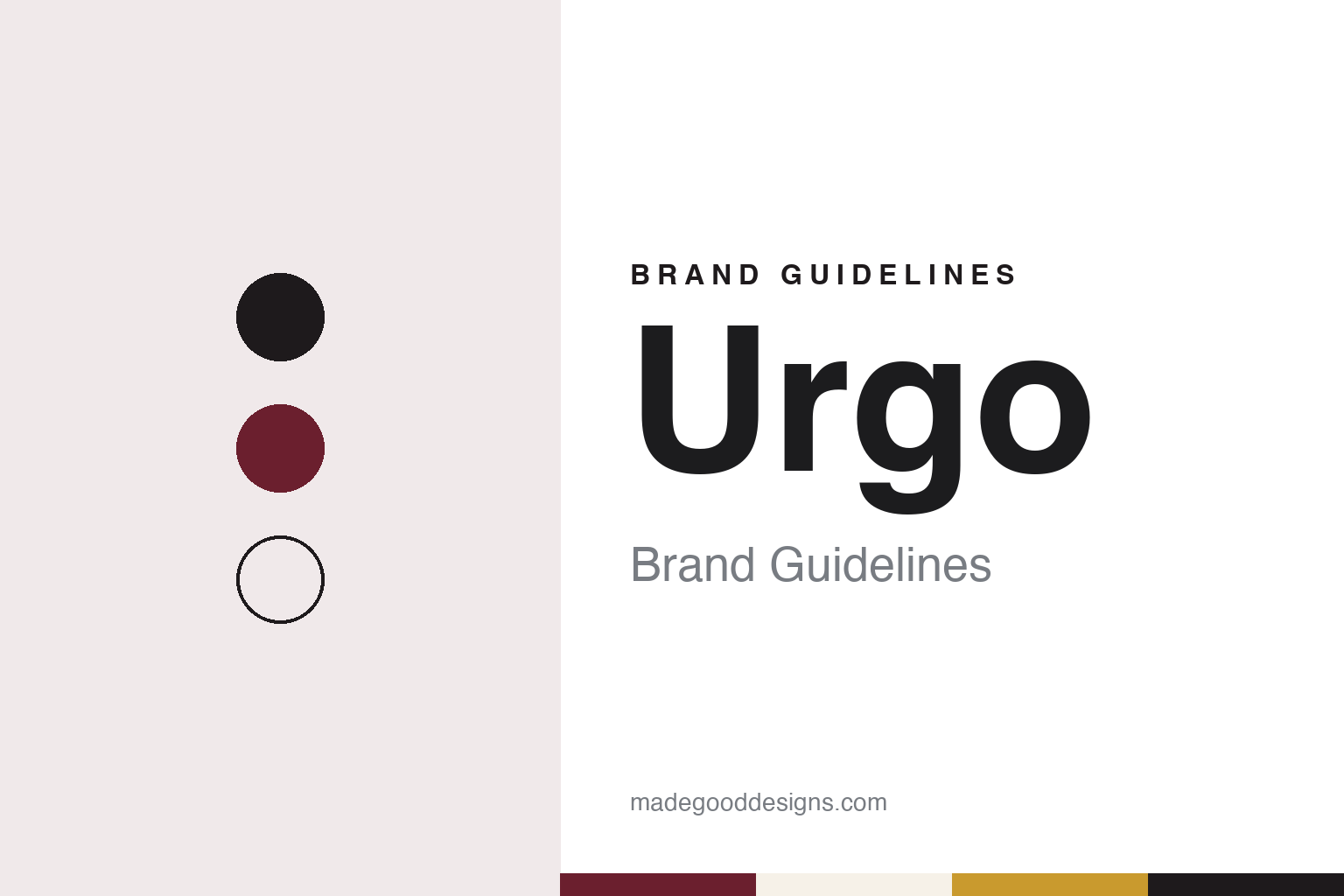
Urgo Brand Guidelines
The 1958 Dijon dressing brand run by the Le Lous family.
Aa
Two constants: an Urgo burgundy and mustard palette and a Warm serif register. Abstract homage — not an Urgo product or mark; no dressing, logo or packaging is reproduced.
Fournier of Dijon
A drugstore of 1880 and a brand of 1958.
Urgo’s roots are older than its name. French Wikipedia, citing the Dijon daily Le Bien Public, records that Laboratoires Fournier began in 1880 in Dijon as a medicinal drugstore run by a herbalist, Pierre Bon, and a druggist named Fournier; the business opened offices, shops, workshops and a laboratory in the city in 1894 and became Fournier et Cie in 1904. Reporting in May 2026, AFP described Urgo as born in Burgundy in 1880.
The war years brought new management. Jean Le Lous, a 29-year-old pharmacist, took charge of the Fournier laboratories in 1940, French Wikipedia says, and in 1941 a new operating company was formed with him as pharmacist-director; the firm then employed about 60 people making medicines, sticking plasters and dressings. The sources read for this guide do not describe what the firm did under the German occupation of 1940–44. Urgo’s own history says Le Lous was a former military pharmacist who had lived through the shortage of dressings during the war, and that he wanted to build a French dressing industry and make dressings easy for households and pharmacies to buy.
He created the Urgo brand in 1958, the company says, and French Wikipedia dates the Fournier site at Chenôve, next to Dijon, to 1960. Fournier itself went on to become a pharmaceutical company, launching Humex syrups in 1963 and the drug fenofibrate in 1975, according to French Wikipedia.
Advertising made the name familiar in France. The slogan “Il y a de l’Urgo dans l’air, il y a de l’air dans Urgo” — roughly, “there is Urgo in the air, and there is air in Urgo” — was launched in 1979, the company says, and it still uses the line in telling its history. French Wikipedia gives a later slogan as “Tous vos maux méritent Urgo,” or “all your ills deserve Urgo.”
Colour
From Fournier to a family group.
Urgo became separate from Fournier in 2003. French Wikipedia says the Fournier group was then divided between Fournier Pharma, the patch business Tilderm, the adhesives maker Plasto and the Urgo laboratory, which was bought by Hervé Le Lous, Jean Le Lous’s son and then head of Juva Santé. Fournier Pharma was acquired by Solvay in 2006, French Wikipedia records, citing Les Echos.
Hervé Le Lous had started his own business in 1987, the company says, buying and relaunching a small firm later renamed Laboratoires Juva Santé, which launched the Juvamine vitamins for sale in supermarkets; Urgo calls it the first business of today’s Groupe Urgo. Acquisitions then built a consumer-health portfolio around the dressings, including Mercurochrome in 1996, Marie-Rose in 1997 and Belloc in 2009, by the company’s account.
Wound care became a business of its own in 2000. The company says its lipido-colloid technology, first used in a tulle dressing for burns that is “non-greasy to the touch,” led to the creation of Urgo Medical, a company dedicated to medical dressings, followed by compression bandages for venous leg ulcers and products for cleaning wounds. Urgo Medical describes itself as the advanced wound-care division of the group, says it was created in 2000 and has about 2,300 employees. Its named ranges include UrgoStart dressings and UrgoK2 compression bandages, and its programmes for clinicians carry names such as Save Feet Save Lives and LEGS GO!.
The group grew abroad in steps. French Wikipedia records a German subsidiary in 1991, the purchase of Parema in the United Kingdom in 2002, Vitafarma in Spain in 2007 and LM Pharma in Brazil in 2011; the company says it entered the United States in 2018 by acquiring SteadMed. In 2025 its consumer-health arm, Urgo Healthcare, bought Vista-Life Pharma in Belgium, MyBestPharm in Poland and Nutriexperts in Spain, La Gazette France reported in March 2026.
Typography
Clinic and everyday life.
Wound-care, ostomy and continence companies sell mostly to nurses, surgeons and pharmacists, and their visual language tends to reflect that audience. Brochures and websites in the category often favour soft-focus close-ups of skin and dressings, clean white backgrounds and pale, calm colours, with the product shown in use rather than as an object. Nurses appear again and again: at hospital bedsides, in clinics and in community care, changing a dressing or talking with a patient at home.
Ostomy and continence brands face a different task. Their users live with the products every day, so the imagery usually moves out of the clinic and into ordinary life: discreet lifestyle photography of people with a stoma swimming, hiking, travelling or at work, with the pouch rarely in view. Packaging across the category tends towards pastel tones, plain product names and clear labelling that has to read on a ward shelf and in a home bathroom alike.
The trade also has its own calendar. Companies meet clinicians at congresses such as the conference of the European Wound Management Association (EWMA) in Europe, the Symposium on Advanced Wound Care (SAWC) in the United States and the annual meeting of the Wound, Ostomy and Continence Nurses Society (WOCN), where stands, posters and education sessions carry much of a brand’s presence. Swedish Wikipedia records that Mölnlycke prepared a position document on its Safetac technology together with EWMA.
The companies in this guide range from a Swedish textile mill of 1849 and a Dijon family group to British ostomy specialists and American medical-technology firms. Each guide sets out what can be checked — who founded the company, who owns it and where it says its products are made — and separates documented facts from the company’s own claims.
Aa
A warm serif — a brand made in Dijon. (Specimen set in Fraunces, a serif STAND-IN; NOT the Urgo logo.)
Urgo
A family group that stresses “made in France.”
Control stays in the family. The company says that in 2019 it introduced a presidency rotating every three years between Hervé Le Lous’s three sons, Briac, Tristan and Guirec Le Lous; Briac held it until 2022, when Tristan succeeded him, and AFP named Tristan Le Lous as president in May 2026. French Wikipedia lists the Le Lous family as shareholders and gives the head office of Laboratoires Urgo as Chenôve, beside Dijon; AFP describes the group as a family company based in Côte-d’Or.
“Made in France” is central to how Urgo presents itself. Its group website speaks of a “savoir-faire made in France,” and Urgo Medical calls “Made in France” “a conviction.” AFP reported in May 2026 that, according to the group, nearly 80 per cent of its products are made in France, and that it employs about 4,000 people, around 2,000 of them in France. French Wikipedia lists French production sites at Chevigny-Saint-Sauveur, Forbach, near Valenciennes and at Veauche, and AFP reported that the group is building a new factory for medical compression bandages at Andrézieux-Bouthéon, in the Loire; French Wikipedia says it is planned for the UrgoK2 range, with a first phase due in 2028.
One court case is on the record. In January 2023 Laboratoires Urgo were fined, with part of the fine suspended, for offering gifts to pharmacists in return for their giving up commercial discounts, Le Quotidien du Pharmacien reported on 27 January 2023.
For a design guide, Urgo shows how a household plaster name can carry a whole family group, from first-aid strips to hospital wound care. Compare B. Braun, another long-established European medical company, and Mölnlycke, a fellow maker of wound dressings. For this guide we use a burgundy, a Dijon mustard and a cream with a serif, an unofficial interpretation; no product or logo is reproduced.
Explore & save
Keep Urgo’s identity on hand — save it to a board in the Made Good inspiration library.
Urgo identity set
Pin the Urgo burgundy and mustard palette and the Warm serif register to your own board.