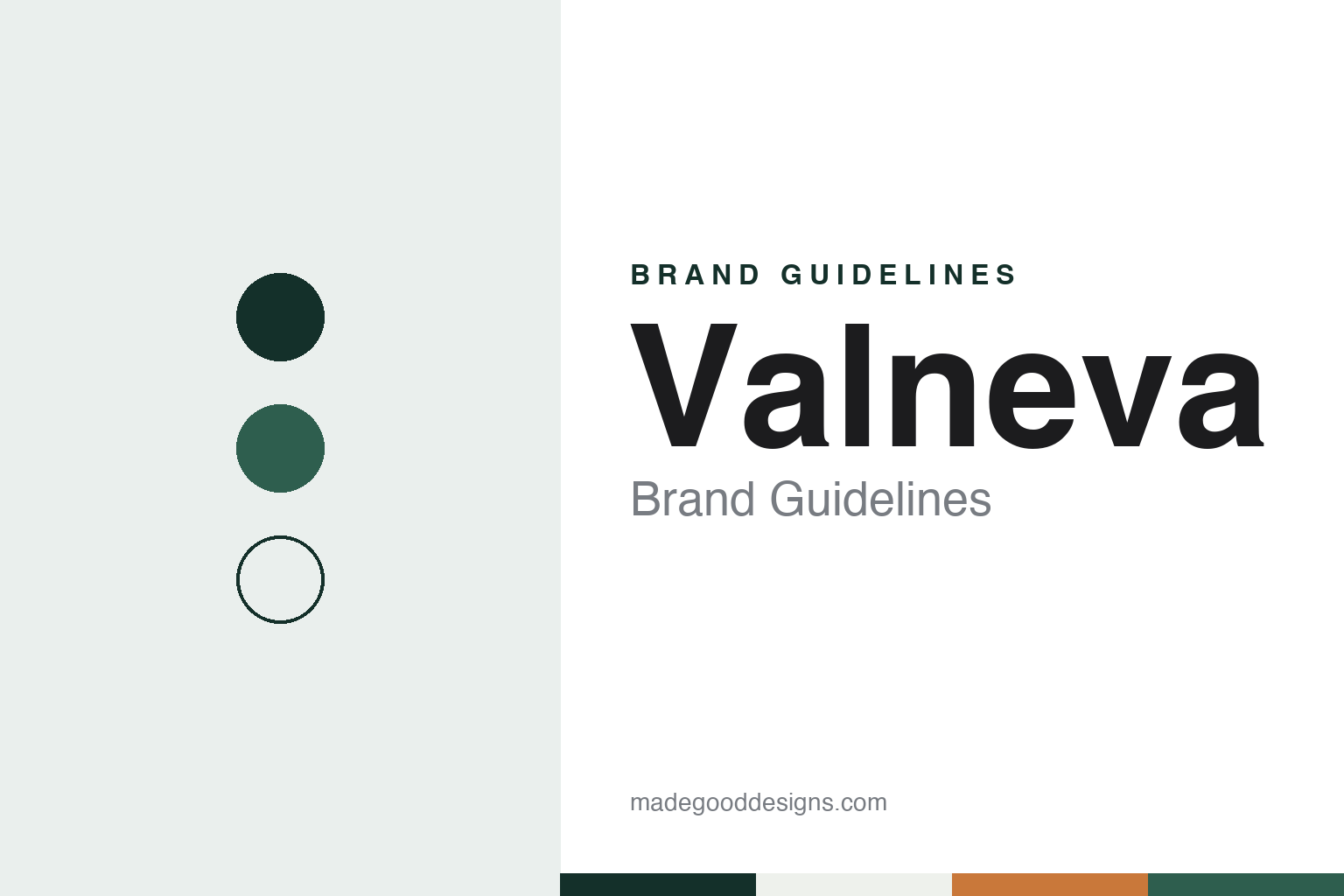
Valneva Brand Guidelines
The Franco-Austrian travel-vaccine maker born of a 2013 merger.
Aa
Two constants: a forest, green and amber palette and a travel serif register. Abstract homage — not a Valneva product or mark; no vial, pack or logo is reproduced.
Two companies
A Viennese spin-off and a French biotech.
Valneva is the product of a merger. Intercell was formed in Vienna in 1998 as a spin-off of the Research Institute of Molecular Pathology, English Wikipedia says, and was listed on the Vienna Stock Exchange from February 2005. It worked on vaccines against infectious diseases, cooperated with pharmaceutical companies including Novartis, Merck and Sanofi-Aventis, and in 2008 announced its intent to acquire Iomai, a Maryland developer of needle-free vaccination technology; its projects included a vaccine against Japanese encephalitis, approved in Europe, the United States and Australia.
The second partner was Vivalis SA, a French biotechnology company. The two companies agreed to combine at the end of 2012, and Intercell’s shareholders approved what was presented as a merger of equals in February 2013, English Wikipedia says; the combined company, Valneva SE, was created in 2013 and has been listed on Euronext Paris since May of that year. French Wikipedia describes it as a Franco-Austrian company that develops, produces and sells vaccines against infectious diseases.
Valneva later added a second listing on the U.S. Nasdaq in May 2021, and French Wikipedia says it joined the SBF 120 and CAC Mid 60 indices on 22 March 2021. Its own website now lists a delisting from the Vienna Stock Exchange, where Intercell had traded. The company says it has more than 650 employees in six countries.
For most of its life Valneva’s registered office was at Saint-Herblain, outside Nantes. On 26 November 2025 it confirmed the closure of that site, regrouping its French operations in Lyon, where it was moving its head office, and centralising all research and development in Vienna, Le Journal de l’Économie reported the next day. Valneva’s 2026 announcements are datelined Lyon, and its annual general meeting in June 2026 was held there.
Colour
Vaccines for travellers.
Valneva sells three vaccines, according to French Wikipedia and the company. Ixiaro is its Japanese encephalitis vaccine, inherited from Intercell. Dukoral is an oral vaccine authorised in the European Union and Australia for cholera and for diarrhoea caused by enterotoxigenic E. coli, French Wikipedia says. Ixchiq is a single-dose, live-attenuated vaccine against the chikungunya virus.
Ixchiq’s path has been the most closely watched. The U.S. Food and Drug Administration first approved it under its accelerated approval pathway in November 2023, and on 22 August 2025 its Center for Biologics Evaluation and Research suspended the biologics licence held by Valneva Austria GmbH, the FDA said in a safety communication. In October 2026 Valneva said the UK’s Medicines and Healthcare products Regulatory Agency had revoked the UK marketing authorisation after a further benefit-risk review, and that the decision did not affect its licences in the European Union, Canada, Brazil or other markets.
Production is split across three countries. Valneva says its site at Livingston, just outside Edinburgh, produces drug substance for its viral vaccines; its site at Solna, near Stockholm, has a long tradition of vaccine manufacturing connected to Sweden’s state-owned vaccine institute; and in Vienna it runs laboratories for testing and quality control, alongside its development centre.
The Livingston site was at the centre of Valneva’s COVID-19 programme. Its candidate, VLA2001, was an inactivated whole-virus vaccine derived from the company’s Japanese encephalitis vaccine and developed with an adjuvant from Dynavax, English Wikipedia says. In September 2021 the UK government served notice terminating its supply agreement, alleging a breach that the company “strenuously denies,” BBC News reported on 13 September 2021. The UK regulator approved the vaccine in April 2022; the European Commission cancelled its purchase agreement in May 2022, and in 2023 Valneva asked for the European authorisation to be withdrawn, French Wikipedia says.
Typography
Vaccine makers and how they present themselves.
Vaccine makers sell to health ministries, procurement agencies, hospitals and clinicians long before any patient sees a pack, and their visual language reflects that audience. The imagery tends to stay close to the work itself: gloved hands holding a vial up to the light, rows of filled vials on a stainless line, and researchers in lab coats at a bench or a microscope. The point of these pictures is to show process and care rather than spectacle.
Production is a second recurring subject. Company photographs often show clean production suites, with staff in full gowns, hoods and masks behind glass, and long views of filling lines, bioreactors and freezers. For mRNA companies in particular, the plant itself has become part of the story, and new sites tend to be photographed and announced as milestones in their own right.
A third strand is global health. Vaccine makers frequently show clinics, community health workers and the cold chain: insulated boxes, refrigerated trucks and storage rooms that keep doses within a temperature range on the way to where they are used. Maps, partner logos and the names of public bodies often sit alongside these images, because much of the business runs through governments, international agencies and non-profit funders.
The trade has its own meeting places. Conferences such as the World Vaccine Congress and ESCMID Global, the congress of the European Society of Clinical Microbiology and Infectious Diseases, bring companies, researchers and buyers together. In a field where so many pictures show similar vials, gowns and laboratories, a name, a typeface and a single accent colour often do much of the work of telling one company from another.
Aa
A travel serif for a vaccine maker that serves travellers. (Specimen set in Source Serif 4, a serif STAND-IN; NOT the Valneva logo.)
Valneva
A Lyme partnership and a smaller footprint.
Valneva’s largest development project is shared with Pfizer. French Wikipedia names Pfizer among its main shareholders, alongside the Caisse des Dépôts et Consignations and Novo Holdings, and says the two companies are developing a vaccine against Lyme disease. On 14 August 2026 Pfizer and Valneva announced that the European Medicines Agency had validated their marketing authorisation application for the candidate, known as PF-07307405, and would begin its assessment; no approval had been announced at the time of writing.
Its other programmes, as French Wikipedia lists them for 2025, include a shigellosis vaccine developed with the Swiss company LimmaTech and a Zika candidate, which the company says it would take further only if outside funding is found. The company’s own pipeline page lists Lyme disease, chikungunya and shigella programmes.
The restructuring announced in November 2025 narrowed the company’s footprint. Le Journal de l’Économie reported that the Saint-Herblain site of about 3,200 square metres of offices and laboratories had housed operations and preclinical research, and that Lyon would become the national administrative and operational centre while Vienna took all research spending.
For a design guide, Valneva shows how a merged company can build one name from two histories — an Austrian research spin-off and a French biotech. Compare Pfizer, its Lyme disease partner, and Dynavax, whose adjuvant it used for VLA2001. For this guide we use a deep forest green, a muted green and an amber with a serif, an unofficial interpretation; no product or logo is reproduced.
Explore & save
Keep Valneva’s identity on hand — save it to a board in the Made Good inspiration library.
Valneva identity set
Pin the Valneva forest, green and amber palette and the travel serif register to your own board.


