Wang Xizhi is a strange subject for a design guide: a calligrapher whose own sheets of paper are gone, known through copies made centuries after his death. Everything that reaches us has passed through carvers, rubbers and collectors, and it still reads as one confident voice. This guide covers who he was, what to look at in the rubbings, how the Orchid Pavilion gathering became a picture subject, and how to borrow his rhythm in layouts and lettering. Four images are public domain at the Metropolitan Museum of Art and one is CC0 at the Cleveland Museum of Art, and more historic works are gathered in the MGD museum inspiration collection.
Wang Xizhi in brief
The Met and the Cleveland Museum of Art both give Wang Xizhi’s dates as 303–361, and Cleveland calls him a Jin-dynasty calligrapher. Later writers paired him with his son, Wang Xianzhi, as the “Two Wangs”: a colophon of 1348 by Chen Ji, translated by Cleveland, praises a painting by Zhao Mengfu as if its brushwork came “directly from the calligraphies of the Two Wangs”.
Two moments define his public image. One is the spring gathering of 353 at Lanting, the Orchid Pavilion, in Zhejiang province, where the Art Institute of Chicago and Cleveland both record that he and a circle of scholars spent the day composing poems while cups of wine floated down a winding stream. Cleveland puts the guest list at 41 scholar-poets. The other is the preface he wrote for the poems from that day, a text the Met catalogue still names in works such as Bada Shanren’s hanging scroll After Wang Xizhi’s “Preface to the Orchid Pavilion Gathering Collection” of about 1694–96. For the wider tradition of scripts and tools, see our guide to Chinese calligraphy.
Why every Wang Xizhi image is a copy
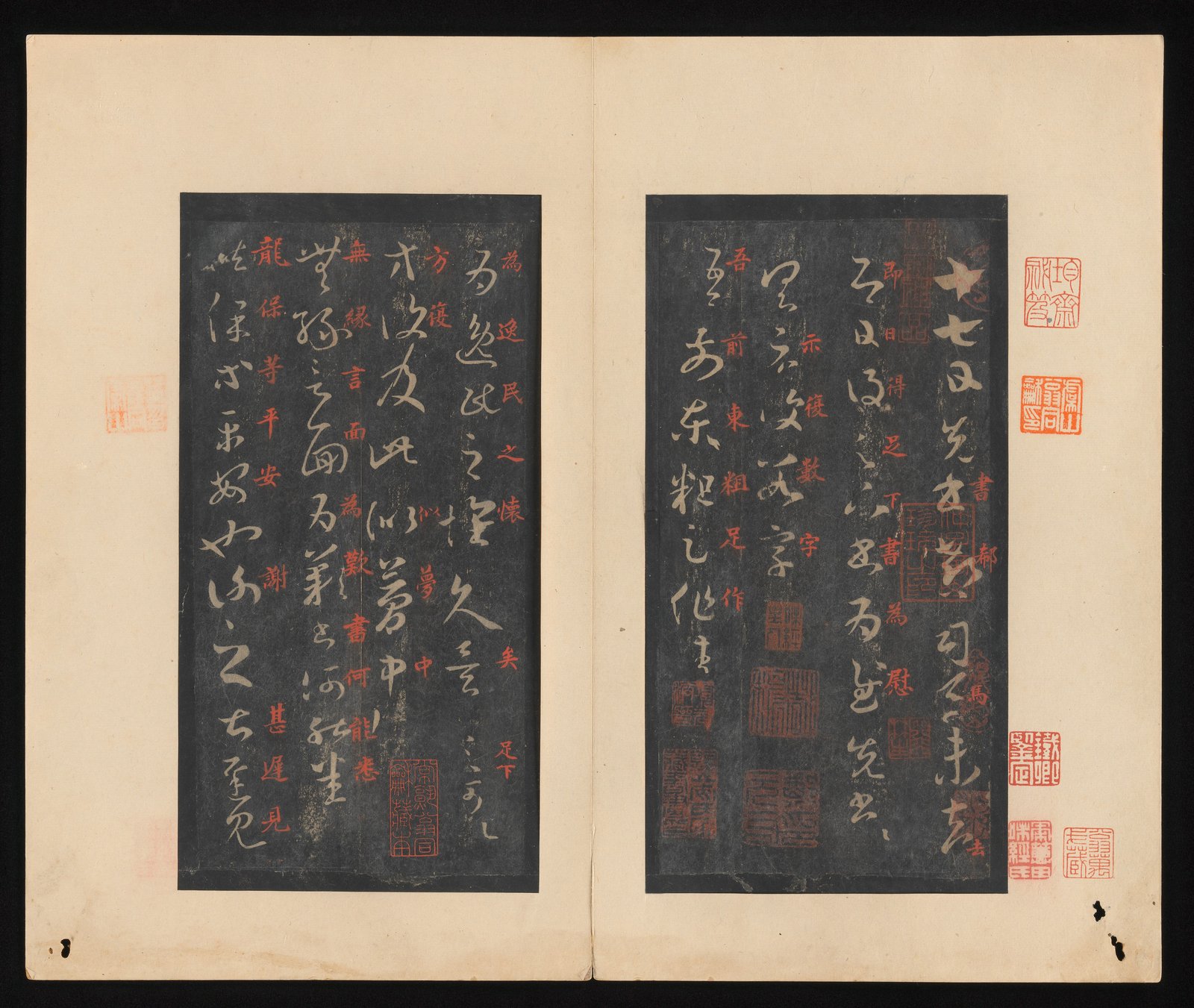
The Met dates the album above as a “13th-century rubbing of a series of 4th-century texts” and lists Wang Xizhi as the calligrapher. That wording is the key to all of his surviving work. A text was traced, carved into stone or wood, and then printed by laying damp paper over the carving and tamping ink onto the surface. The paper picks up ink everywhere except the cut-away strokes, so the characters appear pale on a black field.
For designers, this matters in two ways. To begin with, the rubbing is a reversed image, closer to a knockout or a stencil than to ink on paper, and that reversal is a big part of its graphic punch. Beyond that, what you see is a collaboration. The carver set the stroke edges, the rubber set the density of the black, and later owners added seals and notes, which is why captions here say “after Wang Xizhi”.
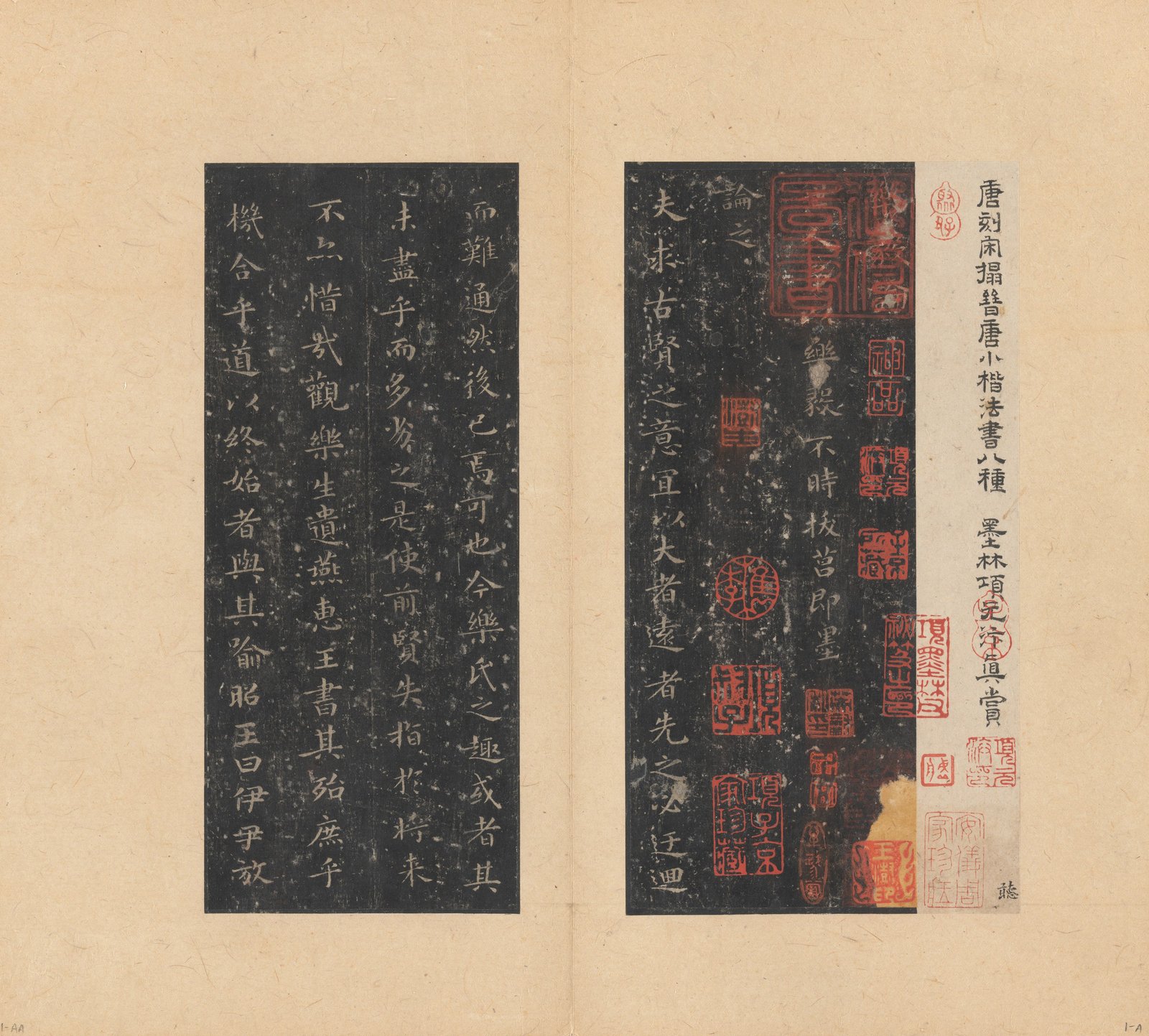
The Met catalogues this second album as rubbings of eight Jin and Tang writings in small standard script, mounted on 45 leaves. Every character sits upright in its own invisible square. Beside it, the cursive album looks like handwriting at speed: same format, same black ground, very different voice.
What to look at in Wang Xizhi’s letters
The opening characters as a title. The Met’s title, On the Seventeenth Day, comes from the words that begin the album’s opening letter. The date line works like a headline set in the same face as the body: no change of size, just position.
Columns, not lines. Text runs top to bottom and right to left, and characters swell or shrink to fit the flow. Squint and you see rhythm rather than words: dense clusters, open gaps, a long trailing stroke.
Linked strokes. In the cursive leaves, the brush often carries from one character into the next without lifting. These ligatures give the column its momentum, much as joined script does in Latin lettering.
Layers of later marks. Small red characters in a clearer script sit beside some columns, and square red seals cluster in the margins. The result is a primary text plus a secondary layer of annotation, kept apart by colour.
The Orchid Pavilion: a gathering that became a motif
The 353 gathering gave later artists a ready-made composition: a winding stream, scholars along its banks and a pavilion for the host. Cleveland notes that by the Ming dynasty the theme had moved beyond painting onto lacquer, jade and porcelain, and its fifteenth- to sixteenth-century carved panel shows how well the scene adapts to relief.

Look at how the carver organises the panel. Each zone gets its own texture, from tiny lozenges on the ground to wavy lines in the water, and figures cluster along the stream so the eye reads the panel as a path. Cleveland points out that the host, shown watching geese, has been moved toward the top register.
Painters made it a long horizontal read. Qian Gu’s 1560 handscroll at the Met unrolls the stream across more than four metres of paper, like a storyboard with the stream as its continuity line.

Geese, ink and the brush: technique and stories
Stories about Wang Xizhi’s practice became subjects in their own right. A poem inscribed on Tao Cheng’s handscroll Chrysanthemums and Cabbage alludes, in Cleveland’s translation and note, to the story that he practised so diligently beside a pond that the water turned black with ink. The other recurring image is the calligrapher watching geese. The Met holds Qian Xuan’s handscroll of the scene from about 1295, a late sixteenth-century porcelain jar with the same subject, and the Art Institute of Chicago owns an early eighteenth-century cup titled Cup with Wang Xizhi Watching the Geese.

Qian Xuan’s version is worth studying for its restraint. The scholar stands in an open pavilion, framed by posts and a railing; two geese float in a field of empty water to the right. Blue-green rocks, dotted foliage and a crisp roof line give it a flat, decorative finish suited to screen print.
As for the brush itself, the rubbings show what to practise. Strokes thicken where the brush presses and thin to a hairline as it lifts. Cursive characters compress several strokes into one gesture. Standard-script characters, by contrast, keep each stroke distinct and end it with a small pause.
Colours measured from a Wang Xizhi rubbing
These values were measured from the Met’s scan of this impression of On the Seventeenth Day, not from original inks.
- #3E3E3E: rubbed ink ground, a soft charcoal rather than pure black.
- #A3917B: the pale strokes of the characters, a warm grey-brown.
- #E5CEB0: the buff album page around the rubbings.
- #AA5445: collectors’ seal red, closer to brick than to scarlet.
From Cleveland’s scan of the lacquer panel, the main red measures #8D2F27 and its shadowed recesses #6B2720. To sample your own swatches from museum images, try the image colour picker.
How designers can borrow Wang Xizhi’s ideas today
Use the rubbing reversal. Pale lettering on a soft charcoal field such as #3E3E3E, with a warm off-white surround, gives an archival feel.
Design in columns. For posters, packaging or editorial openers, try a single vertical column of display text with generous margins.
Add a second layer of marks. A small red stamp, date or reference number placed off the main axis echoes the collectors’ seals and adds a sense of provenance.
Tell a story in one long scroll. The handscrolls suggest a horizontal web layout in which one continuous line, such as a stream or a timeline, carries the reader through clusters of content.
Choose free brush fonts with care. For Chinese-language work, Google Fonts offers Ma Shan Zheng, a brush-style handwriting face, and Zhi Mang Xing and Liu Jian Mao Cao, which lean toward cursive brushwork. All three are released under the SIL Open Font License, but none is a reproduction of Wang Xizhi’s hand. Check terms in our font licensing guide, and browse more options in our list of calligraphy fonts. For more brush-and-ink works, see the calligraphy theme page.
Frequently asked questions
Who was Wang Xizhi?
A Chinese calligrapher of the Jin dynasty, dated 303–361 by the Met and the Cleveland Museum of Art. He is remembered for his letters and texts in several scripts, and for the gathering of poets he hosted at the Orchid Pavilion in 353.
Do any original works by Wang Xizhi survive?
No brushwork in his own hand is known to survive. Museums hold rubbings and later copies; the Met’s album On the Seventeenth Day, for example, is catalogued as a thirteenth-century rubbing of fourth-century texts.
What is the Orchid Pavilion gathering?
A spring gathering in 353 at Lanting in Zhejiang province, where scholars composed poems as wine cups floated along a winding stream. It became a recurring subject in Chinese and Japanese painting and, according to Cleveland, appeared on lacquer, jade and porcelain by the Ming dynasty.
Are these Wang Xizhi images free to use?
The Met flags its four works here as public domain, and the Cleveland Museum of Art releases its lacquer panel under CC0. Many modern works on the same themes are still in copyright, so check each museum record. Our guide to Chinese art gives wider context.