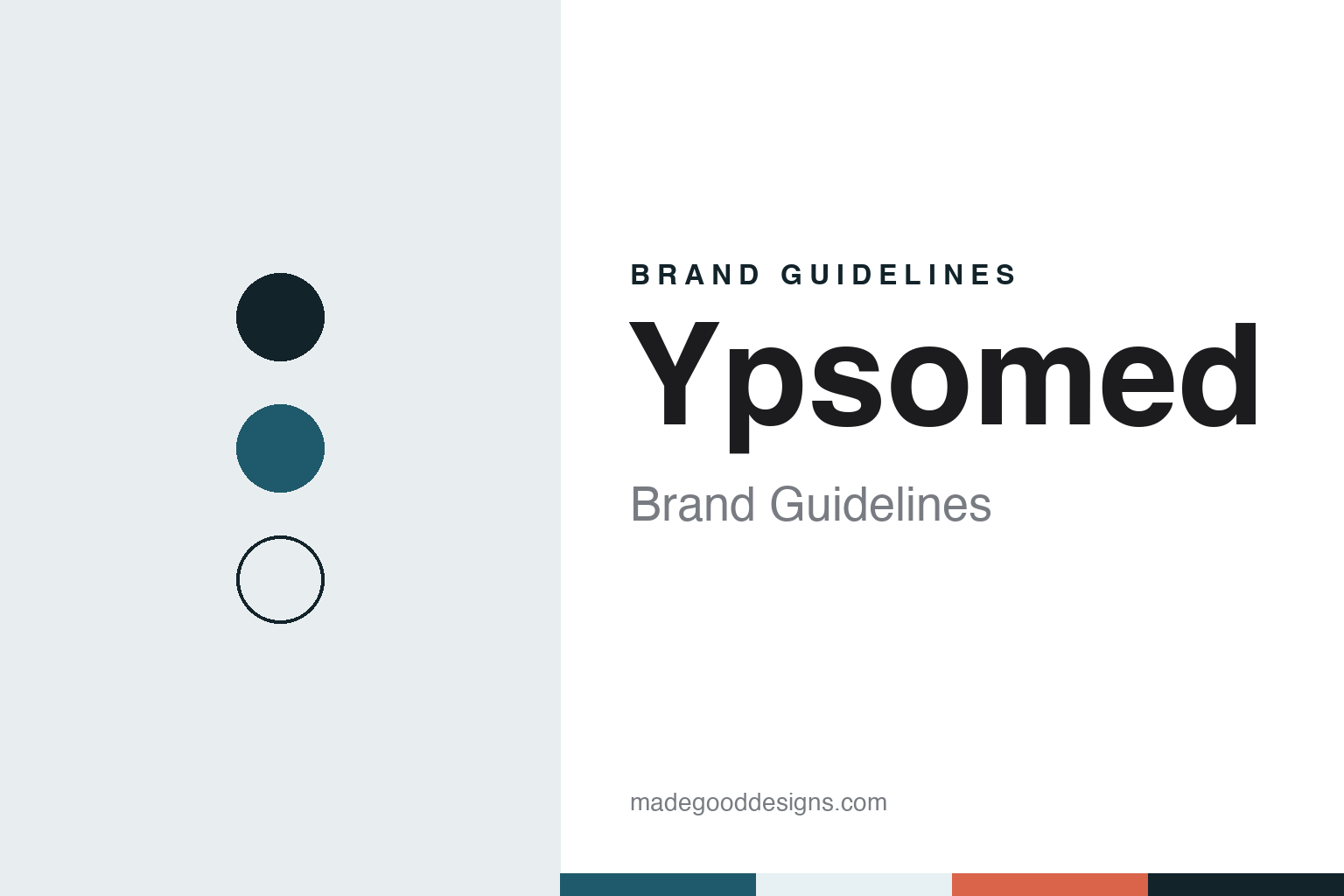
Ypsomed Brand Guidelines
The Burgdorf company that makes the pens other brands put their names on.
Aa
Two constants: a teal, mist and coral palette and a precise engineering sans register. Abstract homage — not a Ypsomed product or mark; no pen, autoinjector or logo is reproduced.
From Disetronic
Two brothers, a Burgdorf pump maker and a split in 2003.
Ypsomed’s story begins in 1984 in Burgdorf, a small town in the canton of Bern, Switzerland. That year the brothers Willy and Peter Michel founded Disetronic, a company that became known for insulin pumps; German Wikipedia notes that it was set up with state support. Alongside its infusion pumps, the company says, Disetronic built a second business in injection systems, the pens that people use to give themselves a dose of medicine.
The split came in 2003. German Wikipedia says the Disetronic group was divided that year: the infusion business, the larger part, went to the pharmaceutical group Roche, which folded it into its diabetes-care unit, while the injection business, Disetronic Injection Systems, carried on as an independent company under a new name, Ypsomed. In the company’s own account, Willy Michel, co-founder and majority shareholder, sold the infusion side to Roche and kept the injection side, and “that is how Ypsomed was born.” The new company listed its shares on the Swiss stock exchange, SIX, in 2004.
The name is meant literally. The company explains that “ipso” means “self” and “med” stands for medication: its business is devices that let people give themselves their own medicine. German Wikipedia lists Matthew Robin as chief executive from 2003 to 2006. Simon Michel, Willy Michel’s son, has led the company since 2014, and Gilbert Achermann has chaired the board since 2022; Willy Michel remains the main shareholder and, since May 2022, honorary president. In 2024 the company marked forty years since the founding of Disetronic.
Colour
Pens, autoinjectors and a wearable, made for drug companies.
Most Ypsomed devices never carry the Ypsomed name on a pharmacy shelf. The company develops and makes injection systems that pharmaceutical and biotech companies fill with their own drugs and sell under their own brands; its website describes it as a partner to those companies for more than forty years. Its range, it says, runs from simple disposable pens to pens with variable dosing and electronic displays, and on to complex injectors with built-in electronics.
The products are organised as platforms that a drug company can adapt. The pen injectors include UnoPen, ServoPen, YpsoPen and YpsoFlow. The autoinjectors are the YpsoMate family, in 2.25 mL and 5.5 mL sizes, and the newer YpsoLoop. YpsoDose is a large-volume wearable injector, worn on the body during the injection, and SmartPilot is an add-on that connects some of the devices to a phone. In January 2026 Ypsomed announced an expanded partnership with BD, the American medical-technology group, and in September 2026 a new step with the Swiss filling company ten23 health, which is installing device assembly for YpsoDose.
YpsoLoop is the most design-led of them. Launched in October 2025, it is, the company says, the first autoinjector platform designed for circularity: two assemblies made of single-material plastics that can be separated by machine so the materials can be recycled, in 1 mL and 2 mL versions. In July 2026 Ypsomed announced that YpsoLoop had won a Red Dot Award 2026 in the Product Design category, quoting the jury’s praise for its “precise form” and “intuitive handling.”
For many years Ypsomed also sold directly to people with diabetes, under the mylife Diabetescare brand: pen needles, blood-glucose meters and the mylife YpsoPump insulin pump. German Wikipedia says it distributed Insulet’s patch pump in Europe from 2010 until July 2018 and, from 2020, worked with Dexcom so that its pump could run with Dexcom sensors. That consumer side of the business has since been sold.
Typography
How drug-delivery makers present themselves.
Drug-delivery device makers sell mostly to other companies. Their customers are pharmaceutical and biotech firms that fill a pen, an autoinjector or a prefilled syringe with their own medicine and put their own name on the box, so the device maker’s brand often lives one step back from the patient. That shapes how these companies present themselves: less as consumer brands, more as engineering partners that can be trusted with a drug company’s product.
The pictures follow from that. The typical image is a clean render of a pen or autoinjector on a white or pale ground, often shown from several angles or in a technical cutaway that reveals the spring, the plunger and the syringe inside. Product families are usually named as platforms, with one prefix running across a range, and shown in neutral greys and whites so that a customer can imagine its own colours on the device.
Production is the other recurring theme. Websites and brochures show cleanroom assembly lines, injection-moulding machines, operators in gowns and hairnets, and gloved hands holding glass syringes, cartridges and vials. These images carry the message that the work is precise and controlled, and they sit beside pages on quality systems, regulatory support and human-factors testing with patients.
Much of the industry’s public face is seen at trade shows. Makers book stands at events such as CPHI, the pharmaceutical ingredients and packaging fair, Pharmapack in Paris, and the conferences of the Parenteral Drug Association, where they show new platforms to drug companies. The visual language there is the same: white stands, large product renders, cutaway models and short films of devices being assembled and used.
Aa
A precise engineering sans for a maker of pens and autoinjectors. (Specimen set in Manrope, a sans STAND-IN; NOT the Ypsomed logo.)
Ypsomed
From diabetes brand to pure injection specialist.
Ypsomed has spent recent years narrowing itself to one business. In March 2024 it agreed to transfer its pen-needle and blood-glucose-meter business to the Italian company MTD (Medical Technology and Devices). In April 2025 it announced the sale of its remaining diabetes-care business, including the mylife insulin pump system, to TecMed AG, also based in Burgdorf, and the company said the sale was completed on 4 August 2025. Drug Delivery Business News reported that day that TecMed is controlled by Willy Michel. In October 2025 Ypsomed also sold its subsidiary Ypsotec to Callista. What remains, the company says, is a focus on subcutaneous self-injection systems for pharmaceutical and biotech customers.
Production is spread across several countries, according to the company. Burgdorf houses the headquarters, research and development, toolmaking and the moulding and assembly lines for the YpsoMate autoinjector. Solothurn, the second large Swiss site, runs fully automated pen and autoinjector lines in clean rooms, and a new tool-making facility opened there in April 2026. Schwerin, in northern Germany, recommissioned in 2019, makes pens and autoinjectors and is being doubled in size, and a plant in Changzhou, near Shanghai, opened in June 2025 to make devices for the Chinese market. In October 2025 Ypsomed announced its first plant in the United States, in Holly Springs, North Carolina, due to supply the American market from the end of 2027.
For a design guide, Ypsomed shows how a supplier whose devices carry other companies’ names can still build a recognisable design language, from naming its platforms with one family prefix to putting recyclability into the shape of an autoinjector. Compare BD, the American medical-technology group and a Ypsomed partner, and Owen Mumford, a British maker of pens and autoinjectors. For this guide we use a deep teal, a pale mist and a warm coral with a sans, an unofficial interpretation; no product or logo is reproduced.
Explore & save
Keep Ypsomed’s identity on hand — save it to a board in the Made Good inspiration library.
Ypsomed identity set
Pin the Ypsomed teal, mist and coral palette and the precise engineering sans register to your own board.