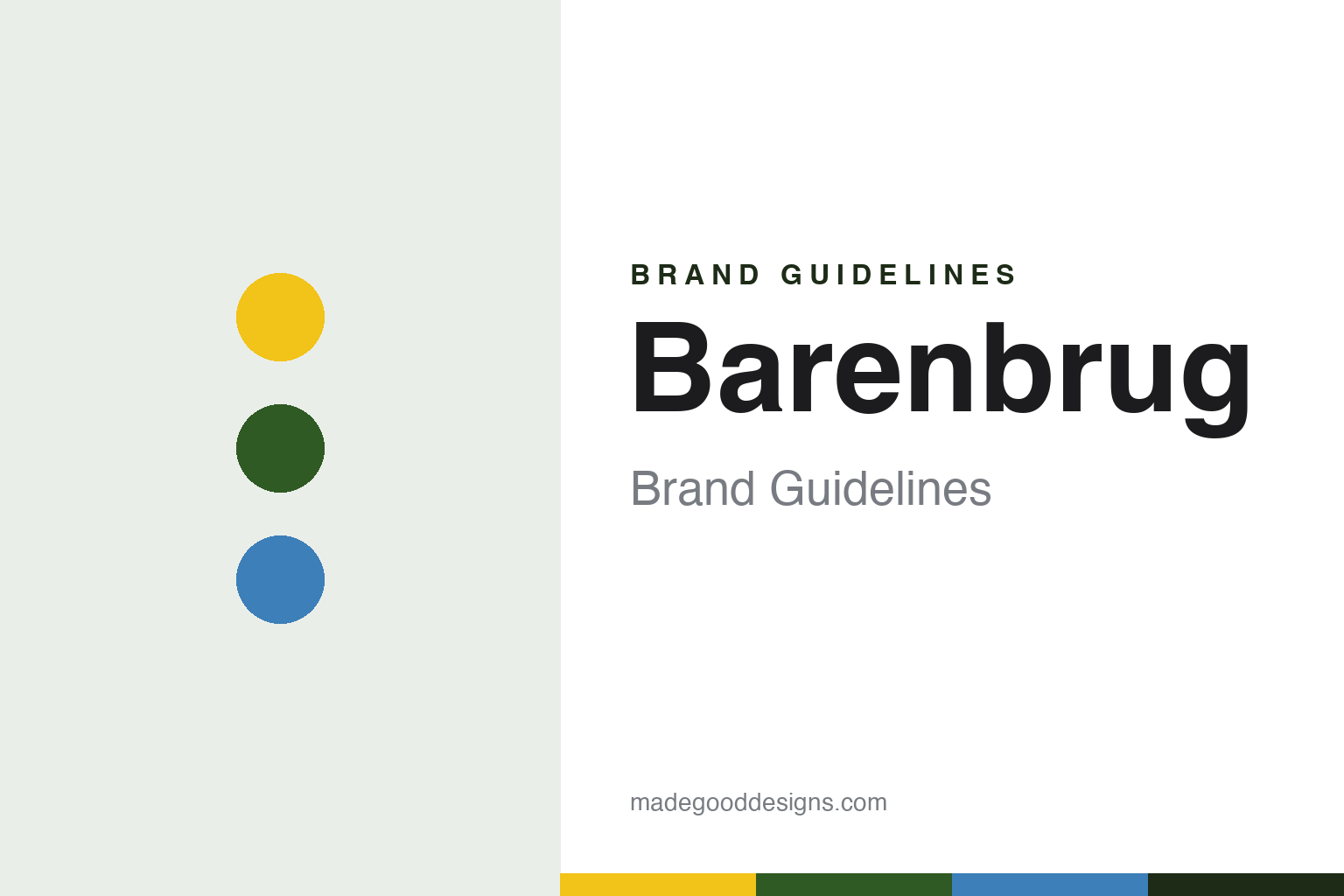
Barenbrug Brand Guidelines
A Dutch grass seed family since 1904, and its yellow bags.
Aa
Two constants: a yellow, green and sky-blue palette and a grotesque sans register. Abstract homage — not a Barenbrug product or mark; no bag, logo or sign is reproduced.
From a barn
A seed merchant, a book and four generations.
Barenbrug is a Dutch grass seed company, and its own dating is simple: 1904, when Joseph Barenbrug began trading in grass seed. A company release published by the New Zealand news site Scoop in June 2020 gives the same year and founder. The Dutch trade magazine Greenkeeper, in its third issue of 2022, described the start in plain terms: the first Barenbrug put grass seed from his barn into a bag and sold it, with no idea of what the family business would become 118 years later. The sources read for this guide do not describe the company during the German occupation of the Netherlands in 1940–45.
The company also points to a book. Barenbrug says Joseph Barenbrug wrote “Money in Grasses”, first published in 1908, which looks at how farmers in different countries grew grass and produced grass seed, with lessons the company describes as aimed in particular at American farmers. The book still has its own page on the company website.
The business has stayed in the family. Seed World reported in March 2020 that Bert Barenbrug, a grandson of the founder, joined the company in 1967, set up Barenbrug Germany in 1968 and later succeeded his father, Joop Barenbrug, as chairman of the board of directors. Under his leadership, the magazine wrote, the group built a presence in the United States, the United Kingdom, New Zealand, Australia, Argentina and China. He retired in 2002 and stayed on the supervisory board until his sons, Bastiaan and Frank Barenbrug, joined the board of directors in 2007.
Today the company calls itself the Royal Barenbrug Group and speaks of four generations of the family. It says it was granted the Dutch royal predicate, the right to use “Royal” in its name, in 2004, a distinction it describes as reserved for companies more than a hundred years old with a strong reputation in their field. Its group chief executive is John Thijssen, whom Seed World named in 2020 as chairman of the board of directors.
Colour
Forage, turf and a lot of trial plots.
Barenbrug breeds and sells seed for two broad worlds: farm forage and turf. The company says it develops varieties for agricultural forage, sports fields, lawns and landscaping, and that its growers also produce clover and alfalfa seed for it. Greenkeeper listed the turf customers in 2022 as five groups: sport, golf, turf growers, roadside verges and dykes, and lawns and public green space, alongside the farming side of the business. Sales, the magazine was told, always go through dealers.
Seed production relies on contract growers. Barenbrug says each of its subsidiaries has its own production, supervision and processing, and that much of the grass, clover and alfalfa seed it needs comes from growers it has worked with for many years, advised by its own production managers.
Research is the part the company puts forward most. Its website names RPR, a ryegrass it describes as “self-repairing”; NutriFibre; SOS, short for “Super Over Seeding”; and Yellow Jacket, which it calls a seed enhancement. Greenkeeper described RPR as an English ryegrass that spreads by runners, and named further turf lines including Water Saver, Shadow and Resilient Blue. The magazine reported a test station at Wolfheze, trials around the world and drones used to inspect breeding fields, and its sales manager said the company wants independent research stations to confirm its claims before a product goes on the market.
The group is spread widely. The 2020 release described 22 research programmes across six continents and operating companies in 18 countries; the company’s current key-figures page lists 16 operating companies and 22 research and development facilities. In New Zealand, the release said, the business that had traded as Barenbrug Agriseeds took the Barenbrug name on 1 July 2020, 33 years after it first teamed up with the Dutch family firm. It works from a 224-hectare breeding and research station in Canterbury and sells pasture cultivars including Trojan and Shogun.
Typography
How seed companies show themselves.
Grass, forage and field seed companies sell something that looks almost the same in every bag, so much of their identity sits in where the seed ends up. Their pictures tend to come from three places: the finished turf of a football stadium or golf course, the cattle or sheep grazing a pasture, and the breeding plots where new varieties are tested in long rows before they reach a farmer. The Danish encyclopedia Lex, for example, illustrates its entry on DLF with a stadium pitch in Paris and a golf tournament in Arizona.
The seed bag itself often carries the brand. Bags stacked on pallets in a warehouse or a dealer’s yard are a common sight in the trade, and some companies make the bag the signature: Barenbrug says its grass seed is sold in yellow bags, and a 2020 release from its New Zealand business described the new name going onto those bags.
Many of these firms are owned by farmers or families rather than by listed groups, and they say so. DLF is held by a cooperative of Danish seed growers, according to Lex, while Barenbrug describes four generations of family ownership. Founding dates, anniversaries and long histories of mergers are therefore part of how such companies present themselves.
The trade also meets in person. Field days, demonstration plots and agricultural fairs such as Agritechnica in Germany and Farm Progress in the United States are where breeders show varieties to farmers, dealers and contractors. This guide sets out what can be checked about each company, who founded it, who owns it and what it sells, and marks clearly what rests only on the company’s own word.
Aa
A plain, heavy grotesque — the register of a printed seed sack. (Specimen set in Archivo, a sans STAND-IN; NOT the Barenbrug logo.)
Barenbrug
A yellow bag and a slogan.
Barenbrug’s most visible brand asset is a bag rather than a logo. The company says its grass seed is sold in “distinctive yellow bags” and calls this the “Yellow Bag Guarantee”; the 2020 New Zealand release also pointed to “the distinctive yellow seed bags” as the place where the new name would appear. The slogan quoted by Greenkeeper was “Make life beautiful”, and on its website the company sets out a mission “to help feed the world sustainably and enhance green spaces.”
The group’s Dutch base is in Nijmegen, where Greenkeeper visited the company’s site in 2022 and found building work under way on a new storage hall. The same article said Barenbrug aimed to be climate-neutral by 2035. It also described “Helping with hands,” a programme in which each employee gives time once a year to a good cause, and a group of young employees, YPAC, set up so that recent graduates can put ideas to the board and comment on its policy.
Ownership is private and in the family. Scoop’s 2020 release named Bastiaan and Frank Barenbrug as the current owners, and the company’s website lists them as the fourth generation on its supervisory board. In the same release John Thijssen described the group as “proudly family-owned” and said it thinks “generation to generation” rather than quarter to quarter.
For a design guide, Barenbrug shows how one colour carried on a seed sack can do the work of a brand across farms, golf courses and football grounds. Compare DLF, the Danish grass seed group owned by its growers, and Germinal, another grass and forage seed company. For this guide we use a seed-bag yellow, a pasture green and a sky blue with a sans, an unofficial interpretation; no product or logo is reproduced.
Explore & save
Keep Barenbrug’s identity on hand — save it to a board in the Made Good inspiration library.
Barenbrug identity set
Pin the Barenbrug yellow, green and sky-blue palette and the grotesque sans register to your own board.


