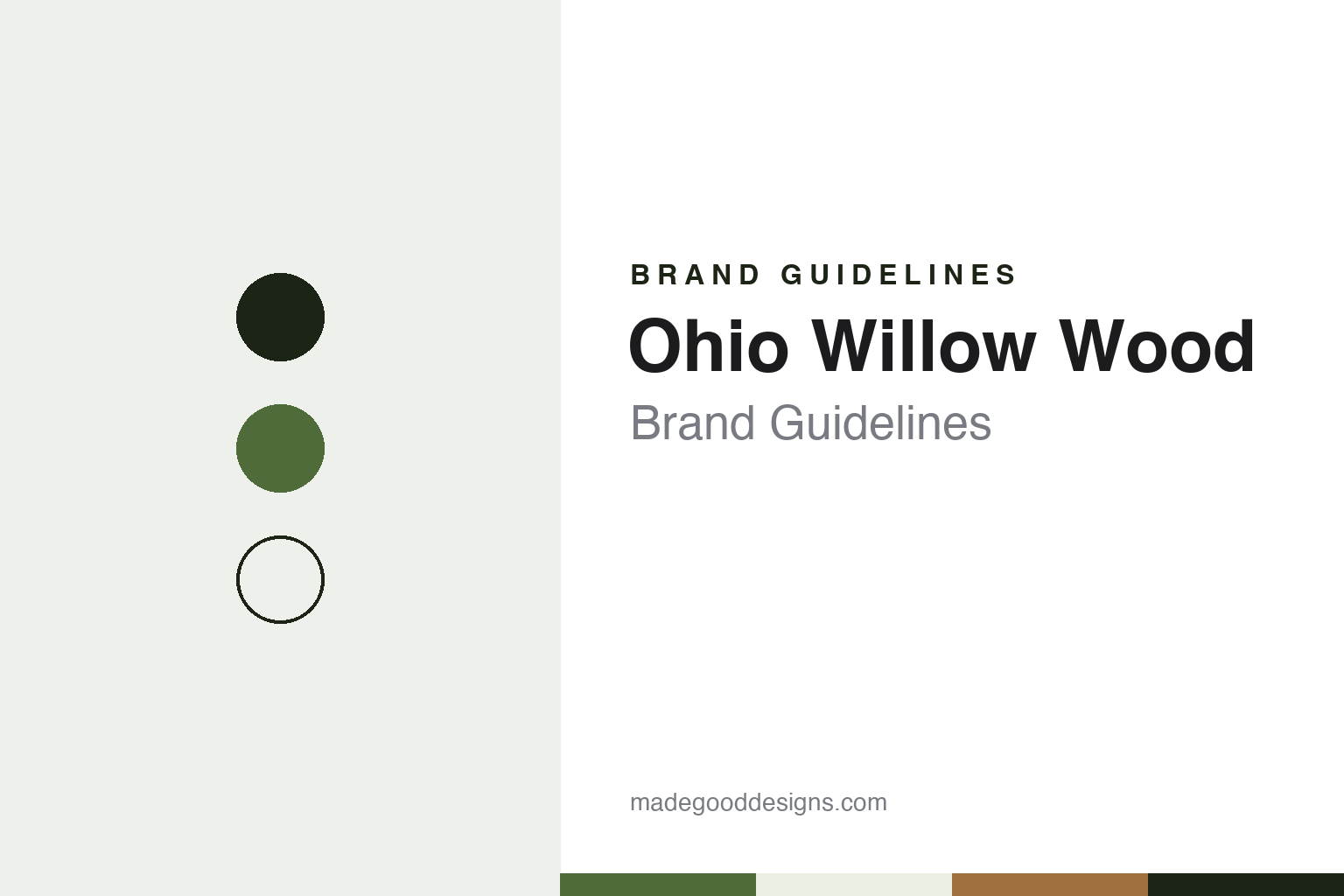
Ohio Willow Wood Brand Guidelines
The 1907 Mount Sterling limb maker now called WillowWood.
Aa
Two constants: a willow green and carved wood palette and a Rounded sans register. Abstract homage — not a WillowWood product or mark; no liner, foot, logo or nameplate is reproduced.
Carving willow
One man, one timber, one Ohio town.
Ohio Willow Wood began in 1907 in Mount Sterling, Ohio, southwest of Columbus. Its founder was William E. Arbogast, who, the company says, was himself a bilateral amputee, and whose business, in the company’s words, “started as one man carving and curing willow wood for prosthetic use.” The timber gave the firm its name. It now trades as WillowWood — the trade press was already using that name by 2016 — and the operating company is WillowWood Global LLC, still based in Mount Sterling with an additional facility in Mesa, Arizona, according to PE Professional in June 2026.
For more than a century it was a family company. In October 2016 The O&P EDGE, the American trade magazine for orthotics and prosthetics, reported that ownership had passed to four children of the third generation, making them the fourth generation of Arbogasts to own the business, with Ryan Arbogast — president since 2011 — holding the majority. “We’re remaining a privately held family business,” he told the magazine.
That changed within three years. In June 2019 The O&P EDGE reported that WillowWood planned to sell a majority stake to DW Healthcare Partners, a private-equity firm based in Toronto and Utah, noting that the Arbogast family had owned and operated the company since its founding 112 years earlier. New leadership came in at about the same time: Mahesh Mansukhani and Daniel Rubin, who now lead the company as co-chief executives, and whose partnership with the family the company dates to 2018. In December 2021 the magazine reported a strategic partnership with Blue Sea Capital, which made “a substantial equity investment.” In June 2026 WillowWood announced that CVC Catalyst III, a fund of the private-markets firm CVC, had agreed to acquire a majority stake from Blue Sea, the Arbogast family and management, all of whom were to reinvest; the deal was expected to close in the third quarter of 2026, subject to regulatory approval, with Ryan Arbogast keeping a supporting role, Pulse 2.0 reported.
Colour
From wool and wood to gel and carbon.
WillowWood’s products trace a path from wood and wool to gel and carbon fibre. Its own timeline lists the Sterling Stump Sock, a woollen layer worn between the residual limb and the socket, in 1921; a knee-shin unit developed by John and Edwin Arbogast in 1952, which the company calls the first semi-finished above-knee prosthesis with interchangeable parts in the United States; and the Marvel SACH foot — “solid ankle, cushion heel” — in 1961, which it says was the first such foot made in the US. In 1984 came the Carbon Copy II foot, which it describes as the first conventional lightweight energy-storing foot on the market to use carbon composites.
The product it is most associated with is the gel liner, the soft sleeve worn over the limb inside the socket. The company dates its first ALPHA liners to 1996, calling them the industry’s first fabric-covered gel interface, and PE Professional wrote in June 2026 that WillowWood “pioneered the gel liner” and offers about 1,000 gel-liner SKUs. Later additions, by the company’s account, include ALPHA DESIGN custom liners in 2005, the LimbLogic vacuum-suspension system in 2007, a silicone ALPHA liner in 2011, and, in May 2023, the ALPHA Control liner system for users of myoelectric arms, developed with Coapt, which the company calls the first prosthetic liner with embedded electronics.
Feet and knees followed. The META line of feet began with the META Arc in 2021, the company says, built on a one-piece carbon “unibody platform”; Core, Shock and Shock X versions followed. The INTUY powered knee in its catalogue is made by Reboocon Bionics B.V., under a January 2023 alliance that gave WillowWood exclusive distribution in the United States. Acquisitions widened the range: MAKstride Prosthetics, an Arizona maker of feet and machined components, in 2022, and Xtremity, a Colorado socket maker, whose purchase WillowWood announced in March 2024. In 2024 the company also announced a partnership with Click Medical on user-adjustable sockets.
Typography
Design and documentation.
Prosthetics and orthotics companies sell to two audiences at once. Their customers are mostly clinicians, the prosthetists and orthotists who measure, cast and fit, and the clinics and health systems that pay; the people who wear the limbs and braces are the ones the pictures are built around. Blatchford’s website, for one, splits into sections for healthcare professionals, with technical documentation, training and clinical papers, and for patients and caregivers.
The imagery follows from that. Product shots often show carbon-fibre feet, knee joints and silicone liners isolated on white, like engineering components, which in part they are. Next to them come people in everyday settings: walking a dog, climbing stairs, at work or at home. Clinic photographs show a clinician kneeling beside a patient to check the alignment of a socket. The language around the pictures is about mobility and independence, often in a short slogan that the company uses as a statement of purpose.
Sport supplies the most dramatic images. Running blades made from carbon fibre have become a visual shorthand for the whole field, and makers put para-athletes in front of the camera; Össur, for one, sponsors a group of them as Team Össur, English Wikipedia says, naming Markus Rehm and Jody Cundy among them. Those pictures sit beside the quieter work of everyday limbs, which make up most of what the trade fits.
The industry also has its own meeting places. OTWorld in Leipzig, a world congress and trade fair held every two years, brought prosthetists, orthotists, manufacturers and researchers together in May 2026 and has announced its next edition for May 2028, with a para-sport activity area among its features. For a designer, the category is a study in balance: precision engineering, clinical trust and personal stories, held together, in several cases, by a founder’s own name.
Aa
A rounded sans — one word, WillowWood. (Specimen set in Figtree, a sans STAND-IN; NOT the WillowWood logo.)
WillowWood
A rebrand that won an award.
The gel-liner years also brought a long patent dispute with ALPS South, a liner maker in St. Petersburg, Florida, reported step by step by The O&P EDGE. WillowWood sued ALPS in December 2004 over a gel-cushioning patent; in November 2013 a federal appeals court held that patent invalid, and in September 2014 a federal district court in Ohio ruled it unenforceable for inequitable conduct before the patent office, a ruling WillowWood said it disagreed with, saying it had acted ethically. In a separate suit brought by ALPS, a 2013 judgment that had barred WillowWood from making or selling its thermoplastic-elastomer liners was reversed by the Federal Circuit in June 2015, which found that ALPS lacked standing to sue; the magazine later referred to a 2015 settlement between the two companies.
The look of the company changed in September 2023, when it announced a new brand identity to mark its move into feet, knees and electronics. The work was by the New York agency DD.NYC, also called Digital Design NYC, and in December 2024 WillowWood announced that the rebrand had won a Gold Anthem Award in the Product and Innovation category, with winners announced that November. The company described the work as “a revitalized logo, a cohesive color palette inspired by movement and vitality,” and a redesigned website for clinicians and prosthetic users alike. In July 2024 it also announced a research centre for prosthetics and orthotics with Ohio State University, funded by a federal disability-research grant.
For a design guide, Ohio Willow Wood shows how a heritage name built on one material can be carried into a technology brand. Compare Össur, the Icelandic prosthetics maker, and Becker Orthopedic, another family-founded American supplier to orthotic and prosthetic clinics. For this guide we use a willow green and a carved-wood brown with a sans, an unofficial interpretation; no product or logo is reproduced.
Explore & save
Keep Ohio Willow Wood’s identity on hand — save it to a board in the Made Good inspiration library.
WillowWood identity set
Pin the willow green and carved wood palette and the Rounded sans register to your own board.


