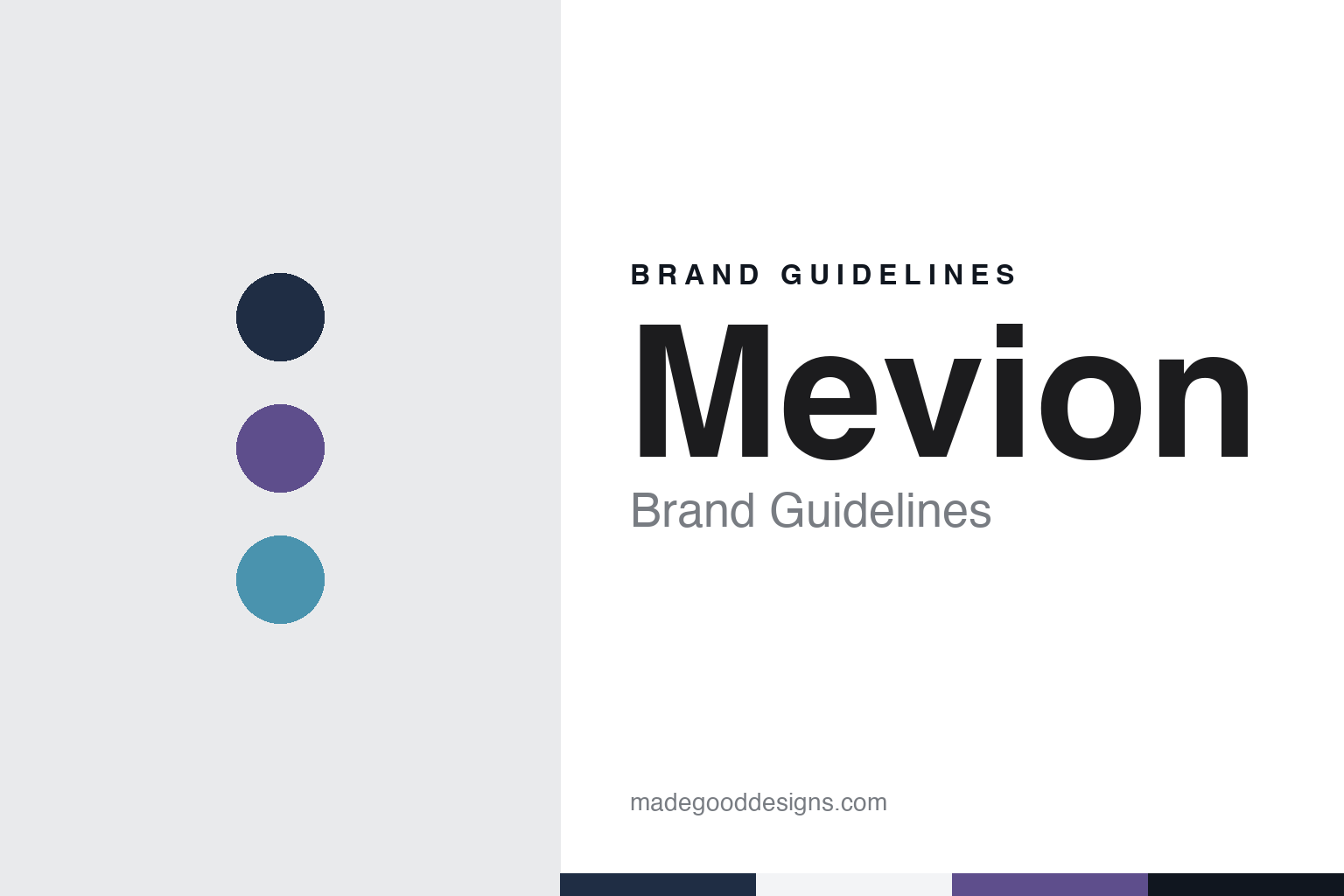
Mevion Brand Guidelines
A Littleton synchrocyclotron, the S250 and a vault-sized FIT.
Aa
Two constants: a navy, violet and cyan palette and an engineering sans register. Abstract homage — not a Mevion product or mark; no system, logo or nameplate is reproduced.
A small accelerator
A proton machine built to fit a room.
Mevion Medical Systems is a proton therapy company based in Littleton, Massachusetts. In a September 2026 release the company says it was founded in Massachusetts in 2004 “with a singular mission: to make proton therapy accessible to every health system.” Its own timeline says the aim was to reduce the size and cost of proton therapy technology, that it entered a development partnership with the Massachusetts Institute of Technology in 2006 to build a high-field magnet that would shrink the proton accelerator, and that it finished developing that accelerator in 2010.
The accelerator reached the trade press in 2010 under the name Still River Systems. In May that year Imaging Technology News and News-Medical reported that Still River Systems, working from technology developed at MIT’s Plasma Science and Fusion Center, had extracted a clinical beam from the first production unit of what it called the world’s smallest high-energy proton therapy accelerator. The machine was a superconducting synchrocyclotron about six feet across, weighing 20 tons and producing a 250 MeV proton beam, built for the Monarch250 Proton Therapy System then being installed at the Siteman Cancer Center at Barnes-Jewish Hospital and Washington University School of Medicine in St. Louis.
Those reports named Kenneth Gall as Still River’s founder and chief technology officer and Joseph Jachinowski as its chief executive, and said Robert Wood Johnson University Hospital and the University of Oklahoma Medical Center were also building rooms for the system. Mevion’s timeline picks up the same site: it says the MEVION S250 received US FDA clearance in 2012 — the world’s first compact proton therapy system, in the company’s words — and that the first patient was treated on an S250 at the Siteman Cancer Center in 2013.
Colour
From one room to an existing vault.
After the first installation, Mevion’s timeline lists a run of variants on the same platform. In 2014 it announced HYPERSCAN pencil-beam scanning; in 2015 it introduced the MEVION S250i with HYPERSCAN and the S250mx multi-room system; and in 2016 it presented the S250i with HYPERSCAN and its Adaptive Aperture. The same timeline records clinical treatment starting in 2015 at a cancer centre in New Jersey and at a physician-owned centre in Jacksonville, Florida, and in 2016 in Orlando and Cleveland, and says the first S250 Series installation in Europe was announced in 2015.
The current flagship is the MEVION S250-FIT, introduced in 2022, which the company describes as the first proton therapy system designed to fit within an existing linear-accelerator vault. Mevion says the system received FDA clearance in 2025 and the CE mark in 2026, and in September 2026 it said about a dozen FIT systems were in development around the world. Its website lists recent programmes at AdventHealth in Central Florida and BayCare in Tampa, a first patient at Stanford, and selections of the S250-FIT by Acıbadem and Rönesans in Türkiye.
The FIT has also become a platform for upright treatment. In a release dated 25 September 2026, Mevion, the British company Leo Cancer Care and Sweden’s RaySearch Laboratories said Stanford Medicine had reported treating its first patient upright on 4 June 2026, using an S250-FIT with Leo Cancer Care’s Marie positioning and imaging system and RaySearch’s RayStation planning software, inside a standard radiotherapy vault. The three companies said they would show the seated set-up at the ASTRO annual meeting in Boston, the city the release connects with the origins of proton therapy.
Typography
Design and documentation.
Radiotherapy companies sell machines that most people never see. A linear accelerator sits in a shielded treatment room, often called a bunker, and is bought by hospital physicists, radiation oncologists and administrators rather than by the public. Their brand material is therefore built for a professional audience first, and the patient appears mostly through the treatment room and the people who work in it.
The dominant image is the machine itself: a large, rounded white gantry around a treatment couch, photographed in a calm room with soft lighting and, often, a coloured wall or ceiling panel. Close-ups of the gantry head, the couch and the imaging arms stand in for the engineering inside. The palette that follows is clinical: white and pale grey for the hardware, with one or two blues, teals or purples carried through the logo, the interface and the trade-show stand.
Software has become the second subject. Treatment-planning screens show a scan of the body with the planned dose laid over it as a colour wash, usually running from cool blues at the edges to warm reds and yellows at the centre, and those images are used in brochures as freely as the machines. Physicists and radiation therapists at a console, checking a plan or a quality-assurance result, supply the human scene.
Much of the industry’s visual calendar is set by congresses. The annual meeting of ASTRO, the American Society for Radiation Oncology, and the ESTRO congress in Europe are where companies launch systems, build their stands and publish the photographs and films that then circulate for the year. For a designer, the category is a study in presenting heavy, regulated equipment in a quiet, exact register.
Aa
An engineering sans for a coined, capitalised product name. (Specimen set in Archivo, a sans STAND-IN; NOT the Mevion logo.)
Mevion
A Littleton company and its board.
Mevion’s leadership page names Lawrence Yuan Tian as chairman — a board member since 2015 and chairman since 2018 — and describes him as a founding partner of YuanMing Capital, a private equity firm that invests in medical companies in China and the United States. Its president and chief executive, Tina Tianning Yu, is described as a co-founding partner of the same firm. The company’s timeline says that in 2015 it announced its largest investment round to date and a joint venture to develop proton centres in the Chinese market.
The company makes broad claims for itself: it says it “invented compact proton therapy,” that it has more systems installed and treating patients than any other compact proton therapy manufacturer, and that more NCI-designated cancer centres choose it than any other proton therapy supplier. Those are Mevion’s own statements. Its press releases carry a Littleton, Massachusetts dateline.
The naming is consistent. The company name is short and coined, and the products carry it in capitals as a prefix — MEVION S250, S250i, S250mx and S250-FIT — with features such as HYPERSCAN and Adaptive Aperture marked as trademarks.
For a design guide, Mevion shows how one engineering idea — making the accelerator small enough for a single room — can organise a whole product family under one naming system. Compare IBA, another proton therapy maker, and Varian, a linear-accelerator maker. For this guide we use a deep navy, a muted violet and a cool cyan with a sans, an unofficial interpretation; no product or logo is reproduced.
Explore & save
Keep Mevion’s identity on hand — save it to a board in the Made Good inspiration library.
Mevion identity set
Pin the Mevion navy, violet and cyan palette and the engineering sans register to your own board.


