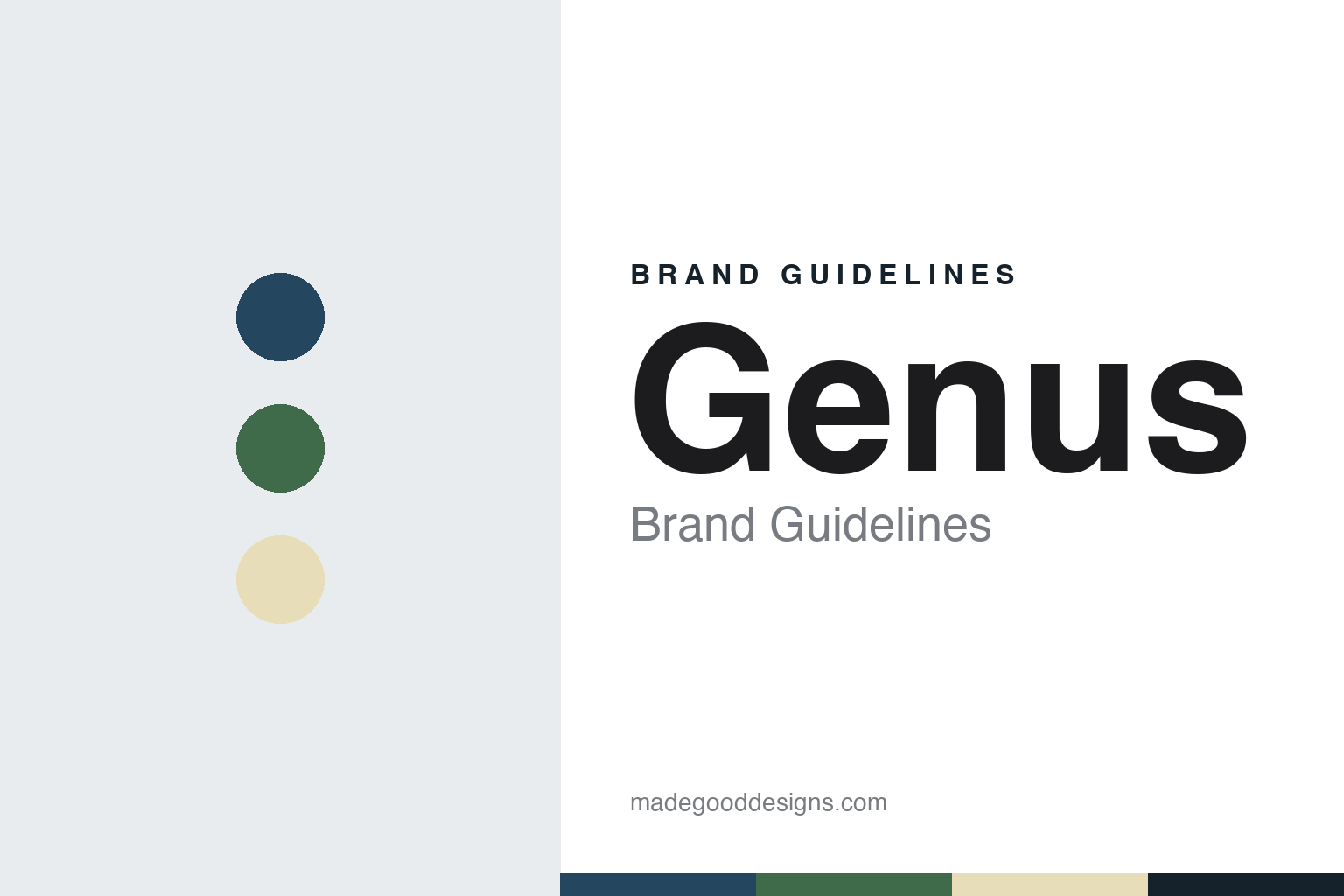
Genus Brand Guidelines
From a milk board’s breeding division to cattle and pig genetics on six continents.
Aa
Two constants: a blue, green and straw palette and a plain technical sans register. Abstract homage — not a Genus, ABS or PIC product or mark; no animal, logo or packaging is reproduced.
A milk board’s breeding arm
From Thames Ditton to Basingstoke.
Genus traces its roots to a British public body rather than a founder. English Wikipedia says the business began as the Breeding & Production Division of the Milk Marketing Board, the producer-run board set up under the Agricultural Marketing Act of 1933 and established on 6 October that year, with its base at Thames Ditton in Surrey. The board bought farmers’ milk as the buyer of last resort, ran advertising campaigns such as “drinka pinta milka day” and, in its final form, covered four activities: milk marketing, Dairy Crest, Genus and National Milk Records.
The board’s role effectively ended in April 1994, when the British milk market was deregulated under the Agriculture Act 1993, and it was formally dissolved in January 2002, according to English Wikipedia. Genus grew out of that breeding arm and today is a public company headquartered in Basingstoke, Hampshire, and a constituent of the FTSE 250 index, Wikipedia says.
Two acquisitions turned that British breeding business into an international one. In 1999 Genus bought ABS Global, the American cattle-breeding company. English Wikipedia dates the closing to 15 November 1999 and says the seller was Protein Genetics, a New York firm; at the time ABS had around 340 employees. In 2005, through its takeover of Sygen International plc, Genus acquired PIC, which English Wikipedia says was founded in the UK in 1962 by six pork producers as the Pig Improvement Company.
ABS had its own long history. English Wikipedia says it was founded in 1941 by John Rockefeller Prentice as the American Dairy Guernsey Associates of Northern Illinois, took the name American Breeders Service in 1950, and by 1962 was based in Madison, Wisconsin, storing frozen bull semen in liquid nitrogen. By 1983 it was owned by W. R. Grace and Company. Sources differ on when it became ABS Global: English Wikipedia gives 1994, while a 2011 ABS news release published by Progressive Cattle gives 1995. Its headquarters are in DeForest, Wisconsin.
Colour
Two brands: ABS for cattle, PIC for pigs.
Genus describes itself as running two business units: ABS, for dairy and beef cattle, and PIC, for pigs, alongside a research and development arm. The company says it uses genomic selection, testing each animal’s DNA for markers linked to particular traits and calculating an estimated breeding value, and then breeding from the animals that score highest.
ABS sells dairy and beef bull semen and embryos for artificial insemination, much of it, the company says, in sexed form, sorted to raise the chance of a female calf for dairy herds or a male one for beef. Genus says its best bulls are housed at six stud locations, where semen is collected and frozen in straws. In the UK and France, it says, ABS genetics are still sold under the long-established Genus and Bovec brands. The 2011 ABS release in Progressive Cattle marked several of the business’s milestones: the Genetic Management System mating programme, launched in 1968; ABS Sexation sex-sorted semen, launched in 2006; and the DURAbulls brand a year later.
PIC sells breeding pigs and semen to pork producers. Genus says PIC’s pure-bred lines are kept in biosecure facilities on four continents and bred out through more than 500 multiplication farms, many run by customers, with boars housed in more than 400 studs around the world. PIC genetics are sold under the PIC brand.
The most widely reported recent step was a regulatory one. On 2 May 2025 the British title Farming News reported that the US Food and Drug Administration had approved a gene-editing technology for Genus’s pigs for the US food supply chain. The edit, developed with researchers at the University of Edinburgh’s Roslin Institute, removes a small section of the CD163 gene, which produces the cell receptor that the PRRS virus uses; the report described the resulting pigs as resistant to that disease. Genus’s chief executive, Jorgen Kokke, called the approval a major step towards US commercialisation, and said the company would pursue approvals in other countries, with a focus on key US export markets.
Typography
How breeders show genetics.
Livestock-genetics companies sell something a customer cannot see: the breeding value carried in an animal, a fertile egg or a frozen straw of semen. Their marketing therefore leans on the animals themselves. A prize bull or a breeding sow is photographed side-on, square to the camera, against a barn wall or an open sky, so that frame, legs and topline read clearly; the pose echoes the show ring and the sire catalogue.
Poultry breeders work at a different scale. Their pictures tend to show a day-old chick held in gloved hands, rows of laying hens in clean housing, or a single bird against a plain backdrop, with the brand name and line number set beside it. The gloves signal hygiene, and with breeding farms closed to casual visitors, staged photography often stands in for a site visit.
The laboratory is the third setting. Cattle and pig genetics companies show technicians filling or sorting semen straws, opening liquid-nitrogen tanks wrapped in vapour, or reading genomic data on a screen, to show that selection now runs on DNA testing as well as on pedigree and performance records. Alongside them come farmer portraits: a dairy farmer in the parlour, a pig producer in the barn, a family on the farm, used to make a technical product feel local.
Much of this imagery is made for trade shows. World Dairy Expo in Madison, Wisconsin, EuroTier in Hanover and the International Production & Processing Expo (IPPE) in Atlanta are where breeders put up stands, hand out sire catalogues and parade cattle in the ring. The companies in this guide are set out by what can be checked: who founded them, who owns them and what they breed.
Aa
A plain technical sans for a science-led breeder. (Specimen set in Archivo, a sans STAND-IN; NOT the Genus, ABS or PIC logo.)
Genus
A corporate parent behind two trading brands.
Genus’s own name sits mostly in the background. Farmers buy from ABS or PIC; Genus plc is the listed parent that owns them, and it says it operates in 30 countries across six continents and reaches a further 50 markets through distribution partners. In Britain and France, the Genus name still appears on cattle genetics, a link back to the milk board’s breeding service.
The company frames its purpose as “pioneering animal genetic improvement to sustainably nourish the world,” and its pages lean on the language of science: DNA markers, breeding values and proprietary technologies. Those are its own descriptions. The documented milestones are the corporate ones: the milk board’s 1933 founding and 1994 wind-down, the purchase of ABS in 1999, the takeover of Sygen and with it PIC in 2005, and the US approval of its gene-edited pig in 2025.
The two brands carry their own American and British histories. ABS goes back to a Guernsey breeders’ association in northern Illinois in 1941; PIC to six British pork producers in 1962. Genus says both are sold through direct sales channels and strategic partners under their own brands, while a separate unit, Genus R&D, manages the research pipeline for cattle, pigs and other species, English Wikipedia says.
For a design guide, Genus shows how a listed parent can let older trading brands face customers while its own name stays on the corporate side. Compare Topigs Norsvin, a pig-genetics company formed by a merger, and Semex, a farmer-owned cattle-genetics business. For this guide we use a nitrogen blue, a pasture green and a straw tone with a sans, an unofficial interpretation; no product or logo is reproduced.
Explore & save
Keep Genus’s identity on hand — save it to a board in the Made Good inspiration library.
Genus identity set
Pin the Genus blue, green and straw palette and the plain technical sans register to your own board.