Topigs Norsvin Brand Guidelines
Dutch and Norwegian pig farmers’ shared breeding company.
Aa
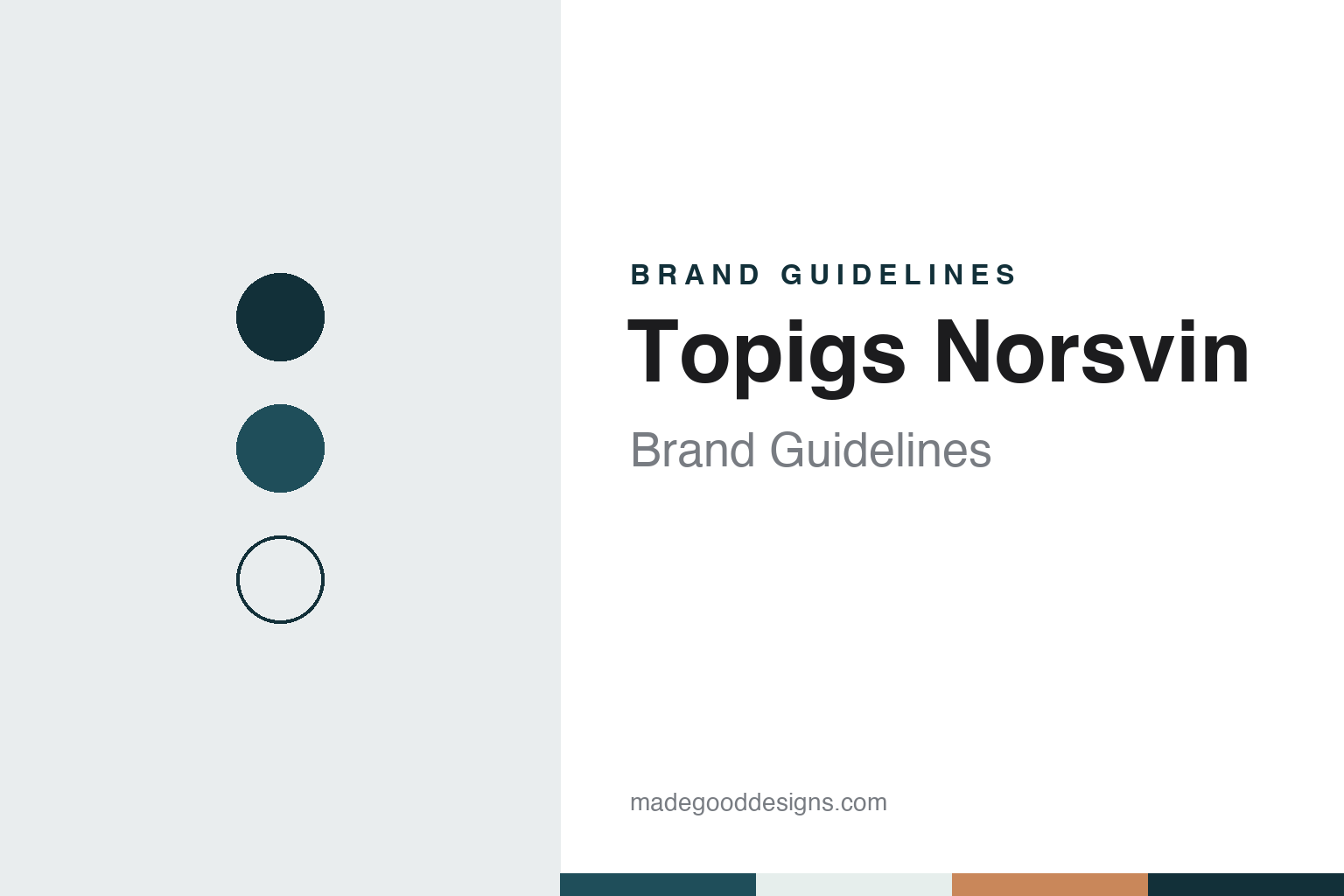
Two constants: a fjord teal, mist and clay palette and a plain grotesque register. Abstract homage — not a Topigs Norsvin product or mark; no animal, logo or nameplate is reproduced.
Two cooperatives
A Dutch breeding programme and a Norwegian one.
Topigs Norsvin is a young name with old roots. The company was created in 2014, when Topigs International and Norsvin International AS merged their international activities into a new company, The Pig Site reported on 4 June 2014, when the deal was presented at the World Pork Expo. The report said the head office would be in Vught, in the Netherlands, and that Topigs Nederland, the Dutch AI business Varkens K.I. Nederland and the Norwegian cooperative Norsvin SA stayed outside the merger. Martin Bijl was named chief executive. Today the company’s website places its head office in ’s-Hertogenbosch, and names Dick Hordijk as chief executive.
Both parents are farmers’ organisations. The Pig Site described Topigs and Norsvin in 2014 as farmer-owned, with farmer-owned meat processors and a feed supplier as minority shareholders. The company now says that the two cooperatives, “representing hundreds of pig farmers who are the owners,” jointly own Topigs Norsvin, and that it is run with a two-tier structure of a supervisory board and a board of directors. Norwegian Wikipedia describes Norsvin SA as a cooperative owned by about 1,500 Norwegian pig producers, working on research and breeding, boar semen for artificial insemination and advice to farmers.
The company tells its history as a single line. By its account, provincial farmer-owned herd books, the stamboeken, were set up across the Netherlands between 1906 and 1913, and on 24 February 1922 Dutch pig farmers founded the Centraal Bureau voor de Varkensfokkerij to improve pig breeding together. The sources read for this guide do not describe the bureau under the German occupation of 1940–45. Norwegian farmers founded Norsvin in 1958, the company says, first to run an artificial-insemination station together.
Colour
From herd books to one Dutch programme.
The Dutch side was built by consolidation. The company says new breeding firms appeared in the 1960s — Fomeva, Dalland and Cofok, the last owned by meat processors — alongside the herd books. In the early 1980s Cofok and Prova merged into Dumeco Breeding, part of the meat processor Dumeco, later the VION Food Group; in the late 1980s the herd books, Dalland and Fomeva came together under one breeding programme, Topigs. Dutch Wikipedia dates the formation of Topigs from that group to 1999 and gives Vught as its head office. In 2000 and 2001, the company says, Topigs and Dumeco Breeding merged, bringing nearly all Dutch pig breeding under one roof.
The company also describes how its methods changed. It says its researchers developed “Balanced Breeding” in the 1990s, an approach that selects for traits across the whole animal rather than for growth alone, and it calls itself the method’s inventor. It says it began CT scanning of live pigs in 2008 to measure body composition, began selecting against boar taint in 2010, and first used DNA information to calculate breeding values in 2011.
Growth abroad came through North America. In 2008, the company says, Topigs bought the Canadian breeder GAP Genetics, previously owned by the food processor Maple Leaf, and in 2018 it opened Delta Canada, a boar test and research centre, and Innova Canada, a nucleus centre for its Z-line and TN Tempo. A further test centre, Delta Norway, followed in 2024.
The products carry short, coded names. The TN70 is a hybrid sow which the company says combines Norsvin Landrace and Z-line genetics, and which it promotes as “the best mother in the world.” The TN Tempo is a white synthetic terminal boar “of Large White origin,” in the company’s words, and the range also includes TN Duroc, TN Select, TN Rex and Iberduroc. The Norsvin Landrace in the TN70 descends from the Norwegian Landrace that Norwegian Wikipedia names as Norsvin’s main breed.
Typography
Design and documentation.
Livestock-genetics companies sell something a customer cannot see: the breeding value carried in an animal, a fertile egg or a frozen straw of semen. Their marketing therefore leans on the animals themselves. A prize bull or a breeding sow is photographed side-on, square to the camera, against a barn wall or an open sky, so that frame, legs and topline read clearly; the pose echoes the show ring and the sire catalogue.
Poultry breeders work at a different scale. Their pictures tend to show a day-old chick held in gloved hands, rows of laying hens in clean housing, or a single bird against a plain backdrop, with the brand name and line number set beside it. The gloves signal hygiene, and with breeding farms closed to casual visitors, staged photography often stands in for a site visit.
The laboratory is the third setting. Cattle and pig genetics companies show technicians filling or sorting semen straws, opening liquid-nitrogen tanks wrapped in vapour, or reading genomic data on a screen, to show that selection now runs on DNA testing as well as on pedigree and performance records. Alongside them come farmer portraits: a dairy farmer in the parlour, a pig producer in the barn, a family on the farm, used to make a technical product feel local.
Much of this imagery is made for trade shows. World Dairy Expo in Madison, Wisconsin, EuroTier in Hanover and the International Production & Processing Expo (IPPE) in Atlanta are where breeders put up stands, hand out sire catalogues and parade cattle in the ring. The companies in this guide are set out by what can be checked: who founded them, who owns them and what they breed.
Aa
A plain grotesque — a short, coded name. (Specimen set in Archivo, a sans STAND-IN; NOT the Topigs Norsvin logo.)
Topigs Norsvin
Farmer-owned, by its own account “for generations to come.”
The company’s present-day voice is that of a cooperative. Its website says that “as a farmer-owned cooperative, we have a long term horizon as we breed for generations to come,” and that its structure means genetic gains “are returned to farmer-owners” rather than to outside investors. In 2014 The Pig Site reported the merger’s pitch in similar terms: both partners described a philosophy of paying their owners back through genetic progress from research.
Its own milestones are told in the same register. The company marked the centenary of the Centraal Bureau voor de Varkensfokkerij in 2022, and says it is now active in more than 70 countries. It calls itself the world’s second-largest swine genetics company; we give that as its own description. Its newest line, R3silience, was launched on 2 June 2026 at a North American Pork Event it hosted in Des Moines, Iowa, according to a company release dated the following day.
The name joins its two parents with no hyphen: Topigs, from the Dutch side, and Norsvin, from the Norwegian one. Its products are labelled with a TN prefix — TN70, TN Tempo, TN Duroc — so that the joint name becomes a short code across the range. On its website the company presents itself through science, selection and sustainability pages rather than through a founder’s story, and puts its cooperative ownership near the top of its “about” page.
For a design guide, Topigs Norsvin shows how a merged cooperative can keep both parents in one name and shorten it to a product code. Compare Hendrix Genetics, another Dutch breeding company with a pig business, and Genus, the British owner of the PIC pig-genetics brand. For this guide we use a fjord teal, a pale mist and a brick clay with a sans, an unofficial interpretation; no product or logo is reproduced.
Explore & save
Keep Topigs Norsvin’s identity on hand — save it to a board in the Made Good inspiration library.
Topigs Norsvin identity set
Pin the Topigs Norsvin fjord teal, mist and clay palette and the plain grotesque register to your own board.