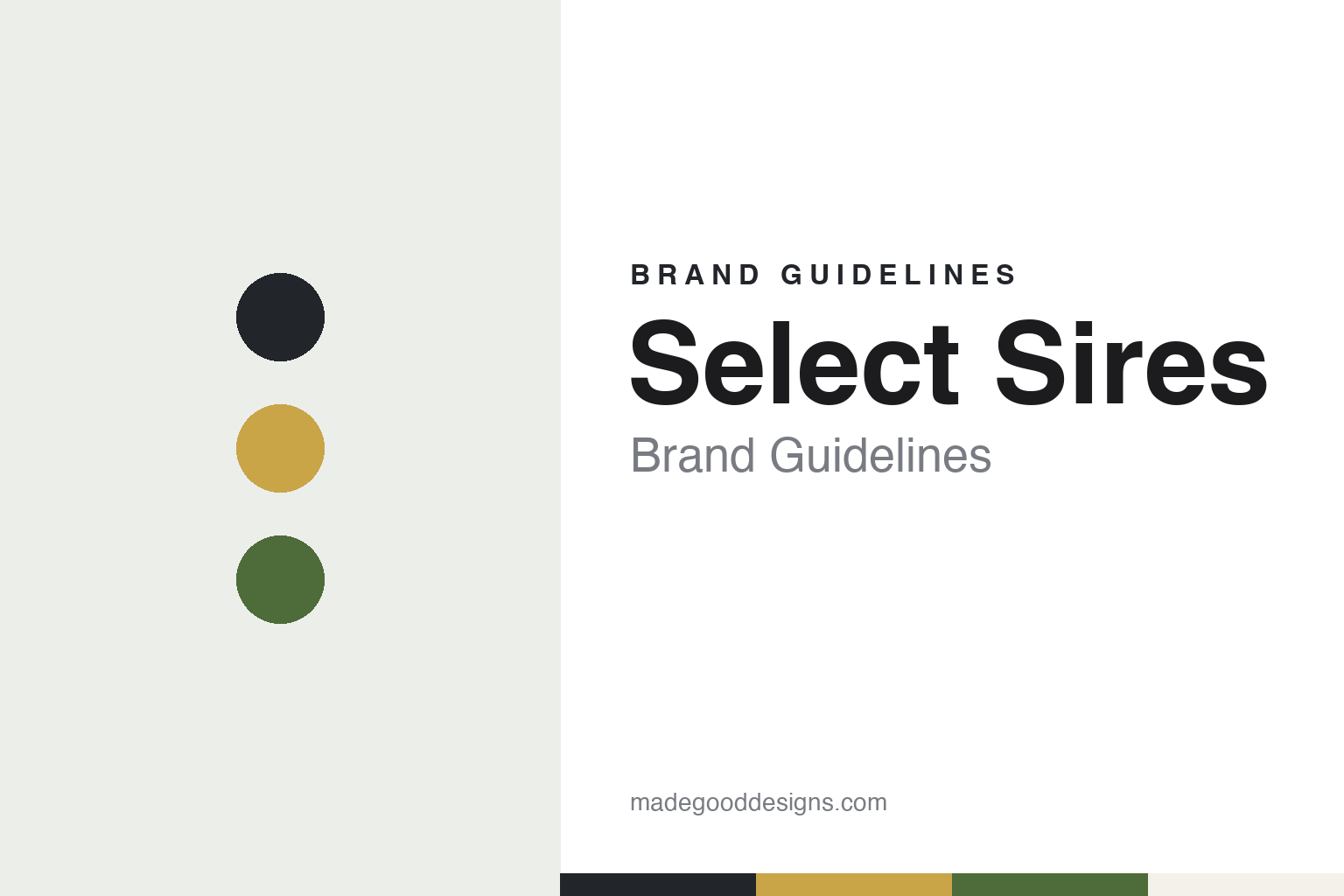
Select Sires Brand Guidelines
The Ohio cooperative that farmers own, built on bull semen and breeding advice.
Aa
Two constants: a black, straw gold and pasture green palette and a Plain sans register. Abstract homage — not a Select Sires product or mark; no straw, logo or sire photograph is reproduced.
Four cooperatives
A charter signed by farmers in 1965.
Select Sires was not founded by one breeder or one family. On 12 October 1965, the company says, four farmer-owned artificial-insemination cooperatives signed the charter of incorporation for Select Sires Inc.: the Central Ohio Breeding Association, the Kentucky Artificial Breeding Association, the Northern Illinois Breeding Cooperative and the Southern Illinois Breeding Association. They consolidated their production facilities in Columbus, Ohio, and the first board of directors was made up of eight customer-owners.
That structure is still the core of the brand. Select Sires describes itself as a company based in Plain City, Ohio, whose semen and genetic advice reach farmers through farmer-owned and farmer-controlled cooperatives, each running its own marketing, sales and service in a region. Each member cooperative, the company says, is represented on the Select Sires board by customer-owners, and patronage dividends are returned to them. Over the years more cooperatives, and distributors that turned into cooperatives, joined the federation.
The company tells its early history partly through bulls. It dates the birth of the Holstein sire 7HO58 Elevation to 30 August 1965, weeks before the charter was signed, and cites a 2014 report by Holstein Association USA on how widely his genes still appeared in the breed. In 1972, it says, it moved from glass ampules to straws for semen, and in 1973 it began the Select Mating Service, with evaluators visiting herds to match cows with sires on functional type.
In 1974 it started its young-sire sampling scheme, the Program for Genetic Advancement, which it describes as a national programme. The same year, by the company’s account, saw the birth of what it calls the first calf born from embryo transfer in the United States, a bull that went on to become one of its proven sires. In 1980 it formed a subsidiary, Select Embryos, for embryo transfer and research.
Colour
From straws to sexed semen and genomics.
Select Sires’ products are bull semen for dairy and beef cattle, sold with breeding and reproduction services. The company names Jersey sires among its milestones, including 7JE254 Berretta, born in 1983, and 7JE590 Action, born in 1995, alongside its Holstein lines.
The company says it began sending semen to the United States Department of Agriculture’s repository in 1992, material that later fed into genomic selection, which it describes as having reshaped cattle breeding. In 2005 it introduced gender SELECTed semen, its sexed-semen product, and set up Select Reproductive Solutions, a reproduction consulting service. Later programmes include the Aggressive Reproductive Technologies programme of 2009, for developing elite Holstein sires, and StrataGEN, a sequential breeding system introduced in 2012 that the company says is meant to help herds meet breeding goals while limiting inbreeding.
Growth came through purchases and partnerships. In March 2000, the company says, it bought its main distributor in eastern Canada, TransCanada, and formed Select Sires Canada; in July of the same year it acquired the land, bulls and production assets of Sire Power and began semen production at Tunkhannock, Pennsylvania. In 2001 it bought half of World Wide Sires, which sells its semen abroad. It created Select Sires do Brasil in 2011, merged its Canadian business with GenerVations in 2014 to form Select Sires GenerVations, and added an Argentine business in 2019.
The biggest step was the union with Accelerated Genetics, the Wisconsin-based cooperative. TheCattleSite reported on 19 June 2017 that the boards of both cooperatives had reached a unanimous decision to unify them, with Select Sires to acquire Accelerated Genetics’ assets, and noted that the two had shared ownership of World Wide Sires since 2001. Progressive Cattle reported on 22 June 2017 that Accelerated Genetics delegates had voted in favour at a special meeting that day. Select Sires says the merger gave it full ownership of World Wide Sires, which serves Europe, Africa, Asia, the Middle East and Oceania.
Typography
Design and documentation.
Livestock-genetics companies sell something a customer cannot see: the breeding value carried in an animal, a fertile egg or a frozen straw of semen. Their marketing therefore leans on the animals themselves. A prize bull or a breeding sow is photographed side-on, square to the camera, against a barn wall or an open sky, so that frame, legs and topline read clearly; the pose echoes the show ring and the sire catalogue.
Poultry breeders work at a different scale. Their pictures tend to show a day-old chick held in gloved hands, rows of laying hens in clean housing, or a single bird against a plain backdrop, with the brand name and line number set beside it. The gloves signal hygiene, and with breeding farms closed to casual visitors, staged photography often stands in for a site visit.
The laboratory is the third setting. Cattle and pig genetics companies show technicians filling or sorting semen straws, opening liquid-nitrogen tanks wrapped in vapour, or reading genomic data on a screen, to show that selection now runs on DNA testing as well as on pedigree and performance records. Alongside them come farmer portraits: a dairy farmer in the parlour, a pig producer in the barn, a family on the farm, used to make a technical product feel local.
Much of this imagery is made for trade shows. World Dairy Expo in Madison, Wisconsin, EuroTier in Hanover and the International Production & Processing Expo (IPPE) in Atlanta are where breeders put up stands, hand out sire catalogues and parade cattle in the ring. The companies in this guide are set out by what can be checked: who founded them, who owns them and what they breed.
Aa
A plain, sturdy sans — SELECT SIRES in capitals. (Specimen set in Libre Franklin, a sans STAND-IN; NOT the Select Sires logo.)
Select Sires
Owned by the farmers it serves.
The number of member cooperatives has fallen over time. In June 2017 Select Sires described itself as made up of nine farmer-owned and farmer-controlled cooperatives, according to TheCattleSite; today it lists three in the United States: CentralStar Cooperative, Premier Select Sires and Select Sires Member Cooperative. The last of these, the company says, was formed when All West/Select Sires, COBA/Select Sires, Select Sires MidAmerica and Minnesota/Select Sires voted to merge, and as of 1 October 2023 it served members across 27 states and Mexico. Outside the United States, World Wide Sires handles international sales.
The company states its mission as serving livestock producers “with the highest integrity,” and lists four values: integrity, dedication, respect and innovation. Its website also names brands it carries beside its own, including Accelerated Genetics and GenerVations.
For a design guide, Select Sires shows a brand whose identity rests on ownership: a cooperative federation that speaks through bull names, programme acronyms and the farmers who sit on its board. Compare CRV, another farmer-owned cattle-breeding cooperative, and Genus, whose ABS business sells bovine genetics. For this guide we use Holstein black and straw gold with a sans, an unofficial interpretation; no product or logo is reproduced.
Explore & save
Keep Select Sires’s identity on hand — save it to a board in the Made Good inspiration library.
Select Sires identity set
Pin the Select Sires black and straw gold palette and the Plain sans register to your own board.