Würth Elektronik Brand Guidelines
The Niedernhall board maker inside the Würth Group.
Aa
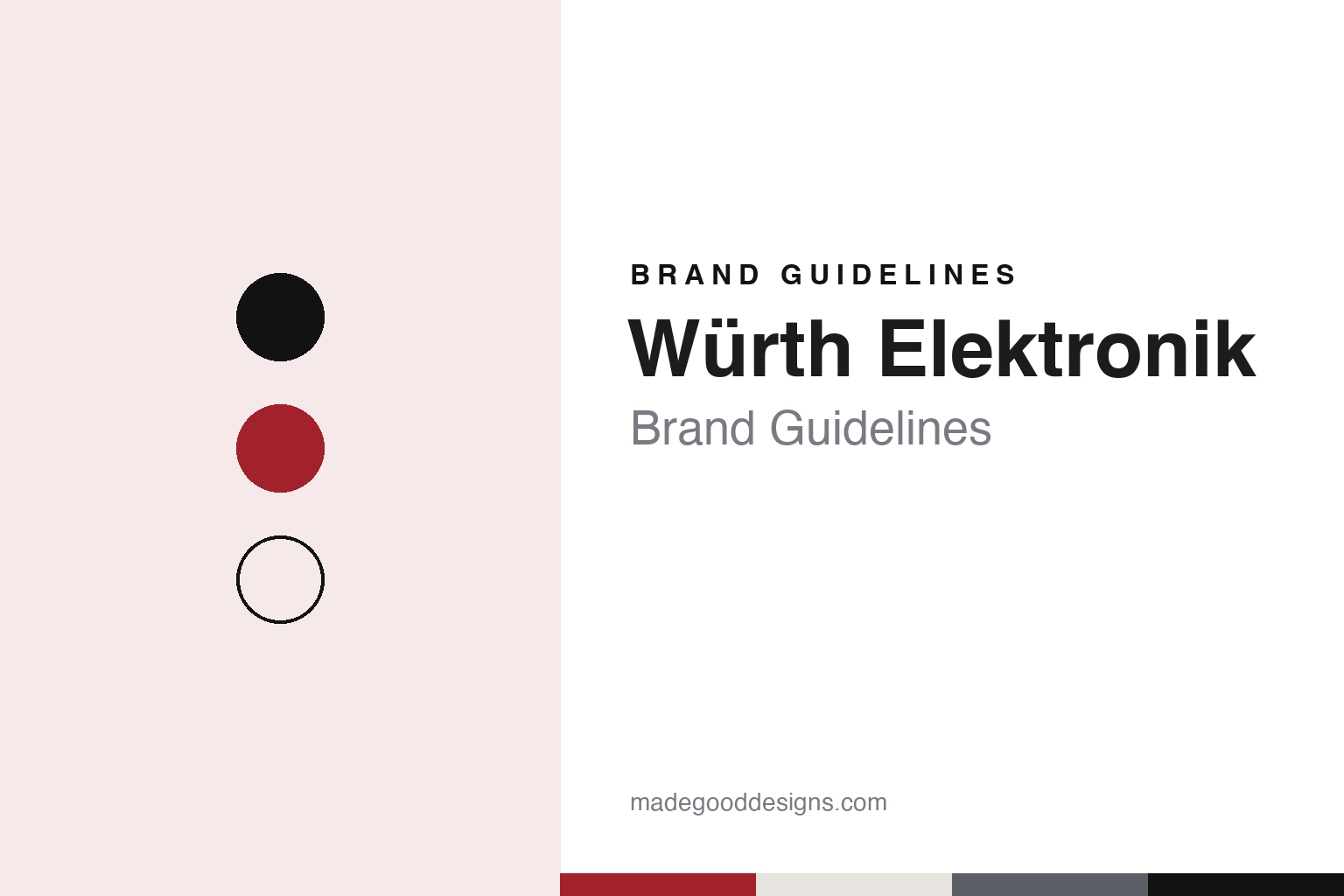
Two constants: a red, black and warm grey palette and an industrial sans register. Abstract homage — not a Würth Elektronik product or mark; no board, component or logo is reproduced.
A department in 1971
Circuit boards inside a screw business.
Würth Elektronik began in 1971 as a department of Adolf Würth GmbH & Co. KG, the screw and fastener wholesaler of Künzelsau in Baden-Württemberg, German Wikipedia says. That parent business had been founded in Künzelsau in 1945 by Adolf Würth and had been run since 1954 by his son Reinhold Würth, according to English Wikipedia. The new department specialised in printed circuit boards for the electrical industry, and in 1976 it was entered in the commercial register as a company in its own right.
In 1980 a circuit board works was built at Niedernhall, near Künzelsau, and Niedernhall remains the seat of the group, German Wikipedia says. In 1984 two further units were formed, one for electromechanical assemblies and one for connection technology; a team of eight people at first made mostly backplanes for the telecommunications trade.
Those two units grew into separate companies. The electromechanical assemblies unit was renamed ICS, for Intelligent Connecting Systems, in 2000, and in 2007 became Würth Elektronik ICS GmbH & Co. KG, strengthening its business in central electrical systems for commercial vehicles. The connection technology unit became Würth Elektronik eiSos in 2002 and moved into newly designed sales and administration buildings at Waldenburg, widening its range to include components for electromagnetic compatibility, inductors, transformers and radio-frequency parts.
The board business also changed. In 2011 an Asia Production operation began adding boards made in Asia to the range, and in 2016 a new board plant opened at Niedernhall that the company described as the most modern in Europe when it was commissioned, German Wikipedia reports, citing the company.
Colour
Three businesses, one family name.
Würth Elektronik makes and sells circuit boards, electronic components, electromechanical parts such as connectors, and complete system assemblies; German Wikipedia says its customers come largely from industrial electronics, telecommunications, consumer electronics, automotive, aviation, medical technology, sensors and renewable energy. Today the group has three divisions, it says. Circuit Board Technology, headquartered at Niedernhall with a further German site at Rot am See and a site at Mysore in India, develops and makes boards to customer designs for fields such as medical technology, automotive and aerospace. Its range takes in flexible, rigid-flex, multilayer and HDI boards, as well as boards with embedded components and printed sensors, and it runs an online shop for boards and stencils under the name WEdirekt.
Würth Elektronik eiSos, based at Waldenburg, develops, makes and sells electronic and electromechanical components — capacitors, resistors, quartz crystals and connectors among them — with production listed in Germany, the Czech Republic, Bulgaria, China, Singapore, Taiwan and Mexico. Its subsidiary Würth Elektronik iBE, at Thyrnau in Bavaria, specialises in the car industry, and its American subsidiary, Wurth Electronics Midcom of Watertown, South Dakota, develops and makes custom transformers. In 2016 the division bought AMBER wireless, a specialist in radio modules for the industrial internet of things.
Würth Elektronik ICS, at Niedernhall-Waldzimmern, develops and makes power distribution boxes, electronic controls, display modules and high-voltage systems, chiefly for agricultural and construction machinery and commercial vehicles, with further offices in the United States, France, Britain, Italy and India.
Across the three divisions, the company says it had 23 production sites worldwide in 2025 and about 7,300 employees, figures German Wikipedia gives from the company’s own provisional numbers.
Typography
Europe’s board makers under pressure.
Printed circuit boards sit inside almost every electronic product, yet the companies that make them rarely sell to the public. Their brands are written for engineers, buyers and investors, and their pictures tend to come from a short, shared list: a green or black board lit from the side so that its copper traces catch the light, a macro shot of vias and solder pads, or the gold-plated contact fingers along a board’s edge.
The factory is the other recurring subject. Board makers show long plating lines, rows of drilling machines, clean rooms and inspection stations, because scale and process are what they are selling. Flexible circuits get their own pose — a thin amber strip curled over a fingertip — while makers of IC substrates, the fine-lined carriers that sit between a chip and its board, tend to show close-ups of dense, glossy panels rather than finished products.
Names are often short and technical: TTM Technologies, for one, says its initials stand for “time-to-market.” Few makers publish formal colour standards, so the palettes in these guides are our own reading of the trade’s materials — the green of solder mask, the dark of laminate, the warm metal of copper and gold — rather than any company’s specification.
The trade meets at its own shows. The TPCA Show in Taipei gathers Taiwan’s board and substrate makers and their suppliers, and the electronica fairs, in Munich and elsewhere, bring board makers together with the component and equipment trade; TTM Technologies, for one, announced that it would exhibit at electronica India in Bangalore in 2026. The makers in this guide are spread across the United States, Taiwan, mainland China, Japan and Europe, and several of them run plants in more than one of those places.
Aa
An industrial sans for a family-owned component group. (Specimen set in Archivo, a sans STAND-IN; NOT the Würth Elektronik logo.)
Würth Elektronik
More than you expect.
The board business has felt the decline of European circuit board making. On 7 October 2024 the trade site Evertiq reported that Würth Elektronik Circuit Board Technology would close its board production at Schopfheim, in the south of Baden-Württemberg, giving a severe crisis in the European industry and a dramatic drop in incoming orders as its reasons; more than 300 employees were affected, and future orders were to be handled at the company’s other German sites. On 13 February 2025 Evertiq reported that the closure had been finalised, with a reconciliation of interests and a social plan agreed with the works council. The company said firms from the region and from neighbouring Switzerland had offered jobs, and that an internal job exchange had placed nearly all trainees and about 50 employees. German Wikipedia dates the closure to the summer of 2025.
The name carries the Würth family brand into electronics, and the division’s identity has moved with the times. German Wikipedia shows an older group logo and a new one, in use since 2022, that carries the line “More than you expect.” From the first Formula E season, in 2014–15, Würth Elektronik was technology partner to the ABT Sportsline team of Kempten, a link the company described as a hard test for its electronics; English Wikipedia says its logo appeared on the nose of the team’s cars. It withdrew from the series at the end of the 2020–21 season, German Wikipedia says.
For a design guide, Würth Elektronik shows how a family name from one trade — screws — can stretch across circuit boards, components and power systems, with each division marked by its own suffix. Compare AT&S, another European board maker, and TTM Technologies. For this guide we use a strong red, a near-black and a warm grey with a sans, an unofficial interpretation; no product or logo is reproduced.
Explore & save
Keep Würth Elektronik’s identity on hand — save it to a board in the Made Good inspiration library.
Würth Elektronik identity set
Pin the Würth Elektronik red, black and warm grey palette and the industrial sans register to your own board.