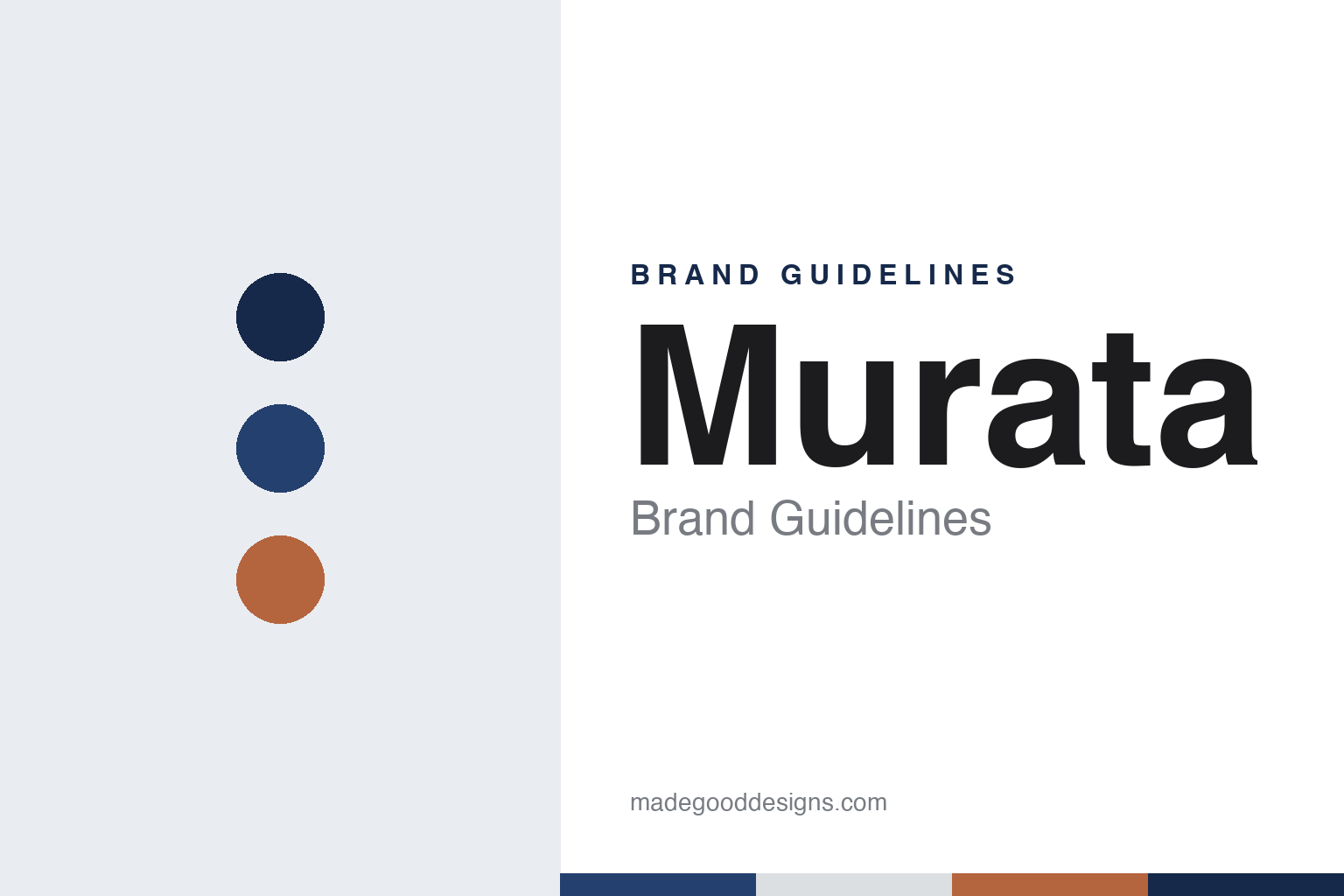
Murata Brand Guidelines
The Kyoto capacitor workshop that grew around ceramics.
Aa
Two constants: a kiln blue, porcelain grey and terracotta palette and a clean Japanese sans register. Abstract homage — not a Murata product or mark; no component, robot or logo is reproduced.
A wartime workshop
Titanium-oxide capacitors in central Kyoto.
Murata began in Kyoto in October 1944, during the Second World War. The company’s own history says Akira Murata (1921–2006) started it as a personal venture in Nakagyo-ku, in the centre of the city, in a small factory of about 150 square metres, and that its first product was a titanium-oxide ceramic capacitor, used mainly in heterodyne radios. Japanese Wikipedia adds that the workshop was a rented former dye works and that the business started as a small factory making ceramic goods such as insulators. Murata’s brand story says its roots “go back to the challenging days of wartime Japan,” when scarce materials and limited facilities meant many trials and failures, and that the founder’s father ran a ceramics factory.
The business was reorganised as a joint-stock company, Murata Manufacturing Co., Ltd., in December 1950, English and Japanese Wikipedia say. The company still marks its founding on 15 October; Japanese Wikipedia says the date recalls Akira Murata’s visit to the Atago shrine, dedicated to the god of fire, before he began firing ceramics. In the years after the war, the company says, radio was almost the only entertainment and news source, and its tubular ceramic capacitor was used for temperature compensation in the superheterodyne sets that became popular. In 1952 the head office and plant moved to Yamashina in Kyoto, and in 1961 the head office moved to Nagaokakyo, where it remains; Japanese Wikipedia says a new head office was built there in 2004.
Japanese Wikipedia describes a pattern set early: production in regional subsidiaries, beginning with a plant in Fukui prefecture in 1951 that became the first production subsidiary in 1955, and spreading across the Hokuriku region, while the ceramic-firing works at Yokaichi in Shiga, opened in 1962, stayed under direct control to protect know-how. Later bases included Izumo, set up in 1983, and the Yasu plant in Shiga, opened in 1987, the company says. Akira Murata set out the Murata Philosophy in 1954, according to the company, which says it has since been translated into more than ten languages.
Colour
Filters, resonators and the multilayer capacitor.
Murata’s product story follows the electronics of each decade, its own history says. In the 1950s it made barium titanate transducers for fish finders and commercialised AM radio ceramic filters using lead zirconate titanate; Japanese Wikipedia says Murata won a licence to the material’s US patent, held by Clevite, in August 1963, and that ceramic filters grew into a main product. The 1960s brought the POSISTOR thermistor for colour-television degaussing circuits; the 1970s the GIGAFIL antenna duplexer, which the company says went into NTT’s first-generation car phone; and the 1980s the CERALOCK ceramic resonator, ferrite beads and the chip multilayer ceramic capacitor.
The multilayer ceramic capacitor, or MLCC, now sits at the centre of the business. The company says it pioneered MLCCs that replaced costly palladium electrodes with nickel and, in the 1980s, became the first company in the world to achieve stable mass production of them; that is its own claim. Its history lists an MLCC in the 0201 size, 0.25 by 0.125 millimetres. Japanese Wikipedia, citing the company, says annual MLCC output was approaching two trillion pieces in December 2025, across tens of thousands of types, and that in 2023 Murata set up MF Material, a joint venture making barium titanate, the main raw material, with Ishihara Sangyo and Fuji Titanium.
Abroad, Murata opened a New York office in 1963 and set up Murata Corporation of America in 1965, Japanese Wikipedia says; a plant in Georgia followed in 1973 and closed in 2004. Production followed in Singapore in 1972, Thailand in 1988, Ipoh in Malaysia in 1993 and Wuxi in China in 1994, and Murata bought the Canadian-based capacitor and filter maker Erie Technological Products, which it began running in 1981 as Murata Erie North America. Later purchases included a US power-supply maker in 2007, now Murata Power Solutions; Peregrine Semiconductor, announced in 2014 and renamed pSemi; and Sony’s battery business in 2017. In March 2022 Murata completed its purchase of the US filter designer Resonant and its XBAR technology, Evertiq reported on 30 March 2022.
Typography
How component makers show what they make.
Passive components are hard to photograph and harder to brand. A multilayer ceramic capacitor in the smallest sizes is a speck that sits like a grain of sand on a fingertip, and a scatter of chips on a fingertip is one way to show that scale. Resistors, inductors, filters and fuses look little different from one maker to the next, so the presentation leans on the company’s name, its colours and the way it pictures the work behind the part.
The pictures repeat across the trade. Reels of tape-and-reel parts, ready for pick-and-place machines, stand for volume. Through-hole resistors with their coloured bands, cut-away capacitors that open up the layers or the wound film inside, and close-ups of ceramic sheets being stacked stand for the craft. Automated inspection lines, with cameras checking each part, stand for consistency, and pictures of factories and laboratories often stand in for the end products the parts go into.
Trade shows are where these brands meet engineers in person. electronica in Munich and CEATEC in Japan are among the fairs where component makers take large stands, and some use them for showpieces that have little to do with a datasheet: Murata, for one, says it demonstrated its bicycle-riding Murata Boy robot at CEATEC JAPAN 2005.
Many of these companies began with a material rather than a product: ferrite, titanium oxide, barium titanate, tantalum or film. Several have changed hands or merged, so names, marks and owners do not always line up. This guide sets out who founded each brand, who owns it now and where it says its parts are made, and marks clearly what rests only on the company’s own word.
Aa
A clean Japanese sans for a company named after its founder. (Specimen set in Zen Kaku Gothic New, a sans STAND-IN; NOT the Murata logo.)
Murata
A robot on a bicycle for a maker of invisible parts.
Murata is listed in Tokyo; Japanese Wikipedia says it moved to the exchange’s Prime market in April 2022. In June 2020 Norio Nakajima became president, the first from outside the founding family, and in 2024 Tsuneo Murata stepped down as chairman, leaving no founding-family member on the board for the first time, Japanese Wikipedia says. The January 2024 Noto Peninsula earthquake damaged its plants in Hokuriku; production resumed in stages, and at Anamizu, near the epicentre, not until mid-May or later. In December 2020 the company opened the Minato Mirai Innovation Center in Yokohama, which houses a children’s science facility called Mulabo!.
Murata’s public face is unusual for a component maker. Japanese Wikipedia says that from the 2000s the company put weight on newspaper and television advertising, with TV spots built on a pun about what Murata “makes,” and that a bicycle-riding robot, Murata Seisaku-kun — Murata Boy in English — drew wide attention. The company says Murata Boy was demonstrated at CEATEC JAPAN 2005; a unicycling companion, Murata Seiko-chan, followed in 2008, and a squad of ball-balancing cheerleader robots, developed with Kyoto University, in 2014. On the mark itself, Japanese Wikipedia records a logo change in 2014, and the company’s history shows an early-1950s poster whose logo, it says, seems to have been the prototype of the current one. English Wikipedia flags a name trap: Murata Machinery, a maker of industrial machines, is a separate company often confused with Murata Manufacturing.
For a design guide, Murata shows how a maker of parts that few people ever see can build a public character through robots, a founding philosophy and its own name. Compare TDK, another Japanese ceramics-and-magnetics company with an MLCC business, and Taiyo Yuden, another Japanese maker of multilayer ceramic capacitors. For this guide we use a deep kiln blue, a cool porcelain grey and a warm terracotta with a sans, an unofficial interpretation; no product or logo is reproduced.
Explore & save
Keep Murata’s identity on hand — save it to a board in the Made Good inspiration library.
Murata identity set
Pin the Murata kiln blue, porcelain grey and terracotta palette and the clean Japanese sans register to your own board.