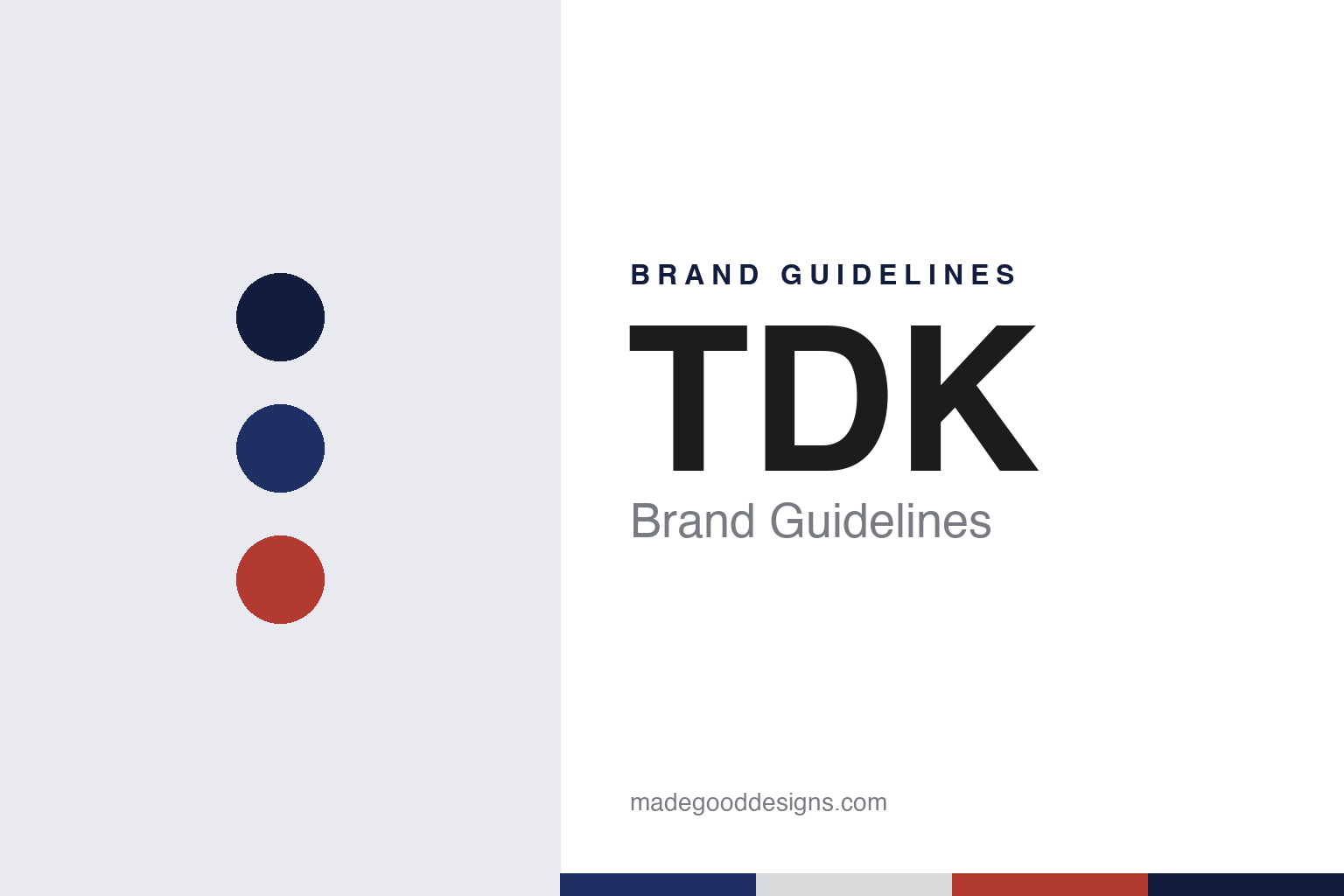
TDK Brand Guidelines
Three initials that went from ferrite to cassettes and back to components.
Aa
Two constants: an ink blue, tape-shell grey and signal red palette and a wide grotesque register. Abstract homage — not a TDK product or mark; no component, cassette or logo is reproduced.
Tokyo Denki Kagaku
A company founded to make one new material.
TDK was founded in Tokyo on 7 December 1935 as Tokyo Denki Kagaku Kogyo — Tokyo Electric Chemical Industry — and the initials of that name are still its name. English Wikipedia says the founder, Kenzo Saito, set it up to manufacture ferrite, a magnetic material invented at the Tokyo Institute of Technology by Yogoro Kato and Takeshi Takei; Japanese Wikipedia says the company name came from the electrochemistry department where the two scientists worked. The International Directory of Company Histories, as reproduced by Encyclopedia.com, says Saito had been searching for a manufacturing business to set up in his home town, which depended wholly on farming, and that Kato granted him use of the technology after a chance meeting. Japanese Wikipedia dates the first ferrite core, sold as the “Oxide Core,” to August 1937, and says many TDK production sites have been gathered in Nikaho, in Akita prefecture, since the company’s early days; the TDK history museum is there too, and English Wikipedia says it is open to the public free of charge.
The war years were part of that early growth. English Wikipedia, citing a 2009 IEEE paper by Akira Okamoto on the invention of ferrites and the miniaturisation of radios, says TDK produced five million ferrite cores through 1945, used mainly to reduce the size and weight of radio receivers used by the Imperial Japanese military. Japanese Wikipedia notes that the TDK initials appeared in catalogues from soon after the founding, except during the wartime restrictions on English. The Directory says Saito left the company in 1946 and later sat in the Diet; Japanese Wikipedia lists his presidency as running to December 1947.
After the war TDK widened its range of materials. The Directory says it began producing ceramic capacitors in 1951 and its first magnetic recording tape in 1952, opened a representative office in New York in 1959 and its first overseas subsidiary there in 1965, and listed on the Tokyo Stock Exchange in 1961. In 1968, it says, TDK set up a subsidiary in Taiwan to make ferrite cores, ceramic capacitors and coils.
Colour
Cassettes, a Kamekura mark and a sign in Times Square.
Japanese Wikipedia says consumers long knew TDK mainly through its recording-media brands. It says TDK supplied Japan’s first domestically made compact cassettes to Matsushita in June 1966 and launched its own Synchro Cassette that September; the Directory credits TDK with the SD tape of 1968 and with Avilyn, a magnetic material developed by a team under Yasuo Imaoka, used in videotape from 1973 and in the SA high-bias cassette of 1975. English Wikipedia says TDK sold its recording-media business, with a licence to the “TDK Life on Record” brand, to Imation in 2007; Imation said in September 2015 that it would give up the licence and stop selling TDK-branded products by the end of that year.
The mark has its own history. Japanese Wikipedia says the letters TDK, set inside a horizontal ellipse, appeared in the corporate mark from 1955; a trademark problem meant “TDK-E” was used from 1961 to 1964; and on 1 January 1967 the company adopted a mark designed by the graphic designer Yusaku Kamekura, the basis of the present logo. In October 1981 the TDK lettering was made slightly slimmer. In 1983 the company took the name TDK Corporation, which Japanese Wikipedia calls the first Japanese company name in Latin letters; until a 2002 change in the law, the registered form had to be written in katakana.
Sponsorship carried the letters a long way. English Wikipedia says TDK has sponsored the athletics World Championships since the first edition in Helsinki in 1983, sponsored Ajax in the 1980s and Crystal Palace from 1993 to 1999, kept a sign at Piccadilly Circus from 1990 until 2015, as it moved away from consumer electronics, and has held a sign on One Times Square since 2000.
Typography
How component makers show what they make.
Passive components are hard to photograph and harder to brand. A multilayer ceramic capacitor in the smallest sizes is a speck that sits like a grain of sand on a fingertip, and a scatter of chips on a fingertip is one way to show that scale. Resistors, inductors, filters and fuses look little different from one maker to the next, so the presentation leans on the company’s name, its colours and the way it pictures the work behind the part.
The pictures repeat across the trade. Reels of tape-and-reel parts, ready for pick-and-place machines, stand for volume. Through-hole resistors with their coloured bands, cut-away capacitors that open up the layers or the wound film inside, and close-ups of ceramic sheets being stacked stand for the craft. Automated inspection lines, with cameras checking each part, stand for consistency, and pictures of factories and laboratories often stand in for the end products the parts go into.
Trade shows are where these brands meet engineers in person. electronica in Munich and CEATEC in Japan are among the fairs where component makers take large stands, and some use them for showpieces that have little to do with a datasheet: Murata, for one, says it demonstrated its bicycle-riding Murata Boy robot at CEATEC JAPAN 2005.
Many of these companies began with a material rather than a product: ferrite, titanium oxide, barium titanate, tantalum or film. Several have changed hands or merged, so names, marks and owners do not always line up. This guide sets out who founded each brand, who owns it now and where it says its parts are made, and marks clearly what rests only on the company’s own word.
Aa
A wide grotesque for three initials. (Specimen set in Archivo, a sans STAND-IN; NOT the TDK logo or the Kamekura mark.)
TDK
Back to components.
Components are now the core. English Wikipedia says TDK developed a multilayer technology for chip capacitors and inductors in 1980, and that since the 2000s it has concentrated on electronic components, hard-disk heads and suspensions, and power supplies. Japanese Wikipedia lists inductors, transformers, aluminium electrolytic capacitors and film capacitors among its component lines, alongside multilayer ceramic capacitors. Purchases included the Lambda power-supply businesses and the Hong Kong battery maker Amperex Technology, both in 2005, and the German component maker EPCOS, announced on 31 July 2008; in October 2009, Japanese Wikipedia says, TDK combined its passive-component division with EPCOS to form TDK-EPC. The US sensor maker InvenSense became a subsidiary in May 2017.
Materials remain the thread. TDK and Nippon Chemical Industrial set up a joint venture, TDK-NCI Advanced Materials, to develop ceramic materials mainly for MLCCs and their manufacturing processes, Evertiq reported on 13 April 2026, after a basic agreement signed in November 2025. English Wikipedia says that on 29 September 2026 TDK signed a memorandum of understanding with Taiyo Yuden to explore joint development of MLCCs and inductors and cooperation in manufacturing and procurement, including the possibility of a future capital alliance; at the time of writing that was an agreement to hold talks, not a completed alliance. The head office is in Nihonbashi, Tokyo, where it moved in November 2018, Japanese Wikipedia says. The company’s motto, in English Wikipedia’s rendering, is “Contribute to culture and industry through creativity.”
For a design guide, TDK shows how three initials and a mark drawn in 1967 carried one company from ferrite cores to cassettes and back to components. Compare EPCOS, the German component brand TDK agreed to buy in 2008, and Murata, another Japanese maker of ceramic components. For this guide we use a deep ink blue, a tape-shell grey and a signal red with a sans, an unofficial interpretation; no product or logo is reproduced.
Explore & save
Keep TDK’s identity on hand — save it to a board in the Made Good inspiration library.
TDK identity set
Pin the TDK ink blue, tape-shell grey and signal red palette and the wide grotesque register to your own board.